

The crypto market remains under pressure as Bitcoin and major altcoins continue to lose key support levels, reinforcing a cautious tone across digital assets. Momentum has weakened in recent weeks, with price action struggling to stabilize after the correction that began in October 2025. While intermittent rebounds have occurred, they have largely failed to restore confidence, leaving sentiment fragile and volatility elevated. Investors appear increasingly selective, deploying capital carefully rather than aggressively accumulating risk assets.
A recent CryptoQuant report highlights a critical structural factor behind this weakness: limited incoming liquidity. According to the analysis, the absence of sustained capital inflows has prevented the market from transitioning into a clear recovery phase. Broader macro conditions also appear unsupportive in the near term. Federal Reserve member Christopher Waller noted that strong February labor market data could justify maintaining the current interest rate stance, an environment that historically constrains risk-on capital flows.
As liquidity tightens, capital rotation dynamics are becoming more pronounced. Funds are increasingly shifting toward equities and commodities, partly driven by continued expansion in the artificial intelligence sector and the persistent strength of precious metals. This redistribution of capital suggests crypto markets may remain in a defensive posture until broader liquidity conditions improve.
The report explains that liquidity dynamics within crypto markets are often reflected through stablecoin flows, which act as a proxy for deployable capital. When stablecoin reserves rise on exchanges, it typically signals increasing readiness to enter risk positions. Conversely, sustained outflows tend to indicate capital withdrawal or reduced trading appetite.


On Binance, stablecoin reserves have been declining steadily since November 13, with nearly $10 billion withdrawn as investors gradually reduce market exposure. These reserves, which generally fluctuate based on investor demand, have fallen from approximately $50.9 billion to $41.4 billion — a contraction of about 18.6%. This shift suggests a measurable reduction in immediately available liquidity across one of the industry’s largest trading venues.
As stablecoins continue to flow out, Binance’s reserve levels have now returned to those last observed around October 2024. Although the platform still accounts for roughly 64% of total stablecoin reserves across centralized exchanges, changes at this scale tend to influence broader market liquidity conditions.
If this trend persists, price stability may remain elusive. Historically, renewed stablecoin inflows have coincided with improving risk appetite and stronger price support. Therefore, a sustained reversal in stablecoin flows will likely be necessary before a more durable recovery phase can develop.
The total crypto market capitalization chart shows a clear transition from expansion to consolidation following the peak reached during the 2025 rally. After climbing toward the $4 trillion region, total market cap entered a sustained corrective phase, gradually compressing toward the $2.1–$2.2 trillion zone. This decline reflects broad risk-off behavior affecting both Bitcoin and altcoins, rather than an isolated asset-specific retracement.

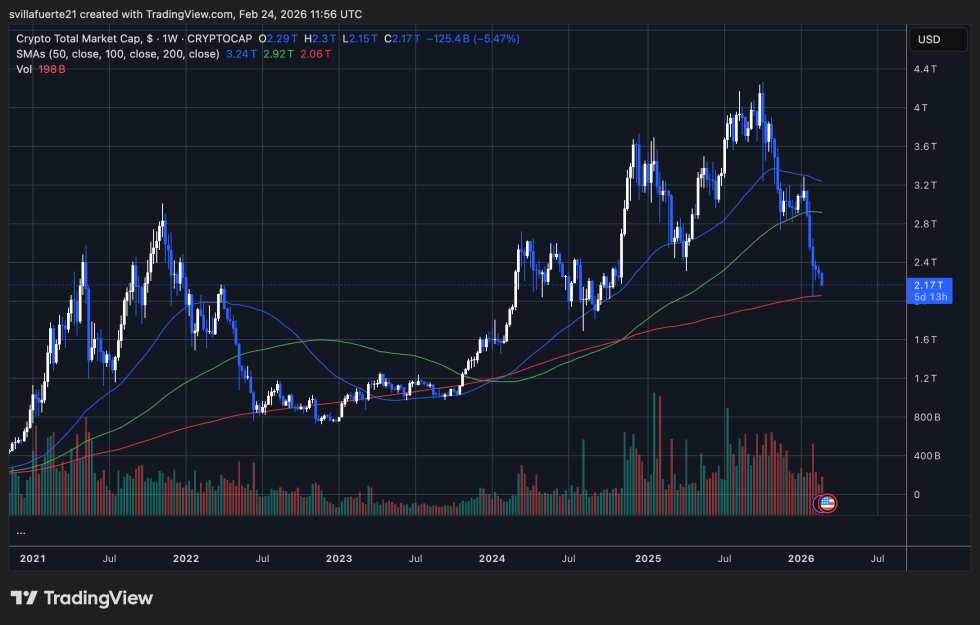
From a structural perspective, the market has recently broken below the 50-week moving average and is now approaching the 100-week average, while the 200-week moving average continues to trend upward beneath price. Historically, this configuration often characterizes mid-cycle corrections rather than full structural reversals, although confirmation requires stabilization above longer-term support levels.
Volume patterns also suggest distribution rather than aggressive accumulation. Selling spikes during declines appear more pronounced than buying reactions, indicating persistent caution among market participants. The absence of strong follow-through rallies reinforces the idea that liquidity remains constrained.
If the $2 trillion region fails to hold, downside volatility could increase due to thinner liquidity conditions. Conversely, stabilization above current levels combined with renewed inflows — particularly through stablecoins — would be the first indication that broader market confidence is gradually returning.
Featured image from ChatGPT, chart from TradingView.com