

Bitcoin (BTC) is once again moving within a narrow band, with price swings contained despite shifting macro signals and fresh debate over whether the cryptocurrency’s long-observed four-year cycle still applies.
Related Reading: Upcoming Crypto Market Structure Bill Markup Likely Pushed To Post-Holiday
As traders react to mixed Federal Reserve messaging, institutional flows, and rising caution across risk markets, analysts remain split on whether Bitcoin’s latest consolidation represents stability, or a deeper shift in how the asset behaves.
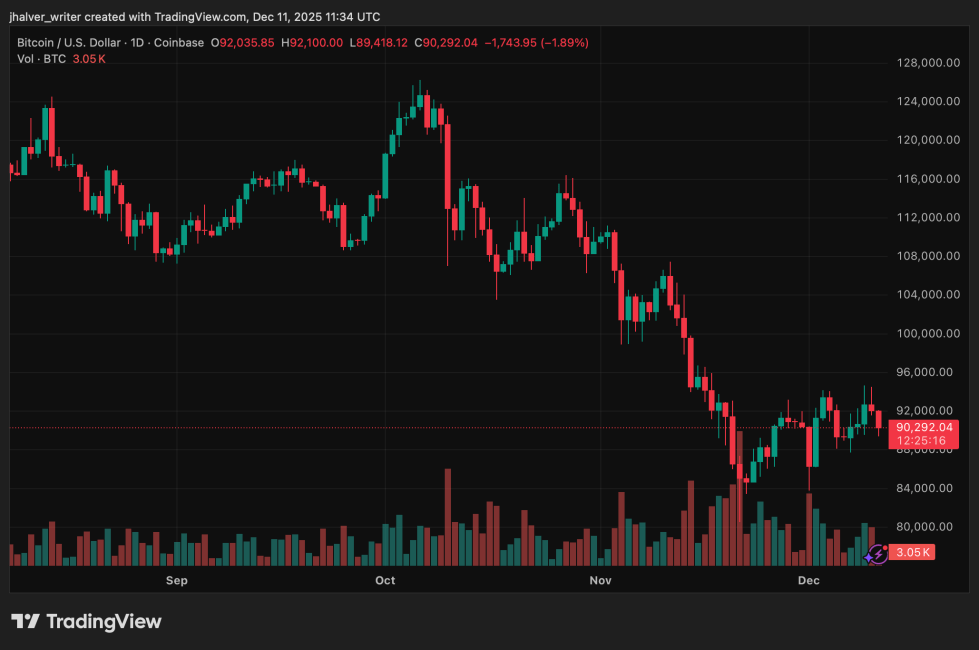

BTC's price trends downwards on the daily chart. Source: BTCUSD on Tradingview
Analysts Question Whether the Cycle Has Ended
A growing number of major firms now argue that Bitcoin may be moving beyond its historic halving-driven rhythm. Investment firm Bernstein said in a recent note that the asset is in an “elongated bull cycle,” pointing to minimal ETF outflows despite a nearly 30% correction.
The firm has raised its 2026 price target to $150,000, projecting a potential cycle peak of $200,000 in 2027 and maintaining a $1 million long-term estimate for 2033.
ARK Invest CEO Cathie Wood echoed this view, saying that institutional adoption is reducing the likelihood of the steep 75–90% drawdowns seen in previous cycles. Grayscale has also suggested Bitcoin could break the four-year pattern, forecasting renewed strength in 2026.
Bitcoin is currently trading near $90,000–$93,000 depending on the venue, with recent intraday swings highlighting a lack of strong directional conviction.
Fed Signals Keep Markets Cautious
The Federal Reserve’s 25 bps rate cut initially lifted risk sentiment, but a shift toward cautious, data-dependent language quickly reversed momentum.
Bitcoin and Ethereum slipped after the announcement, with BTC falling below $90,000 at one point as traders reassessed the macro backdrop. Liquidity remains thin, contributing to choppy movements across major crypto assets.
Analysts note that Bitcoin’s inability to sustain gains, despite the weaker dollar and softer Fed stance, reflects persistent uncertainty. Several commentators say BTC must hold above $90,000 to avoid strengthening bearish pressure, while a break above $94,500 could reopen a path toward $100,000 if inflows improve.
Derivatives and On-Chain Data Flag Rising Bearish Sentiment
Options and on-chain indicators are also signaling caution. Traders have increased bearish option positions, with the put/call ratio turning positive ahead of a significant expiry window. More than $500 million in crypto liquidations occurred within 24 hours, reflecting heightened volatility.
On-chain data shows declining bullish momentum. The Bitcoin Bull Score Index has fallen back to zero, and realized losses suggest further downside could be possible. Analysts warn that despite past buy-the-dip patterns, current readings do not yet reflect the levels typically associated with market bottoms.
Related Reading: Cardano Founder Reacts As NIGHT Token Crashes From $150 To $0.02
As Bitcoin continues to trade in a tight range, the broader debate remains unresolved. Whether the four-year cycle is fading, or simply paused, may depend on how markets digest macro uncertainty, institutional flows, and the next wave of economic data.
Cover image from ChatGPT, BTUSD chart from Tradingview