

According to Chainalysis, crypto interest has been steadily rising across Europe, including Western Europe, as Bitcoin has held relatively steady above the $100,000 mark in recent months. However, crypto news websites in the region experienced a downturn in traffic during the first quarter of 2025.
This comes at a time when crypto awareness and enthusiasm are steadily increasing across Western European countries, according to a recent study by industry groups Adan Deloitte, and Ipsos.
Yet visibility is no longer distributed evenly. According to Outset PR’s Q1 2025 media visibility report, just three markets now dominate crypto readership across Western Europe: Germany, France, and the Netherlands.
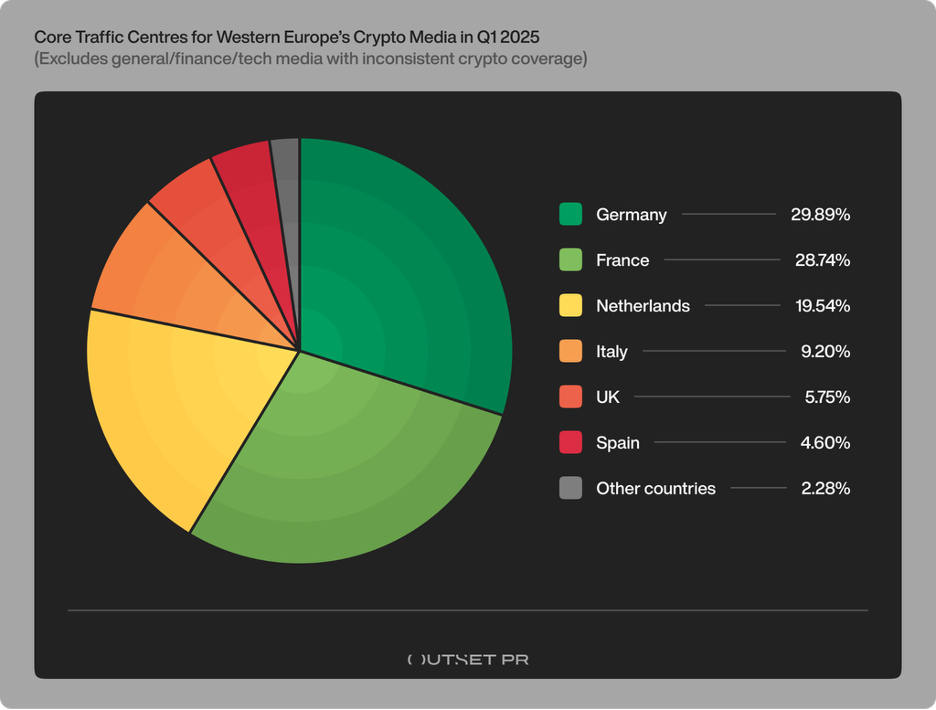

The largest language hubs for Western Europe’s crypto-native media, data sourced from Outset PR
The report, based on data from 133 outlets, reveals that despite mounting user interest, crypto-native media entered a correction phase, driven not by user fatigue and the overall market turbulence, but by tighter compliance demands, regulatory scrutiny, and algorithmic changes that reshaped who gets seen.
Essentially, the entire crypto media sector in the region faced a broad slump in visibility. Over 80% of outlets were in decline, and only 20 sites consistently appeared in Google’s Discover feature during the quarter.
The report builds on Outset PR’s earlier LATAM media analysis and reinforces a broader trend: crypto media is becoming top-heavy, with a growing gap between dominant players and fading independents, and most local outlets are losing visibility. What follows is a closer look at how that imbalance took shape during Q1 2025.
Three Language Markets Dominate Crypto News Readership
Despite widespread traffic declines, the readership for crypto news in Western Europe remained concentrated in just a few dominant language markets. German-, French-, and Dutch-language outlets emerged as the clear audience leaders in Western Europe, Outset PR noted. In fact, only seven crypto-focused publications in the region managed to exceed 1 million monthly visits in Q1 2025, and most of these serve readers in Germany, France, or the Netherlands.
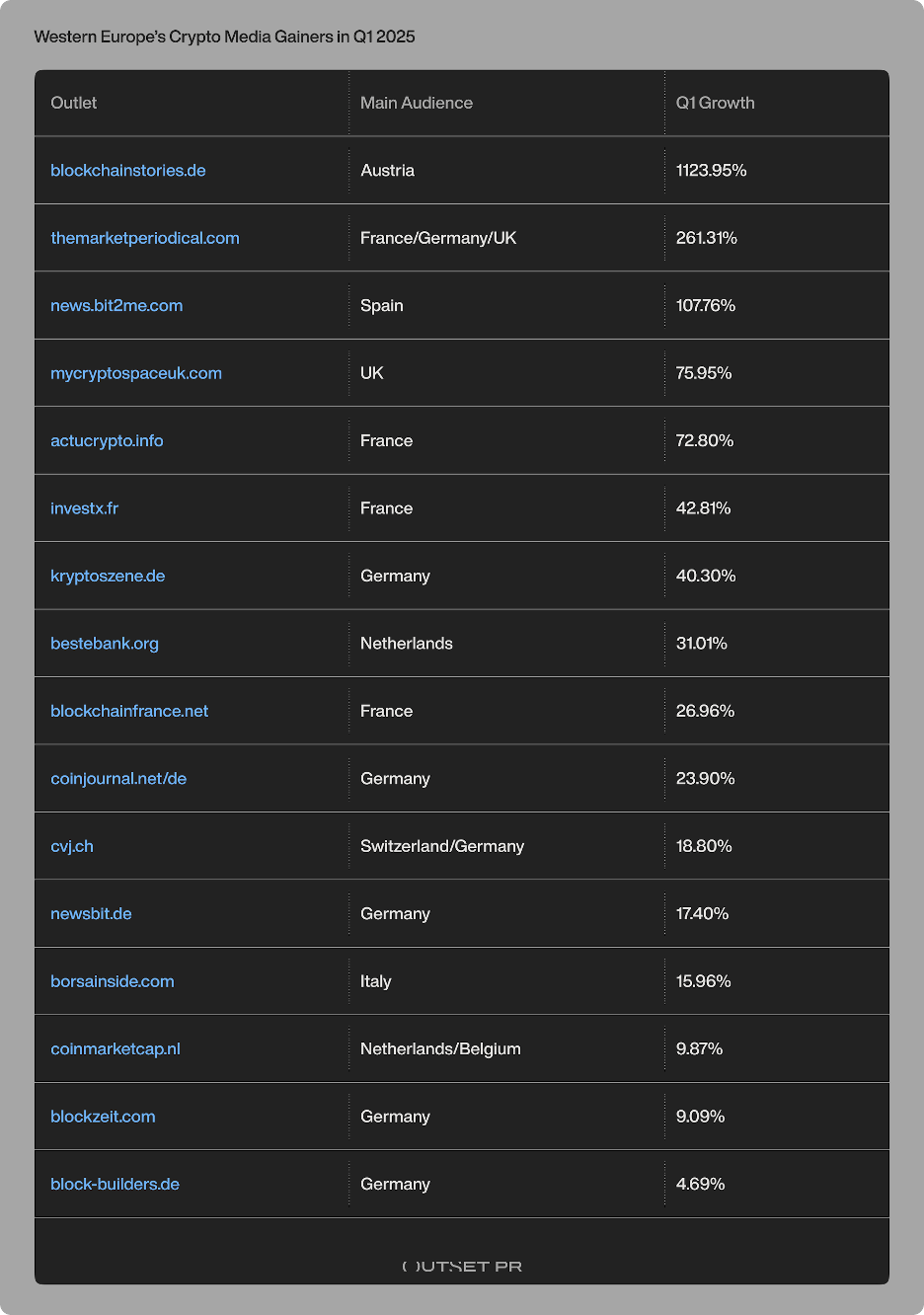

Western Europe’s crypto media gainers, tracked by Outset PR in Q1
Together, these seven leading sites (which include Germany’s BTC-ECHO, France’s Cointribune, the Dutch platform Crypto Insiders, and others) accounted for about 60% of all traffic to crypto media in Western Europe.
This leaves dozens of smaller outlets competing for an increasingly thin slice of the audience. A mid-tier of six publications (each averaging 500,000–900,000 visits in Q1) took roughly 18% of the traffic. Beyond that, the remaining 74 crypto news sites in the study, many of them niche blogs or local news pages, together made up just around 22% of regional reach.
Germany and France stand out as the largest hubs by language, followed by a strong Dutch-speaking cluster. By contrast, markets like Italy and the U.K. contributed only modestly. In those countries, no crypto-specific site reached even 500,000 monthly in early 2025.
Q1 Traffic Losses: Regional Trends and Outliers
While crypto readership in Western Europe is consolidating around a few dominant language markets, Outset PR’s data shows that most countries still experienced steep traffic drops, with some faring worse than others.
Italy saw the sharpest decline in relative terms, with crypto media traffic falling by nearly 30% quarter-over-quarter. Regulatory advisories from CONSOB and tightening platform rules made it difficult for most Italian outlets to recover visibility after January. Few managed to adapt quickly enough to algorithmic or compliance shifts.


Outset PR chart shows Italy’s crypto media hit hardest in Q1 2025
In Spain, new advertising restrictions from the CNMV also took a visible toll. By March, the only Spanish-language outlet that showed meaningful growth was Bit2Me News, backed by one of the region’s leading exchanges. Most other platforms posted double-digit traffic declines, continuing a pattern seen since early 2024.
While German-language outlets captured a large share of Western Europe’s crypto traffic (thanks to a few high-performing sites), the broader German-speaking market still faced notable contraction. According to Outset PR, about 62% of crypto-focused sites serving Germany, Austria, and Switzerland saw traffic decline. Much of the pressure came from BaFin’s tougher stance on unlicensed crypto promotions and affiliate content. Independent publishers like Coin-Update fell by over 50%, and even large names such as Cointelegraph DE dropped by more than 60%, showing that visibility losses affected outlets across the board.
In France, the picture was more mixed. While 72% of French crypto outlets posted visibility losses during the quarter, a few sites, including Blockchain France and InvestX, managed to stabilize or grow through content labeling, transparency adjustments, and multilingual expansion. The regulatory tone from the AMF was less punitive than Germany’s BaFin, but algorithmic pressures still made February particularly difficult for most publishers.
The Dutch-speaking region (including the Netherlands and Flanders) experienced a roughly 15% decline in Q1 crypto news traffic. Google’s March core update heavily impacted SEO-reliant sites like Bitcoin Magazine NL and Crypto Insiders, though niche educational platforms like Beste Bank and CoinMarketCap NL eked out small gains.
Even the U.K., while not subject to MiCA, the EU’s new regulatory framework for crypto assets, still felt the ripple effects of the tightening standards it introduced across the continent. The FCA’s updated crypto marketing rules, effective January 2025, indirectly pushed platforms and advertisers to apply stricter standards. Most UK-facing outlets, including Cryptouk and Bitcourier, lost ground. A few, like The Market Periodical, stood out by diversifying beyond the English-speaking market, launching localized content to tap French, Spanish, and German readerships.
In total, only 16 of the 87 crypto-native outlets Outset PR tracked saw traffic grow in Q1. These gains were mostly concentrated among smaller or mid-tier platforms with clear compliance strategies, niche content, or multilingual reach. But in absolute terms, few of these publishers cracked the upper tiers of visibility.
As Niche Crypto Sites Falter, Mainstream Finance Media and Algorithmic Shifts Reshape Readership
According to Outset PR, 81.6% of crypto-native outlets saw traffic declines, with total visits across the segment dropping from 26.6 million in January to 22.2 million in March, which is a 16.3% cumulative loss. February marked the harshest drop: over 76% of outlets had lower traffic than in January, and by the end of March, 58.6% were still down month-over-month.
But while specialist media struggled, broader financial and tech news platforms gained ground. Outset PR tracked 46 non-crypto-native outlets, such as Finanzen.net, Investing.com, and Boursier.com, and found that over 54% of them saw Q1 crypto traffic growth. Together, these mainstream sites amassed 106.3 million crypto-related visits, more than four times the combined readership of crypto-only publications.
This divergence was driven by more than MiCA alone. The European Union’s regulatory rollout in January introduced new advertising and content rules, especially for platforms running token promotions or sponsored crypto material. Meanwhile, Google’s March core algorithm update deprioritized duplicate, shallow, or AI-generated content. Most crypto-native outlets lacked the compliance structures or SEO strength to weather the storm.
Market conditions further strained readership. The geopolitical turbulence of Q1 2025 rattled investor sentiment, leading to inconsistent retail interest. With search algorithms tightening, compliance thresholds rising, and macro uncertainty in play, the audience shifted toward trusted, diversified, regulation-ready platforms, leaving much of the crypto-native media ecosystem behind.
Western Europe’s New Crypto Media Reality
The crypto media landscape in Western Europe is now being reshaped by forces that demand more than enthusiasm. Navigating MiCA, maintaining algorithmic trust, and sustaining audience reach now require strategic depth many outlets weren’t built for.
This isn’t just a regulatory phase but a reset. And in this new reality, visibility is earned, not assumed. The winners aren’t necessarily the loudest, but the most prepared. Outset PR continues to track these shifts in real time, publishing region-specific data, insights, and trend breakdowns via their blog and X profile.