BlackRock chairman and CEO Larry Fink has framed Bitcoin’s latest boom-and-bust swing as the clearest expression yet of its core narrative: not a growth asset, but “an asset of fear.”
Speaking at the New York Times’ DealBook “Crypto and Capital” event alongside Coinbase CEO Brian Armstrong, Fink contrasted the $13.5 trillion BlackRock manages with the motivations behind Bitcoin demand. BlackRock’s portfolios, he said, are essentially “managing hope” over decades: “The $13.5 trillion that BlackRock managed on behalf of our clients, it’s basically managing hope. That’s all it is. I mean, why would anybody invest in a 30-year outcome unless you’re hopeful that in 30 years you’re going to have the compounding effect.”
Why Bitcoin Is ‘An Asset Of Fear’
Bitcoin, by contrast, he placed on the opposite side of the psychological ledger. “Bitcoin is an asset of fear,” Fink said. “You own Bitcoin because you’re frightened of your physical security. You own it because you’re frightened of your financial security. The long-term fundamental reason you own it [is] because of debasement of financial assets because of deficits.”
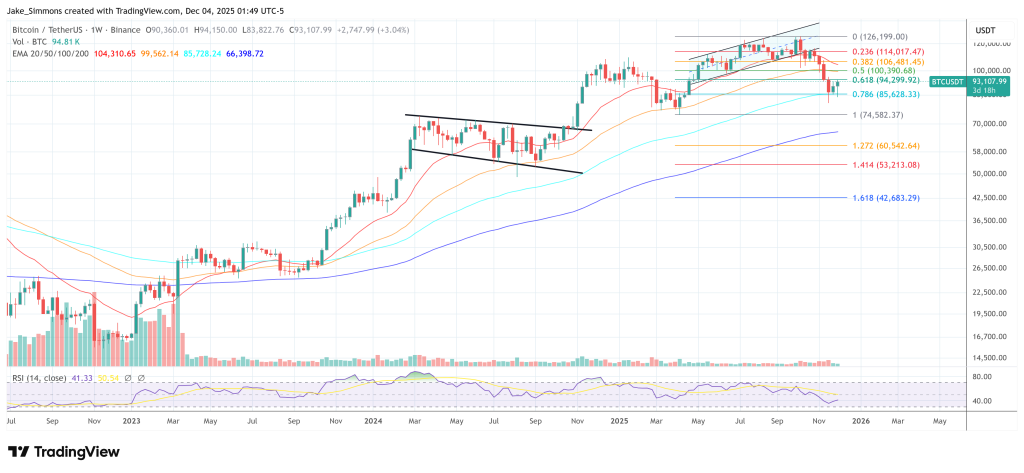
His comments came against the backdrop of a sharp reversal in the Bitcoin market. The asset hit an all-time high above $125,000 in early October 2025 before sliding nearly 30% and briefly dropping below $90,000 in mid-November. Fink explicitly referenced that move to illustrate just how violent the swings can be. “If you had bought it at $125,000 and it’s now sitting at $90,000,” he said, anyone treating it as a trade is dealing with “a very volatile asset” and “you’re going to have to be really good at market timing, which most people aren’t.”
For investors using Bitcoin as a macro hedge, he argued, the volatility looks different. “If you’re buying it as a hedge against all your hope, you know, then it has a meaningful impact on a portfolio.” In his telling, Bitcoin rallies when fear rises and retreats when fear subsides, citing episodes such as a US–China trade agreement or talk of a possible Ukraine settlement, after which Bitcoin “fell a little bit.” The pattern, he suggested, is consistent with a fear-driven hedge against geopolitical risk and fiscal slippage.
Fink also underscored that structurally, the market remains fragile. “The other big problem of Bitcoin is it is still heavily influenced by leveraged players,” he said, linking the asset’s outsized volatility to leverage even as flows through his firm’s spot ETF channel normalize.
Since launching IBIT, BlackRock has already lived through several drawdowns on the order of 20–25%, he noted, yet the holder base is shifting. “We’re seeing more and more legitimate long-only investors investing in it,” he said, citing a large foundation endowment and adding that “a number of sovereign funds” are “adding incrementally at $120k, at $100k,” and “bought more in the $80k’s.” For those allocators, he stressed, “this is not a trade. You own it over years. This is not a trade. You own it for a purpose.”
The stance marks a striking reversal from Fink’s 2017 description of Bitcoin as an “index for money laundering… and thieves.” He told the audience that during the pandemic he “took it upon myself to visit and talk to a lot of people who were advocates of it,” asking, “What am I missing?” and that “around 2021–22” he began to “evolve those views.” It is, he conceded, “a very glaring public example of a big shift in my opinion,” adding, “I have very strong views but that doesn’t mean I’m not wrong.”
At press time, Bitcoin traded at $93,107.