Bitcoin miners are coming under acute financial strain as weaker bitcoin prices, compressed hashprice and elevated network competition push much of the sector toward breakeven or below, according to CoinShares’ Q1 2026 mining report. For public miners in particular, the pressure is no longer just cyclical. It is increasingly shaping business models, treasury policy and capital structure across the industry.
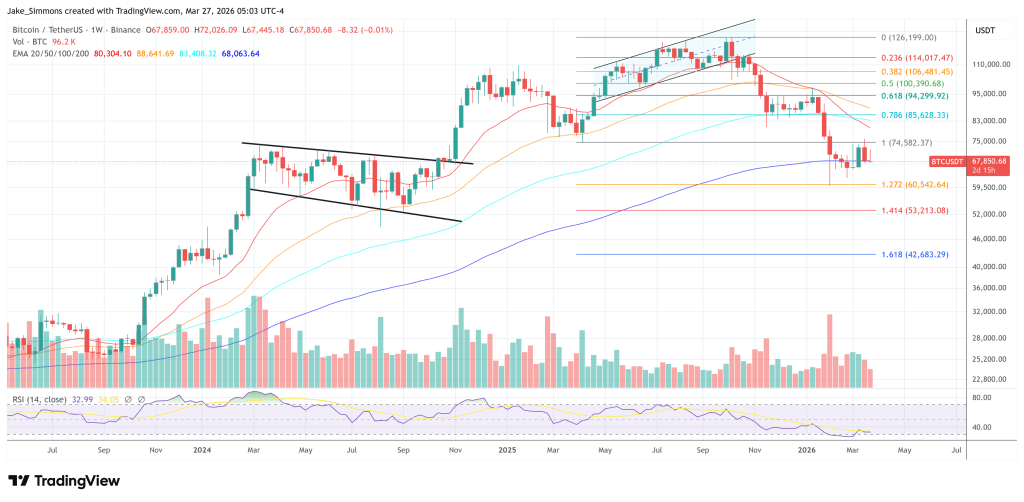
CoinShares said Q4 2025 was “the most challenging quarter for Bitcoin miners since the April 2024 halving,” with BTC sliding from an all-time high of about $124,500 in early October to roughly $86,000 by late December, a drawdown of around 31%. Against that backdrop, the weighted average cash cost to produce one bitcoin among publicly listed miners rose to about $79,995 in Q4 2025.
Bitcoin Miners Are Facing A Serious Profitability Crunch
The squeeze has intensified further in early 2026. CoinShares wrote that hashprice fell to about $36–38 per PH/s/day in Q4 and then dropped “significantly further” to $29 in Q1, implying “further pain” ahead for miners. The report also pointed to three consecutive negative difficulty adjustments, the first such streak since July 2022, as a sign of miner capitulation.
CoinShares framed the pressure in unusually direct terms. “The hash price environment has deteriorated beyond our prior expectations, briefly touching ~$28/PH/s/day in late February before recovering to ~$30-35 at the time of writing,” the report said. “At these levels, miners running mid-generation hardware need access to sub-5c/kWh power to remain cash-profitable, while latest-generation fleets (sub-15 J/TH) retain meaningful margin at typical industrial electricity rates.” “We expect further capitulation among higher-cost operators in H1 2026 unless BTC price recovers materially.”
That economics gap is now wide enough to knock a meaningful chunk of the global fleet out of profitability. CoinShares estimated that at a hashprice of $30/PH/s/day, any miner running hardware below an S19 XP with electricity costs at or above 6 cents per kWh is losing money. By its estimate, that covers roughly 15% to 20% of the global mining fleet.
The result is visible in balance sheets and treasury behavior. CoinShares said public miners have collectively reduced BTC treasuries by more than 15,000 BTC from peak levels. It highlighted Core Scientific selling around 1,900 BTC, or about $175 million, in January alone and planning to liquidate substantially all remaining holdings in Q1 2026, while Bitdeer cut its treasury to zero in February and Riot sold 1,818 BTC, roughly $162 million, in December 2025.
At the same time, the report argues that the sector is splitting into two increasingly distinct groups: miners that remain focused on bitcoin production and operators using mining infrastructure as a bridge into AI and HPC.
CoinShares said more than $70 billion in cumulative AI and HPC contracts have now been announced across the public mining sector, with WULF, CORZ, CIFR and HUT “effectively becoming data centre operators that happen to mine Bitcoin.” It added that listed miners could derive as much as 70% of revenue from AI by the end of 2026, up from roughly 30% today.
That pivot comes with its own risk profile. CoinShares said leverage has risen sharply as some miners finance AI buildouts with large debt loads, citing IREN’s $3.7 billion in convertible notes, WULF’s $5.7 billion in total debt and CIFR’s $1.7 billion in senior secured notes. In the report’s view, the sector’s aggregate leverage has “fundamentally changed its risk profile,” even as the market rewards AI-linked operators with richer valuation multiples than pure-play miners.
At press time, BTC traded at $67,850.