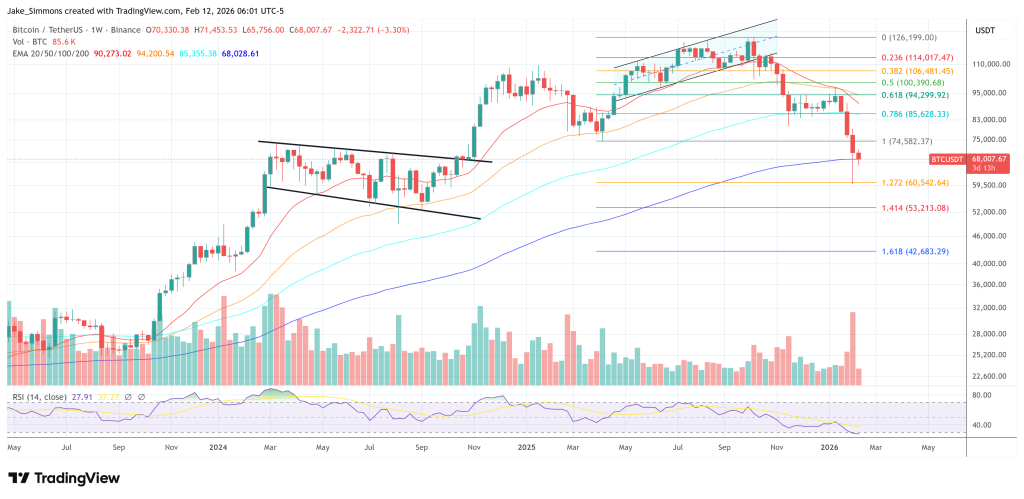
A Deutsche Bank strategist argued that bitcoin has “decoupled” from gold and no longer fits the “digital gold” label, pointing to a sharp divergence in 2025 performance as regulation uncertainty and ETF outflows weigh on sentiment.
In a Yahoo Finance interview, Deutsche Bank senior strategist Marion Laboure told Executive Editor Brian Sozzi and senior reporter Ines Ferré that bitcoin’s volatility hasn’t disappeared, it’s simply showing up again, at an awkward moment for a market that spent much of last year selling a cleaner institutional adoption story.
Is Bitcoin No Longer Digital Gold?
Laboure framed recent weakness as another reminder that “volatility is a feature of Bitcoin. It’s not a bug,” while flagging what she described as “a lot of ETFs outflows” since October alongside a messy policy backdrop in Washington. She pointed to the Stablecoin “Genius Act” being signed last year, but said the Clarity Act “is still in Congress and provides an additional layer of uncertainty.”
She also cited a pullback in retail participation. “In our latest survey, we looked at the US crypto adoption,” Laboure said. “And in July, we had 17% of Americans who had invested in crypto. And the number was down to 12% in December.”
Bitcoin is “no longer digital gold,” Deutsche Bank strategist Marion Laboure says. “Gold outperformed by 65% in 2025. Bitcoin declined by 6.5%.” pic.twitter.com/eBCYp4cxMt
— Yahoo Finance (@YahooFinance) February 11, 2026
Pressed on whether bitcoin still deserves the “digital gold” tagline, Laboure leaned on returns. “If you think about that, if I look at the 2025 performance, it’s not digital gold or it’s no longer digital gold,” she said. “Gold outperformed by 65% in 2025. Bitcoin declined by 6.5%. So we are clearly seeing this divergence.”
Her broader framing was that bitcoin remains stuck between narratives. “Bitcoin, I would say it’s not a means of payment. It’s not a currency. It’s unlikely to replace gold or fiat currencies,” Laboure continued. “And I think the way I see Bitcoin is we are in this transition, we are transitioning between a pure speculative asset to a more realistic use case.”
Laboure also returned to what she called a “Tinkerbell effect,” describing a dynamic where price rises on belief rather than fundamentals, until it doesn’t. “So basically, it’s when the price is based on wishful thinking, much more than fundamental factors,” she said.
Asked what could reignite upside momentum, Laboure pointed back to the last two years’ catalysts and suggested the move still looks larger than those inputs alone explain. She noted bitcoin’s run from roughly $35,000 in November 2023 through a period she called “exceptional years,” citing ETF approvals, the halving, and a “very positive stance” from President Trump after his election.
“But all these factors alone probably didn’t fully explain the move that we had from $35,000 in November 2023 to over $120,000 in October last year,” she said, arguing that the market is still searching for a more durable anchor than narrative-driven flows.
X Pushes Back
Laboure’s “digital gold” critique drew immediate rebuttals on X. Bloomberg ETF analyst Eric Balchunas called it “a fine argument to make” but added: “To hinge it on one year’s returns is absurd. Does that mean it WAS digital gold in 2023 and 2024 when it was up 450%? But now it isn’t because gold did better in 2025. Make it make sense.”
Others went more ad hominem. VP of Investor Relations at Nakamoto Steven Lubka dismissed the comments as coming from a “CBDC shill,” referencing an older citation where she said: “When it comes to retail CBDCs, the question is not whether it will happen, but when.”
At press time, BTC traded at $68,007.