

Bitcoin is struggling to stabilize around the $75,000 level as broader market weakness continues to weigh on sentiment. After weeks of sustained selling pressure, price action remains fragile, with buyers showing limited conviction at current levels. The corrective phase has intensified concerns about whether Bitcoin can defend its higher-timeframe structure or if a deeper reset is still ahead.
A recent CryptoQuant report highlights a notable development during this period of stress. On February 2nd and 3rd, Bitcoin saw the largest BTC inflows to Binance since the beginning of the year. These flows were not marginal. They coincided precisely with BTC trading near a critical technical zone around $74,000, a level that many analysts view as pivotal for maintaining the long-term trend. A sustained breakdown below this area would significantly weaken the broader market structure and shift expectations toward a more prolonged bearish phase.
As the price approached this threshold, investor behavior reflected rising anxiety. Historically, moments like these tend to trigger defensive reactions, with holders moving coins to exchanges in anticipation of further downside. Binance, which continues to dominate spot and derivatives liquidity, absorbed a substantial share of these inflows, making it the focal point of short-term selling pressure.
The report adds that the scale of these exchange inflows was substantial. Over just two days, between 56,000 and 59,000 BTC were sent to Binance, marking one of the largest short-term transfer spikes seen this year. A significant portion of this activity came from Short-Term Holders, a cohort historically known for reacting quickly to price weakness. On February 2nd alone, data shows that roughly 54,000 BTC were transferred to exchanges at a realized loss, highlighting the degree of stress among recent buyers.


These flows represent genuine spot-side selling pressure rather than a purely speculative signal. When large volumes of BTC move onto exchanges during corrective phases, it typically reflects a combination of fear-driven exits and forced selling by participants with weaker conviction. Importantly, while such movements often generate heightened fear, uncertainty, and doubt across the market, the magnitude of these inflows is not abnormal in the context of sharp corrections within larger market cycles.
From a structural perspective, this behavior points toward a developing capitulation phase. As Bitcoin becomes increasingly oversold, marginal sellers are flushed out, reducing near-term supply pressure.
Historically, similar conditions have preceded the formation of local or intermediate bottoms, as selling exhaustion gives way to stabilization. While downside risk may persist in the short term, the data suggests that the market is moving closer to a reset point where long-term positioning begins to outweigh panic-driven decisions.

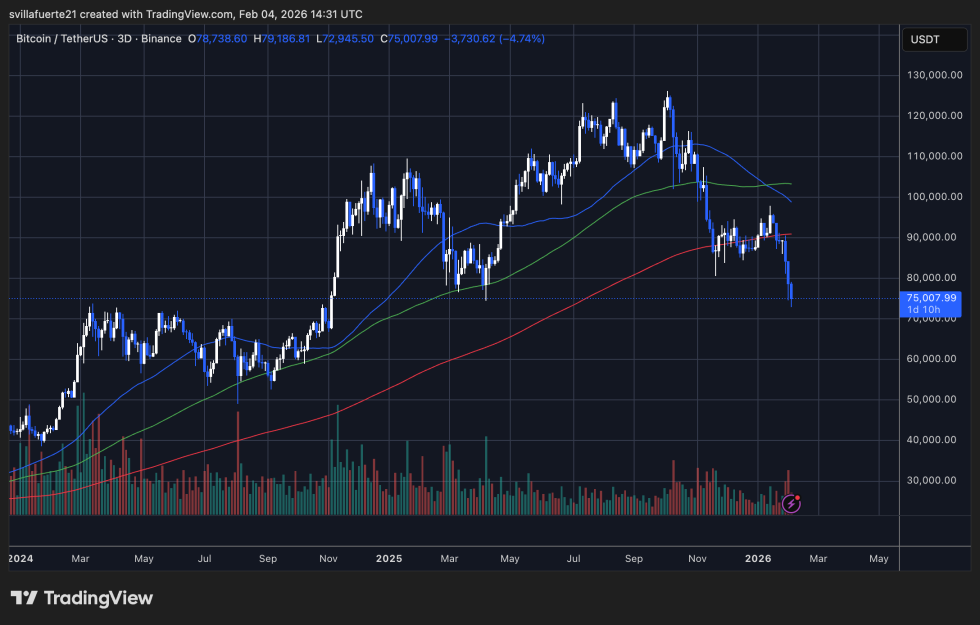
Featured image from ChatGPT, chart from TradingView.com