

Bitcoin is struggling to regain market confidence as sentiment continues to deteriorate and apathy dominates trading behavior. Price remains capped below the $90,000 level, with repeated recovery attempts failing to gain traction. As volatility compresses and participation thins, an increasing number of analysts are warning that the market may face further downside before stability can return. For now, conviction on both sides remains limited, leaving Bitcoin vulnerable to renewed selling pressure.
On-chain data underscores this fragile backdrop. A recent report by Axel Adler examines daily capital inflows and outflows across the Bitcoin network, using a seven-day moving average of net capital flow to assess market health.
This metric captures the balance between realized profits, which represent capital entering the network, and realized losses, which reflect capital being destroyed through loss-making sales. When the net flow turns negative, it signals that participants are selling at a loss more aggressively than they are taking profits.
Currently, the seven-day average stands at approximately negative $160 million, meaning the market has been losing an average of $160 million in capital per day over the past week. The period between December 17 and 24 was marked by sharp volatility, with large outflows interspersed with brief positive days. Although December 25 saw another net inflow, it was not enough to offset prior losses.
Elevated Coin Activity Signals Distribution Under the Surface
On-chain data highlighted by Adler shows that Bitcoin remains unusually active despite weak market conditions. The Bitcoin “% Supply Active (Last 180 Days)” metric tracks the share of total BTC supply that has moved at least once over the past six months.
Currently, that figure stands at 31.79%, slightly above its 30-day average of 31.43% and firmly in the 80th percentile compared with historical data. Activity has also risen sharply on a year-over-year basis, up 14.4%, indicating that coins are changing hands far more frequently than they were a year ago.


At face value, elevated activity can sometimes signal renewed interest or accumulation. In the current context, however, it carries a more cautionary implication. High supply activity is occurring alongside a negative net capital flow regime, meaning that much of this movement reflects loss-making sales rather than profitable distribution. Coins are not simply rotating between long-term holders; they are being sold under pressure.
This combination challenges the idea that the market is simply apathetic. Instead, it points to active distribution, with holders choosing to exit positions despite unfavorable prices. The distinction is important: apathy implies indecision, while distribution suggests stress.
For this metric to turn constructive, elevated activity would need to persist while net capital flows recover toward zero or positive territory. Only then would increased coin movement begin to reflect accumulation rather than capitulation.
Bitcoin Stabilizes As Key Trend Loses Momentum
Bitcoin is trading around the $88,700 level on the 3-day chart, attempting to stabilize after a sharp correction from the $120,000–$125,000 highs set earlier in the year. While the broader uptrend that began in 2024 remains technically intact, the current structure reflects a clear loss of momentum and a transition into a corrective phase. Price action has shifted from strong impulsive moves to choppy consolidation, highlighting growing uncertainty among market participants.

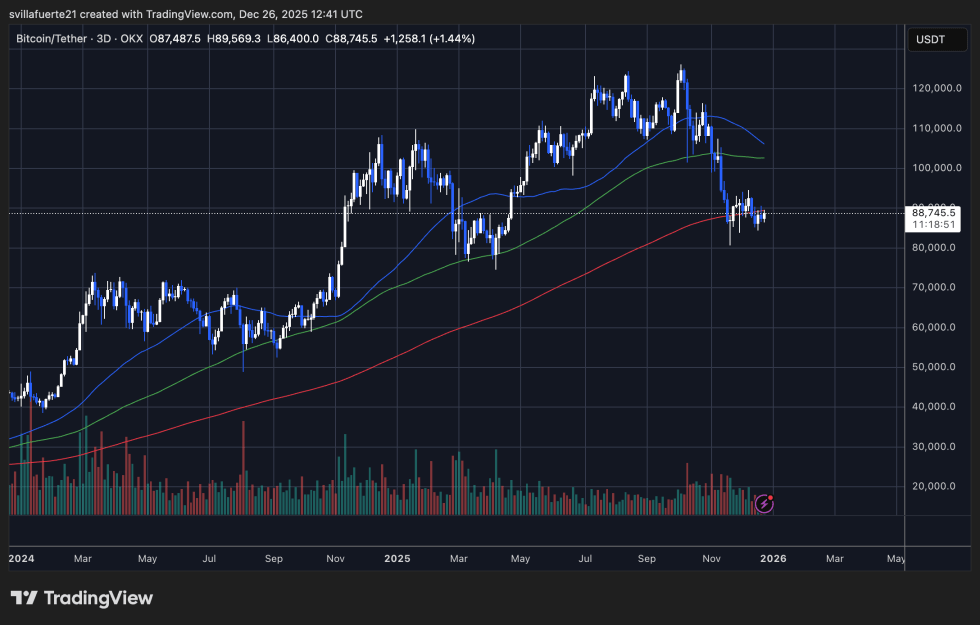
From a technical perspective, Bitcoin is now trading below its faster-moving average, which has rolled over and begun acting as dynamic resistance. The loss of this level marked a decisive change in market character, confirming that rallies are being sold rather than extended.
At the same time, price is hovering just above the rising longer-term moving average, which continues to provide structural support and defines the boundary between a healthy correction and a deeper trend reversal.
Volume dynamics reinforce the cautious outlook. The most aggressive volume expansion occurred during the sell-off from above $110,000, while the recent rebound toward $88,000 has unfolded on relatively muted participation. This suggests that selling pressure has eased, but buyers have not returned with conviction.
Structurally, the $86,000–$90,000 range is critical. Holding above this zone preserves the broader bullish framework. However, a failure to reclaim the $95,000–$100,000 region would keep Bitcoin vulnerable to renewed downside pressure in the weeks ahead.
Featured image from ChatGPT, chart from TradingView.com