

Bitcoin’s drop from $126,000 to the low-$60,000 range has been swift and painful. A 50% crash in just a few months is never comfortable, even for seasoned market participants. Volatility has returned aggressively, leverage has been wiped, and confidence has weakened across both retail and institutional desks.
Corrective phases like this tend to expose structural differences between large-cap assets and early-stage infrastructure plays. Bitcoin navigates a volatile ABC correction, but LiquidChain ($LIQUID) continues advancing its crypto presale, building beneath the surface of market turbulence. In environments defined by uncertainty, positioning often shifts from established names toward high-upside infrastructure projects aligned with the next expansion cycle.
LiquidChain: Building the Liquidity Layer Before the Cycle Turns
LiquidChain operates as a Layer 3 cross-chain settlement protocol, interoperating directly with Bitcoin, Ethereum, and Solana. This project improves their capital efficiency through unified execution and composability.
Fragmented liquidity remains one of crypto’s core inefficiencies. Assets are siloed across chains, limiting capital depth and increasing execution complexity. LiquidChain addresses this through Unified Liquidity Pools, enabling cross-chain swaps, shared order books, lending, borrowing, and staking across ecosystems within a single composable layer.


At the architectural level, the protocol integrates a Cross-Chain Virtual Machine capable of executing transactions referencing multiple underlying blockchains. This interacts with a Unified Proof Engine that verifies Bitcoin UTXOs, Ethereum account states, and Solana data in real time. The result is settlement across networks without reliance on fragile bridge mechanisms.
The $LIQUID crypto presale is currently priced at $0.01375, with incremental increases built into each funding stage. Nearly $600,000 has been raised already. Staking participation continues to grow, supported by high early APYs that taper as more tokens are committed. Tokenomics allocate 35% to development, 32.5% to ecosystem expansion, 15% to AquaVault initiatives, 10% to rewards, and 7.5% to listings and growth, prioritizing long-term scalability.
In corrective markets, capital often begins accumulating infrastructure quietly before sentiment reverses. For those looking for the best crypto to buy now, early-stage liquidity protocols offer asymmetric exposure relative to mature assets already trading at multi-trillion-dollar valuations.
Bitcoin’s ABC Structure: What the Chart Signals
The chart from “More Crypto Online” outlines Bitcoin’s decline as an ABC corrective structure on the daily timeframe. The initial drop from the $126K peak represents wave A. The subsequent rebound forms wave B, and the market now appears to be navigating wave C within a broader corrective sequence.
In Elliott Wave theory, corrective structures differ significantly from impulsive trends. Impulses unfold in five-wave structures with strong directional momentum. Corrective moves unfold in overlapping three-wave patterns, often volatile and uncertain. The recent bounce off local lows remains corrective, with only three waves visible so far, not a confirmed five-wave bullish impulse.
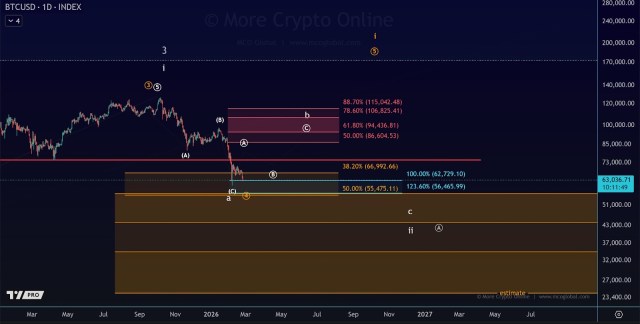

Source: X/@Morecryptoonl
This distinction matters. If the current move is indeed a B-wave, it typically represents a volatile environment rather than a sustained trend reversal. B-waves can extend further than expected, even retracing toward prior highs, but they can also fail quickly and lead into deeper C-wave declines.
The larger structural roadmap remains A → B → C. Whether the B-wave begins immediately or after one more marginal low does not fundamentally change the corrective framework. Until a clear impulsive five-wave structure confirms upside momentum, the environment remains corrective rather than expansionary.
Historically, corrective phases often precede accumulation periods. Liquidity dries up, leverage resets, and volatility compresses before new impulsive trends emerge. However, timing that transition requires confirmation, not assumption.
$LIQUID, not $BTC, Could be the Best Crypto to Invest In
Bitcoin remains the benchmark asset of the digital economy. Its dominance, institutional participation, and macro sensitivity ensure it will always command attention. Yet its size also constrains exponential upside relative to early-stage protocols.
In contrast, infrastructure-focused projects positioned beneath dominant ecosystems often experience disproportionate growth during expansion cycles. LiquidChain does not rely on Bitcoin’s price appreciation alone; it seeks to enhance liquidity across BTC, ETH, and SOL simultaneously.
As markets navigate corrective conditions, evaluating the best cryptos to buy now becomes less about chasing confirmed impulses and more about identifying structural asymmetry. Bitcoin’s ABC pattern highlights uncertainty. LiquidChain’s presale pricing reflects early-stage positioning before broader recognition.
With unified liquidity infrastructure, defined tokenomics, and a structured presale model, $LIQUID presents differentiated exposure compared to established large caps. While Bitcoin may eventually confirm its next impulsive phase, early infrastructure positioning often precedes the headline breakout.
In corrective markets, discipline matters. So does foresight. Among emerging plays, LiquidChain ($LIQUID) stands out as one of the best cryptos to buy now for forward-looking exposure ahead of the next cycle rotation.
Explore LiquidChain and its ongoing crypto presale:
Presale: https://liquidchain.com/
Social: https://x.com/getliquidchain
Whitepaper: https://liquidchain.com/whitepaper