Chainlink co-founder Sergey Nazarov said he is increasingly encouraged by three trends reshaping crypto infrastructure: a stronger industry focus on security, continued product development during quieter markets, and the growth of real-world assets and tokenized finance beyond crypto price cycles.
3 Reasons Nazarov Is Bullish On Chainlink
In a lengthy post on X, Nazarov argued that the market is moving toward infrastructure providers that can meet higher reliability standards across DeFi and TradFi. He said this shift is already benefiting Chainlink because the network was “built with security and reliability in mind from the start,” contrasting Chainlink’s 16-node model with “1 of 1 or 2 of 2” systems, which he said can often functionally resemble a single point of failure.
“Our industry has started caring much more about the security and reliability of the infrastructure, standards and oracles/dependencies that it is built on top of,” Nazarov wrote. “This shift in focus towards security is already massively benefiting Chainlink because it is built with security and reliability in mind from the start e.g. 16 nodes vs 1 of 1 or 2 of 2.” He added that this focus “makes a better system for everyone in the DeFi/TradFi industry to transact with less risk.”
Nazarov said the same dynamic is now playing out in cross-chain interoperability, where he pointed to large users migrating to Chainlink’s Cross-Chain Interoperability Protocol after deeper security reviews of bridging providers. He cited Kraken’s stated rationale for choosing CCIP, including ISO 27001 and SOC 2 Type 2 certifications, secure-by-default architecture, 16 independent nodes and native rate limits.
He also referred to Lido’s cross-chain security review, which said Chainlink CCIP provides decentralization, native safeguards and issuer control as protocol-level guarantees, including protections that insulate wstETH from several attack vectors associated with the Kelp and LayerZero exploit. Lombard Finance, according to Nazarov’s cited example, described CCIP as an “enterprise-grade framework to secure high-value assets.”
“With over $4Billion migrated in just a few weeks and more on the way, I am clearly seeing the industry’s clear preference for security and reliability being a key trend leading to accelerated adoption of Chainlink and CCIP,” Nazarov wrote.
The second trend, Nazarov said, is Chainlink’s ability to keep building through down markets. He framed quieter periods as a productive environment for teams with existing product-market fit, saying less market noise gives builders more room to develop infrastructure for future demand.
“Chainlink has always continued to build and added many of its best features during down markets, when there is less noise to distract top teams from building,” he wrote. “Because Chainlink already has clear product market fit, being able to focus on building the future is a powerful accelerant for future progress and is actually what I and many of the people building Chainlink are here for.”
Nazarov highlighted both use-case-specific features, such as collateral management, and reusable primitives, including verifiable confidential compute in Chainlink Runtime Environment, or CRE. He said those components are being built, refined and launched with major users.
The third trend is the expansion of RWA, TradFi tokenization and digital assets as a market that Nazarov said has “decoupled from crypto prices as a determining factor of its success.” In his view, that creates a more durable opportunity for infrastructure platforms that can combine data, interoperability, identity and compliance, and verifiable off-chain orchestration into end-to-end systems.
He pointed to several recent capital markets examples, including DTCC using CRE and Chainlink Data for production plans around 24/7 collateral management, SGX using DataLink, and Chainlink backend integrations involving State Street and Fidelity International. Nazarov said these are only a few examples of broader work across payments, tokenized equities and tokenized funds.
The broader thesis is that DeFi applications and TradFi institutions may increasingly converge through shared on-chain standards, interoperability connections and oracle infrastructure. Nazarov closed by framing that convergence as the next major phase for Chainlink, saying the goal is not only to solve isolated market problems, but to help DeFi and TradFi “merge into the new global financial system.”
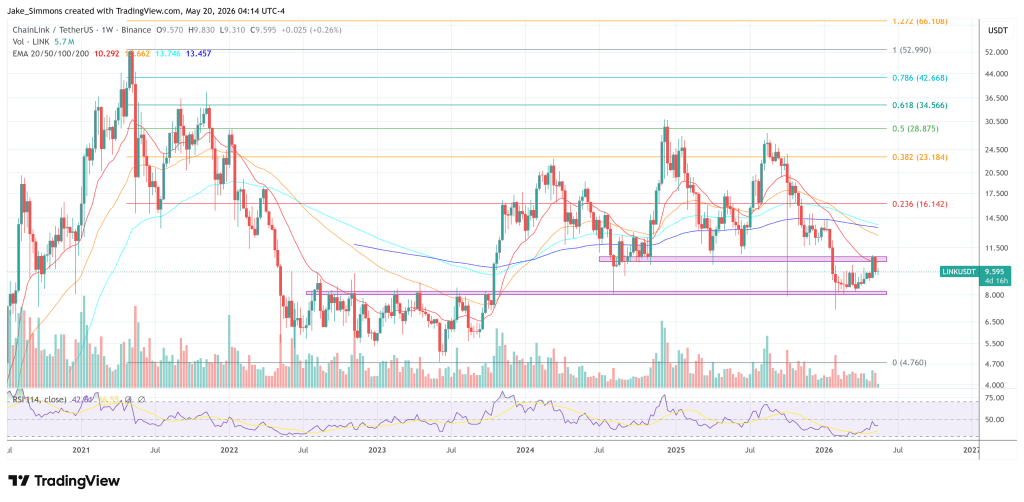
At press time, LINK traded at $9.595.