
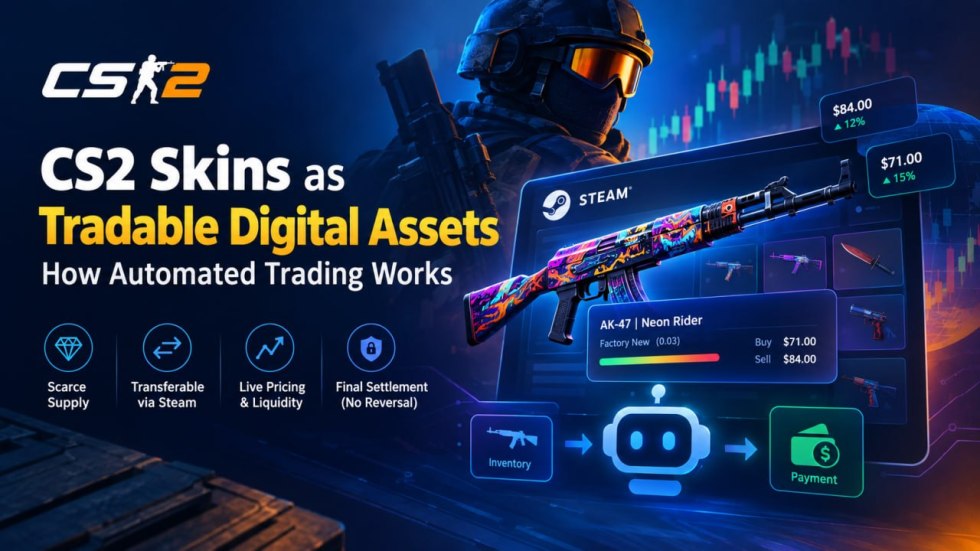
A CS2 skin is a cosmetic item in Counter-Strike 2 that functions as a bearer asset, meaning whoever holds it in a Steam inventory controls it outright. Traders treat these items as an asset class because they are scarce, transferable, priced continuously by an open market, and convertible to cash through independent platforms. The market runs around the clock and prices move within minutes, which is why automated software rather than human dealers now settles the majority of volume.
At a glance: This article explains how CS2 skins behave as digital assets, how automated trading software prices and settles them, where the spread and the risk actually sit, and how custody in this market differs from custody in crypto. It is written for readers who already think in terms of liquidity, spreads, and settlement.
What makes a CS2 skin behave like an asset?
A CS2 skin qualifies as a tradable asset because it has fixed supply, a transparent transfer mechanism, and a continuously quoted price. Supply is set at release and cannot be expanded retroactively. Transfer runs through Steam’s official trade system, which produces a verifiable record of custody changing hands.
The critical property is that the item is a bearer instrument. There is no chargeback, no ledger to roll back, and no issuer to appeal to. That makes settlement final in the same way an on-chain transfer is final, and it explains why the operational risk in this market concentrates almost entirely in session security rather than in counterparty credit. Finality is also why execution moved to software: a csgo skin trade bot can verify an item and settle a transfer in seconds, with no mechanism to unwind the trade afterwards.
How does automated software price a skin?
Automated software prices from live market data because no CS2 skin carries a fixed value. Three inputs drive every quote: rarity tier, wear category, and float value. Float value is a number from 0.00 to 1.00 measuring how worn an item’s texture is, and a lower float means a cleaner finish and a higher price. Two units of the same weapon skin can differ by hundreds of dollars when one reads 0.03 and the other 0.41, which makes float the closest analogue this market has to a quality grade on a physical commodity.
The software then applies a spread, bidding below the observed market and offering above its own cost. On liquid items that spread typically runs between 3% and 12%, widening on rare units that take longer to clear. Those parameters are enforced identically on every trade, which is the entire reason marketplaces can quote an instant firm price on an item a human dealer would need an hour to assess.
How does settlement compare to crypto?
Settlement here resembles crypto in finality but differs in custody and liquidity. The comparison matters because traders arriving from digital assets often assume the risk profile transfers directly, and it does not.
| Property | CS2 skins | On-chain assets |
| Custody | Steam account holds the item | Private key holds the asset |
| Transfer rail | Steam trade system | Public blockchain |
| Settlement | Final, no reversal | Final after confirmations |
| Fungibility | None, each unit differs by float | Full for a given token |
| Liquidity depth | Thin on rare units | Deep on major pairs |
Non-fungibility is the difference that catches people out. A trader can exit a position in a liquid token at a known price in seconds, while an identically valued rare skin may sit unsold for days because the specific float and pattern a buyer wants is a narrower match than a ticker symbol.
How does a single automated trade execute?
The execution path is consistent across venues, and the order is what protects the position. A misconfigured trade URL is behind most stalled settlements.
- Authenticate through Steam’s official login and link the account, never through a page requesting Steam credentials directly.
- Register a Steam trade URL so the software can issue and receive offers.
- The software quotes a firm price drawn from live data and adjusted for the unit’s float and wear.
- On acceptance, the software issues the Steam trade offer and monitors it to completion.
- The transfer confirms and the agreed payment settles to the trader’s balance.
Where does the edge come from?
The edge comes from pricing discrepancies between venues, and capturing it requires seeing every venue at once. The same item routinely carries different bids across platforms because each operator carries its own inventory, its own cost of capital, and its own view of how quickly it can resell.
Tools that read an inventory once and overlay cross-market prices convert that fragmentation into a visible spread. Steam Inventory Helper (SIH), a browser extension for CS2 skin traders, is one example: it exposes the exact float of every item and displays live prices from more than 28 marketplaces on a Steam inventory page. Working from Steam Inventory Helper, a trader can observe that a unit bids $71 on one venue and offers $84 on another, then configure software to act only inside that 15% band rather than trading on impression.
What actually goes wrong?
The failures that cost real money are rarely software faults. A pricing rule set slightly too generously loses a few cents per fill, which is invisible on one trade and material across five hundred. Thin liquidity is the second trap: automation can accumulate a rare unit in seconds and then hold it for days, tying up capital at a price no buyer will meet.
The third risk is the one a trader controls completely. Because skins are bearer assets, a spoofed login page that captures a Steam session token can drain an inventory before the owner notices anything. Software holding 200 units averaging $40 each is guarding $8,000 of instantly transferable value, and a single compromised session is enough to lose the entire book. Verifying that any login form is served by Steam’s own domain eliminates the largest single threat in the workflow.
Net-net
CS2 skins trade like scarce, non-fungible bearer assets with final settlement and uneven liquidity, and automated software dominates the market because it prices from live data and settles instantly. The returns come from disciplined spreads and accurate float data rather than from the automation itself, which only enforces whatever judgment it was given. Liquidity risk on rare units and session security are the two exposures that decide outcomes. Anyone deploying automation should fix a spread and a float threshold in advance, then let the software hold that line without exception.
FAQ
How liquid is the CS2 skin market really?
Liquidity is strong on common and mid-tier items that clear within minutes, and thin on rare units where a matching buyer may take days to appear. Position sizing should follow that split, because capital parked in a rare item is effectively locked until a specific buyer arrives.
Why do identical items receive different automated quotes?
The variance comes from float value, the 0.00 to 1.00 measure of texture wear that software reads on every unit. A lower float means a cleaner finish and a higher bid, so two units sharing a name can be quoted far apart without any pricing error.
What is the main security exposure in automated skin trading?
Session theft through phishing pages that imitate the Steam login is the dominant cause of losses. Because the items are bearer assets with final settlement, a stolen session cannot be reversed, which makes domain verification more valuable than any other single precaution.
Disclaimer: This is a paid release. The statements, views and opinions expressed in this column are solely those of the content provider and do not necessarily represent those of Bitcoinist. Bitcoinist does not guarantee the accuracy or timeliness of information available in such content. Do your research and invest at your own risk.