
Spanish bank Sabadell is the latest to join a consortium of European banks seeking to launch a euro-pegged stablecoin to make transactions more efficient and increase the dominance of Europe’s digital assets market.
Sabadell Joins European Banking Consortium
On Tuesday, Spain’s fourth-largest banking group by assets, Sabadell, announced it will join the Qivalis consortium as traditional financial institutions wrestle with the fast-growing stablecoin industry and broader crypto market adoption, Reuters reported.
The Qivalis consortium was set up in Amsterdam in 2025 by several major European banks to develop and issue a Markets in Crypto Asset Regulation (MiCA) compliant, euro‑pegged stablecoin in the second half of 2026 to help counter the US dollar’s dominance in digital payments.
Sabadell’s CEO, César González-Bueno, said in a press conference that the Qivalis initiative “is primarily designed to make transactions more efficient and secure,” adding, “It is a European project that we believe makes sense, and we will indeed be part of it.
Notably, the project comprises a dozen European institutions, including ING, UniCredit, KBC, Danske Bank, and BNP Paribas. Last month, Spain’s BBVA, the country’s second-largest bank and one of the largest financial institutions globally, announced it had also joined the banking consortium.
As reported by Bitcoinist, the banking giant considers that collaboration is crucial to “create common standards that support the evolution of the future banking model and deliver financial innovation to our clients in a consistent and practical way.”
Reuters noted that the growth of the digital assets industry has prompted traditional institutions to find uses for blockchain technology within their businesses. Therefore, more financial institutions are also considering joining the Qivalis project.
A spokesperson for Spain’s fifth-biggest lender by market value, Bankinter, said on Tuesday it was in talks with the consortium and would update in early summer. In addition, non-listed Spanish entities, including Abanca, Kutxabank, and Cecabank, are reportedly considering joining Qivalis, sources familiar with the matter told Reuters.
Europe’s Push For Stablecoin Dominance
The European bank consortium’s initiative comes as local authorities and industry advocates also push to grow the bloc’s stablecoin market to weaken US dominance over its payment systems.
At the Paris Blockchain Week in April, France’s Finance Minister Roland Lescure encouraged European banks to explore tokenized deposits and called for the development of more Euro-pegged stablecoins, highlighting that their volume compared to US dollar rivals was “not satisfactory.”
For context, euro-pegged stablecoins account for less than 1% of global stablecoin volume, which is significantly lower than the level that would be expected based on the euro’s broader influence in global markets.
Blockchain for Europe, an organization that represents international Blockchain industry players in the European Union (EU), affirmed that the MiCA framework has made euro-pegged stablecoins less competitive than their US-denominated counterparts, despite making them safe.
The group noted that skepticism prevails among European policymakers regarding the trajectory of euro electronic money tokens (EMTs) and that it has placed Europe on the “downward-sloping part of the regulatory Laffer curve.”
To address this, the organization suggested multiple reforms to MiCA to improve the regulated European stablecoin market and maximize its positive impact on the bloc’s industry, citizens, and businesses.
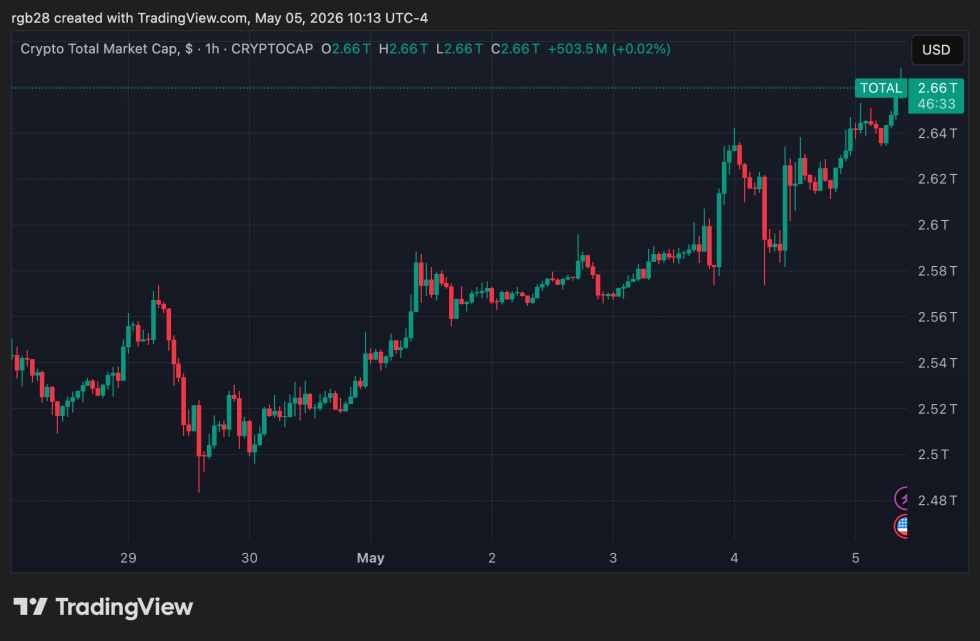

The total crypto market capitalization is at $2.66 trillion on the one-week chart. Source: TOTAL on TradingView