

The crypto market is facing a critical stress test as Bitcoin and Ethereum lose ground, signaling a broader shift in global risk appetite. After weeks of choppy consolidation, downside pressure is intensifying, and traders are watching closely to see whether this move develops into a deeper correction or stabilizes into a new base. At the same time, capital flows are becoming more selective, with crypto struggling to attract conviction while money rotates toward assets perceived as more stable in the current macro environment.
The global risk map is being redrawn. What feels like an earthquake in financial markets is revealing a historic capital migration—one that is actively reshaping what investors define as safety versus danger. While the traditional pillars of the US economy show visible strain and the dollar’s dominance as an unquestioned refuge begins to weaken, the market’s response has not been a rush into digital alternatives. Instead, the immediate bid has been distinctly traditional.
Gold and silver are now commanding attention as the primary destinations for defensive capital. Their record-breaking rallies reflect more than speculation—they represent a renewed demand for tangible, scarce assets in an environment where confidence is being tested. Meanwhile, US equities continue absorbing liquidity on the strength of structural demand and benchmark allocation, leaving crypto caught in the middle.
As metals surge and crypto cools, the message is clear: in today’s market, the safe-haven trade is wearing a metallic face.
Capital Rotates To Metals As Crypto Turns Into The Risk Asset Again
A CryptoQuant report argues that current market flows reflect a desperate search for solid ground, and the numbers highlight how sharply investor behavior is shifting. Silver has broken its historical barrier, surging to $100 per troy ounce, while gold continues its vertical climb toward the $5,000 milestone, trading near $4.9K after posting a weekly gain of almost 8%. This type of synchronized breakout across precious metals signals a powerful flight-to-safety impulse, especially at a time when investors are questioning the stability of traditional macro anchors.

CryptoQuant notes that the US dollar is also under pressure, experiencing its steepest weekly devaluation since May of last year, when markets were still adjusting to the shock from Donald Trump’s extreme tariff hike in April. The timing is not random. When confidence in the dollar weakens, part of that capital often rotates into gold first, reinforcing metals as the default refuge.
The crypto side of the equation tells a different story. The flight is selective: US Bitcoin ETFs recorded $1.33 billion in weekly outflows, the largest since February 2025. Yet Bitcoin has not collapsed, supported by miner resilience as they remain in a zone of operational neutrality. The conclusion is clear: in the short term, capital is prioritizing the classic refuge over innovative risk.
CryptoQuant frames this as a paradigm inversion—money is no longer defaulting to Treasuries, but to metals, even as volatility risk in gold and silver rises.
Bitcoin Weekly Structure Tests Key Support
Bitcoin is trading around $87,900 on the weekly chart, attempting to stabilize after a sharp corrective leg that followed the late-2025 peak. The market has shifted from expansion to consolidation, with BTC struggling to regain momentum after breaking down from the $100K region. While price has not collapsed into a full capitulation phase, the weekly structure shows that sellers remain active on rallies and buyers are increasingly forced to defend key levels.
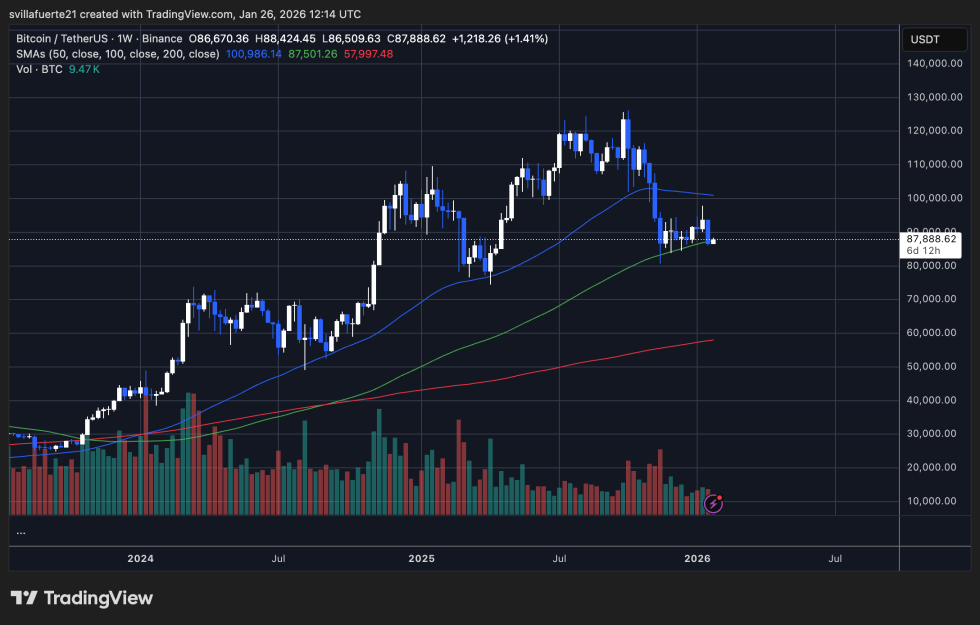
From a trend standpoint, BTC is now compressed between major moving averages. The 50-period moving average (blue) is still above price near $101,000, acting as strong overhead resistance and marking the level the market must reclaim to restore bullish momentum. Meanwhile, the 100-period moving average (green) is rising toward price near $87,500, becoming a critical dynamic support zone. As long as BTC holds above this rising trend reference, the pullback can still be interpreted as a corrective phase within a broader uptrend rather than a full structural breakdown.
The 200-period moving average (red) continues to slope upward far below price near $58,000, highlighting that long-term trend conditions remain positive despite the current volatility. Volume has been elevated during the recent selloff compared to prior weeks, reflecting forced deleveraging and defensive positioning.
For bulls, the key objective is reclaiming $90K and building acceptance above that level. If support fails near the green average, downside risk opens toward the low-$80K range before the market finds stronger demand.
Featured image from ChatGPT, chart from TradingView.com