Quick Facts:
- ➡️ Bitcoin options notional around $2.15B expires Feb 6, 2026, with positioning skewed defensive via put-heavy ratios.
- ➡️ $BTC and $ETH remain highly volatile; post-expiry dealer hedging shifts could change market behavior fast.
- ➡️ ETF flow whiplash suggests institutions are tactically reallocating rather than steadily accumulating.
- ➡️ BMIC’s quantum-secure wallet narrative targets ‘harvest now, decrypt later’ risk, a theme that resonates during risk-off regimes.
A massive derivatives pin hits the market this Friday, February 6, 2026.
Roughly $2.15B in Bitcoin options notional is expiring, with another ~$408M in Ethereum options riding shotgun, according to Deribit’s settlement calendar.
Why care? Weekly expiries tend to suck liquidity out of the room exactly when you need it most. If spot prices are already jumpy, dealers hedging large strike clusters can amplify intraday moves, especially when their positioning leans defensive.
Right now, the $BTC put-to-call ratio sits at a gloomy 1.42, implying traders are paying up for downside protection rather than betting on a moonshot.
The tape is already looking nervous. Bitcoin is hovering near $66K while Ether trades around $1,920 after some nasty risk-off swings.
Mainstream outlets are already calling this another ‘crypto winter, prices are halved from October 2025 highs, and sentiment is shaky (to put it mildly) as leveraged positions get rinsed.
But here’s the thing most headlines miss: settlement doesn’t just ’cause volatility, it re-prices it. Once the expiry clears, implied vol resets, gamma exposure shifts, and the market can finally pick a direction instead of chopping sideways. That’s why veteran traders obsess over these Fridays.
In this mess, capital starts hunting for asymmetric bets away from the crowded majors, specifically plays tied to infrastructure rather than just price action.
That’s the wedge BMIC ($BMIC) is driving into the conversation.
Options Expiry Meets ETF Whiplash: What Traders Watch Next
We’re entering this expiry on thin ice.
Bitcoin’s 24-hour range on CoinGecko has stretched from $64K to $66K, a brutal reminder that liquidity vanishes fast when everyone reaches for the exit at the same time.
Then there’s the ETF situation. U.S. spot Bitcoin ETFs have been erratic, swinging between sharp redemptions and the occasional bounce. MarketWatch flagged heavy damage in the ETF complex during the selloff, noting outflows often hit right as $BTC lost key technical levels.
The takeaway? Dip-buying exists, but it’s tactical. Not unconditional.
So, what happens after the bell?
If $BTC holds the mid-$60Ks, short-dated hedges can come off quickly, allowing spot prices to drift higher as dealer pressure eases.
If $BTC loses the recent lows, that defensive positioning turns into momentum selling as hedges pay out and risk desks cut exposure.
Either way, the risk is obvious: expiry is often the catalyst for a bigger move, not the move itself. Watch if volatility drops after settlement, or stubbornly stays high (usually a bad sign).
And then we have BMIC’s ($BMIC) quantum-security thesis.
BMIC Pushes ‘Quantum-Secure Finance Stack’ as a New Risk Hedge
BMIC ($BMIC) positions itself as a quantum-secure wallet project on Ethereum (ERC-20).
The pitch? ‘The only platform offering wallet + staking + payments protected by post-quantum cryptography.’
It’s a message tailored for a specific nightmare: ‘harvest now, decrypt later,’ where attackers hoard encrypted data today to crack it later with stronger compute.
That narrative is gaining traction precisely because macro structure is getting messy. When volatility spikes, operational security usually degrades, panic leads to sloppy key management, SIM swaps, and rushed transfers.
BMIC’s angle is to remove the weakest link: public-key exposure.
Its stack relies on a few distinct pillars:
- Zero Public-Key Exposure (structural mitigation, not just a bolt-on feature)
- AI-Enhanced Threat Detection (security that adapts rather than just authenticates)
- Quantum Meta-Cloud (branding-heavy, sure, but signals an enterprise-grade layer)
- ERC-4337 Smart Accounts, paired with Post-Quantum Cryptography
There’s a clear link to the options drama: when markets feel like a knife fight, smart money doesn’t just hedge price—they hedge custody risk.
BMIC Presale Numbers: Price, Raise, and the Setup
BMIC has raised over $437K so far, with tokens priced at $0.049474 on the official presale page.
Those figures matter because they define the starting line for liquidity and reveal how much hype is baked into the valuation.
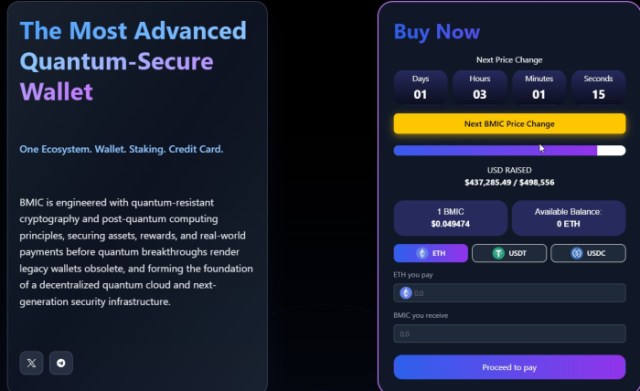
Unlike meme coins selling pure attention, BMIC is selling a security thesis and that tends to perform best when investors are actively worried about risk. Options expiry weeks do that. Sharp drawdowns do that.
The caveat? Big claims need big proof. Markets will eventually demand working product milestones and clarity on how ‘quantum-secure staking’ actually functions under the hood. But right now, the timing feels intentional.
In a week where $BTC’s derivatives calendar is the headline and spot is whipping around, BMIC offers a different kind of hedge: not against price, but against the future security model of crypto itself.
This article is not financial advice; crypto is volatile. Options expiry can distort prices, and early-stage tokens carry execution risk.