



In our quest to find the best crypto exchanges for margin trading, we’ve discovered that not all platforms are created equal when it comes to letting you trade with borrowed funds.
We’ve done the legwork to separate the best crypto margin trading platforms from the ones that’ll have you explaining to your spouse why the rent money is gone.
We’ll walk you through everything, from how margin trading actually works to a review of top platforms like Binance, MEXC, and Kraken.
By the end, you’ll know exactly which crypto margin trading platform fits your risk appetite and which ones to avoid unless you enjoy living dangerously.
Overview – Top Crypto Exchanges for Margin Trading in 2026
Before we dive deep into the weeds, here’s your cheat sheet of the best leverage crypto exchange options we’ve found in 2026. These platforms have actually proven themselves in the trenches of crypto volatility.
| CoinFutures | Simulated trading platform with up to 1000x leverage |
| MEXC | 500x leverage meets zero maker fees for low-cost trading |
| Binance | Industry giant with unmatched liquidity and up to 125x leverage |
| Kraken | US-friendly trading platform with robust security and transparent fees |
| Weex | Zero-fee perpetual futures with competitive leverage options |
| Margex | Bitcoin-focused platform with 100x leverage and tight spreads |
| BloFin | Advanced copy trading features with high leverage support |
| KCEX | Emerging platform with diverse trading pairs and leverage |
| PrimeXBT | Multi-asset trading with 200x crypto leverage options |
| Bybit | Derivatives powerhouse with up to 125x leverage and excellent UI |
What Is Crypto Margin Trading?
Crypto margin trading is essentially borrowing money from an exchange to make bigger bets than your actual bankroll allows.
Think of it as the financial equivalent of asking your friend to chip in on a pizza, except instead of extra pepperoni, you’re potentially multiplying your gains or catastrophically amplifying your losses. At its core, margin trading lets you control a larger position than your account balance by using leverage.
While spot margin trading lets you borrow funds to trade actual cryptocurrencies, futures margin trading involves contracts that let you predict price movements without owning the underlying asset.
Leverage is a double-edged sword that doesn’t care about your feelings. A 10% move in Bitcoin with 10x leverage means a 100% change in your position, and that works both ways.
The platform typically requires you to maintain a certain margin level, and if your position dips below this threshold due to adverse price movements, you’ll face the dreaded liquidation.
For a more traditional breakdown of how margin works and why it’s so risky, the SEC’s guide on margin trading is worth a read.
Margin Trading vs Leverage Trading: What’s the Difference?
Margin and leverage trading are basically the same thing. Margin trading refers to the act of borrowing funds from a broker or exchange to trade, while leverage refers to the multiplier effect you get from that borrowed capital.
Think of margin as the ‘what’ and leverage as the ‘how much.’
How Does Margin Trading Work in Crypto?
Margin trading involves depositing collateral and borrowing additional funds from the exchange to open a larger position.
The exchange charges interest on borrowed funds, typically calculated hourly or every four hours, depending on the platform. Your collateral must maintain a certain percentage of your position value, or you’ll get liquidated.
Let’s break this down with some actual numbers because nothing is a funnier read than financial calculations.
Example: The Good Scenario (Profit)
Say you have $1K and want to long crypto at $50K with 10x leverage:
- Your margin: $1K
- Borrowed funds: $9K
- Total position: $10K
- Crypto amount: 0.2 tokens
If the crypto pumps to $55K (a 10% increase):
- Position value: 0.2 tokens × $55K = $11K
- Borrowed funds repaid: $9K
- Trading fees (approx): $20
- Your profit: $11K – $9K – $1K – $20 = $980
- ROI: 98% gain on your $1K investment
Without leverage, that same 10% increase would’ve only netted you $100. This is why degenerates love leverage.
Example: The Bad Scenario (Loss)
Same setup, but the crypto tokens drop to $45K (a 10% decrease):
- Position value: 0.2 tokens × $45K = $9K
- Borrowed funds still owed: $9K
- Trading fees: $20
- Your remaining funds: $9K – $9K – $20 = –$20
Congratulations, you just lost your entire $1K margin, plus got hit with a liquidation fee. The exchange automatically closed your position to prevent you from owing them money. This is why risk management is the difference between a rough trading session and explaining to your partner why you need to borrow money for groceries.
Most exchanges will send margin calls or liquidation warnings when your position approaches danger levels. However, in volatile crypto markets, these warnings can arrive about as fast as your regrets, which is too late to do much about it.
Best Margin Trading Crypto Exchanges Reviewed
Alright, enough theory. Let’s get into the platforms that’ll either help you get rich or at least lose your money in style. We’ve reviewed these exchanges based on actual trading experience, not just what their PR teams promise in sponsored YouTube videos.
1. CoinFutures – Simulated Trading Platform with up to 1000x Leverage
Trading fees: PnL fee (charged only on profits) or flat fee (fixed cost per trade)
Max. leverage: 1000x (simulated)
CoinFutures is a simulated crypto trading platform that offers up to 1000x leverage on major coins, turning tiny price moves into massive gains or losses. While CoinFutures markets itself as a game, you deposit real funds that can be completely liquidated.
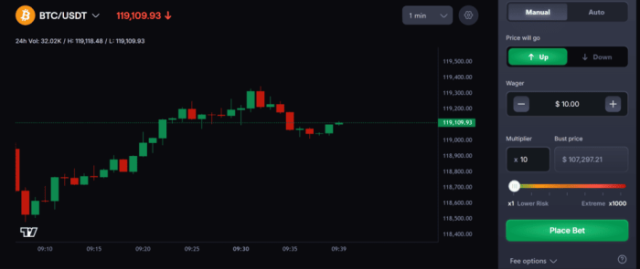
The platform offers up to 1000x leverage on price predictions for Bitcoin, Ethereum, and other major coins, letting you choose between going long or short based on its proprietary volatility algorithm.
You’ll learn valuable lessons about why 1000x leverage is insane, except the tuition is paid in your actual capital, disappearing when a 0.1% simulated price movement hits your bust price.
Think of it as a very expensive crash course in leverage management, with the small consolation that you can set stop losses and cash out early if you realize your mistake fast enough.
2. MEXC – 500x Leverage Meets Zero Maker Fees for Low-Cost Trading
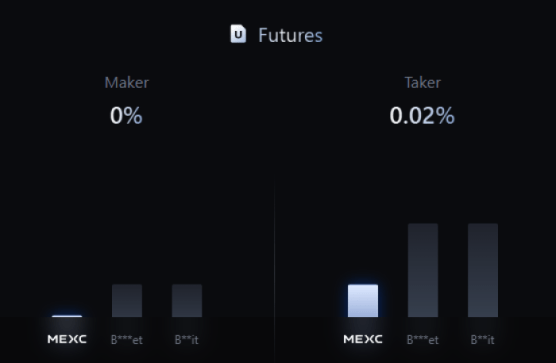
Trading fees: 0.000% maker / 0.020% taker (futures)
Max. leverage: 500x
With up to 500x leverage on select pairs and literally zero maker fees on futures, MEXC has become the playground of choice for traders who believe risk management is just a suggestion.
The platform supports over 800 futures trading pairs, meaning if there’s a new cryptocurrency pumping somewhere, MEXC probably lets you leverage trade it.
Their 0.000% maker and 0.020% taker fees on futures make most other exchanges look like highway robbery. For context, that’s cheaper than your morning coffee per $10K traded.
The exchange also doesn’t require KYC for basic accounts with withdrawal limits up to 10 $BTC daily in some regions, which is either wonderfully libertarian or mildly concerning depending on your perspective.
MEXC particularly excels at listing new projects and altcoins quickly, often before major exchanges. This makes it ideal for degen traders hunting the next 1000x crypto.
The platform’s liquidity on major pairs like $BTC and $ETH is solid, though smaller altcoins can have wider spreads.
MEXC has maintained good security practices with proof-of-reserves and multi-signature cold wallets, though it’s not as battle-tested as older exchanges.
It also charges funding fees every 8 hours on perpetual futures, which can quietly drain profitable positions if you’re not paying attention. Still, for experienced traders who know what they’re doing, MEXC offers some of the most competitive margin trading conditions in crypto.
3. Binance – Industry Giant with Unmatched Liquidity and up to 125x Leverage
Trading fees: 0.02% maker / 0.05% taker (futures)
Max. leverage: 125x ($BTC/$ETH), 100x (other pairs)
As the world’s largest crypto exchange by trading volume, Binance offers margin trading with liquidity so deep you could drown in it.
The platform provides up to 125x leverage on Bitcoin and Ethereum perpetual futures, with most altcoins supporting 100x. Their spot margin trading offers more conservative 10x leverage, which is perfect if you want to lose money slightly slower than on futures.
What sets Binance apart is its ecosystem. You get access to portfolio margin, copy trading, trading bots, and a staking platform that actually pays competitive rates.
The $BNB token provides fee discounts up to 25%, turning already-low 0.02% maker fees into something approaching free.
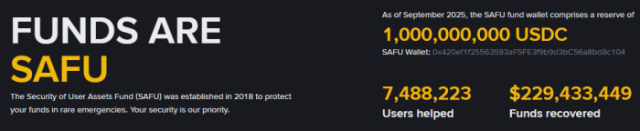
Binance’s SAFU fund (Secure Asset Fund for Users) allocates 10% of trading fees to cover potential losses in extreme cases.
The exchange faces ongoing scrutiny from global regulators, which has led to service restrictions in several countries. US traders are limited to Binance.US, which doesn’t offer futures or margin trading.
The platform’s sheer size also makes it a honeypot for hackers, though its security record has been solid since a 2019 incident where it covered user losses from its own funds.
Summing up, the combination of massive liquidity, competitive fees, and comprehensive features makes it hard to beat, even if you occasionally need a law degree to understand its compliance announcements.
4. Kraken – US-Friendly Trading Platform with Robust Security and Transparent Fees
Trading fees: 0.02% maker, 0.05% taker
Max. leverage: 5x-10x (spot margin), up to 50x (futures)
Kraken is the exchange that actually follows rules, maintains transparent operations, and hasn’t had a major security breach since its 2011 founding.
The platform provides up to 10x leverage on spot margin across 150+ trading pairs, which sounds conservative until you remember that 10x is still enough to completely wreck your account with a 10% adverse move.
Their futures platform offers up to 50x leverage for those who need extra rope to hang themselves with.
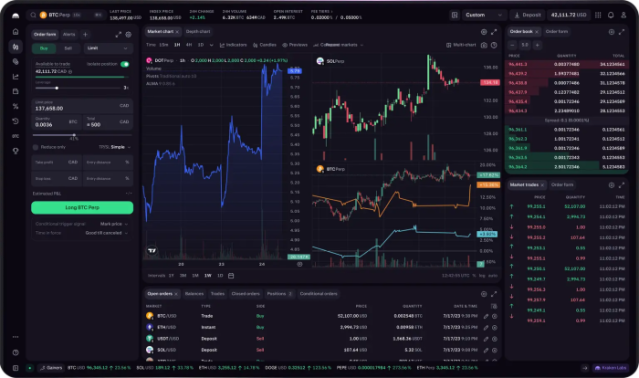
Kraken’s margin trading interface through Kraken Pro is clean and functional, though it won’t win any design awards.
The platform rarely goes down during high volatility, unlike certain competitors whose servers seem to take coffee breaks during crucial moments.
Kraken offers both cross-margin and isolated-margin modes, and its liquidation engine is relatively forgiving compared to exchanges that’ll liquidate you if Bitcoin sneezes wrong.
Its customer support, while not perfect, is generally responsive, which is a rarity in crypto, where support often means screaming into the void of an automated chatbot.
Kraken’s relatively conservative approach means you won’t find the exotic leverage options or obscure altcoin pairs available on more aggressive platforms.
Its liquidity, while solid on major pairs, can’t match Binance‘s ocean of orders. And yes, the Kraken interface looks like it was designed in 2015, because it basically was.
But for US traders who want to sleep at night knowing their funds are probably safe, Kraken is tough to beat.
5. Weex – Zero-Fee Perpetual Futures with Competitive Leverage Options
Trading fees: 0.1% for spot and 0.02% (maker) / 0.08% (taker) for futures
Max. leverage: up to 400x
Weex is the newer kid trying to disrupt the margin trading space with a compelling value proposition: what if we just didn’t charge fees on some pairs? It’s either brilliant marketing or the beginning of a race to the bottom that’ll end with exchanges paying us to trade. Time will tell.
The platform offers regular promos with zero-fee trading on select perpetual futures contracts, which actually means what it says: no maker or taker fees on qualifying pairs.
The select pairs typically mean the most liquid markets like $BTC/$USDT and $ETH/$USDT, while less popular pairs carry standard fees around 0.02% maker and 0.08% taker.
Weex supports up to 400x leverage, putting it in the dangerously high but not completely insane category.
The platform is sleek and modern, clearly designed by people who understand that traders stare at screens for 16 hours straight and would appreciate it if things didn’t look like Windows 95.
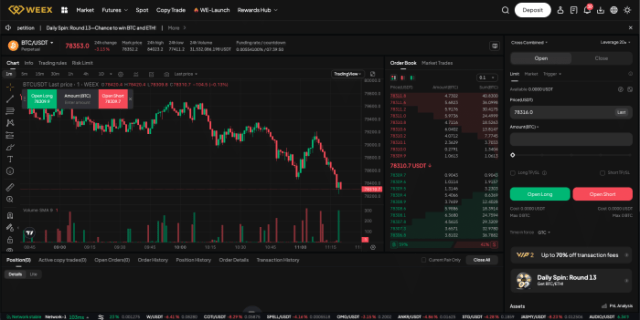
The interface includes advanced charting through TradingView integration, multiple order types, and both isolated and cross-margin modes.
Its API is robust and well-documented, making it popular among algo traders and bots.
The concerns with Weex are similar to those of any newer platform: less battle-tested security, a smaller user base, and liquidity that’s solid but not Binance-level. It also lacks the diverse ecosystem of lending, staking, and DeFi products that older exchanges offer.
But if your primary goal is high-leveraged perpetual futures trading with minimal fees, Weex delivers better than most.
6. Margex – Bitcoin-Focused Platform with 100x Leverage and Tight Spreads
Trading fees: 0.019% maker / 0.06% taker
Max. leverage: 100x ($BTC, $ETH, $BNB, $TRX), 25-50x (others)
Margex has carved out a niche as the platform for traders who think Bitcoin is the only crypto that matters and everything else is just noise.
With 100x leverage on major assets and a laser focus on perpetual futures, it’s designed for people who want to trade derivatives without the distraction of 10K random tokens.
The platform’s standout feature is its tight spreads and consistent pricing, achieved through its proprietary liquidity aggregation.
The 0.019% maker and 0.06% taker fees are competitive without being suspiciously low, and the platform is transparent about additional costs like funding rates.
Margex offers a clean, no-nonsense interface that Bitcoin maximalists will appreciate. No NFT marketplace tabs, no obscure DeFi yield farming sections, just perpetual futures trading as it should be.
It supports 49 contracts across major cryptocurrencies, with Bitcoin, Ethereum, BNB, and Tron offering the full 100x leverage. Other pairs cap at 25x or 50x, which is probably wise given Margex’s lower liquidity.
The platform particularly excels at providing educational resources for margin trading. Its academy section actually explains concepts like funding rates and liquidation mechanics without assuming you have a finance PhD.
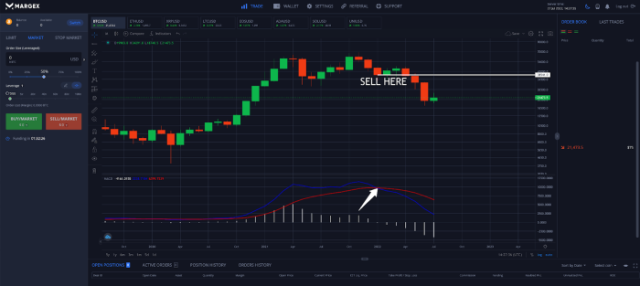
It also offers a demo account with virtual funds, letting you test strategies before committing real money, a feature more exchanges should copy.
Margex is a smaller exchange with modest liquidity compared to giants like Binance. Order execution can occasionally lag during extreme volatility, and their customer support, while decent, operates on European hours, which can be frustrating for traders in other time zones.
The platform also lacks the ecosystem features that keep traders locked into larger exchanges, such as staking, lending, and spot trading.
But if you’re a derivatives trader who wants Bitcoin and major altcoin perpetual futures with high leverage and fair pricing, Margex delivers without unnecessary complications.
7. BloFin – Advanced Copy Trading Features with High Leverage Support
Trading fees: 0.02% maker / 0.06% taker
Max. leverage: 150x
BloFin entered the crypto margin trading scene with a compelling pitch: what if you could leverage trade and copy the strategies of traders who hopefully know what they’re doing?
The platform’s copy trading feature is genuinely sophisticated, letting you browse through detailed trader statistics, including win rates, average returns, and drawdowns.
You can allocate capital to follow specific traders’ positions automatically, with their leverage settings applied to your account. It’s like having a professional trader manage your margin positions, except you’re still on the hook for the losses.
Their fee structure sits at industry-standard 0.02% maker and 0.06% taker, with the twist that successful copy traders can earn profit-sharing from followers.
This creates an ecosystem where skilled traders are incentivized to perform well and share strategies, though it also means popular traders might have their positions front-run by their own followers.
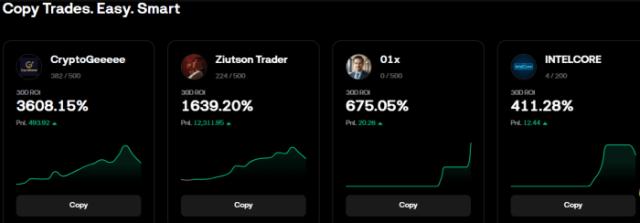
The platform’s interface is modern and intuitive, with comprehensive charting tools and risk management features. It offers both isolated and cross-margin modes, with configurable stop-losses and take-profits.
BloFin also provides detailed analytics on your trading performance, breaking down wins, losses, and the impact of leverage on returns, data that’s surprisingly useful for actually improving as a trader.
However, BloFin faces the classic copy trading paradox: past performance doesn’t guarantee future results, and popular traders can accumulate massive follower positions that become difficult to exit during volatility.
The platform is also relatively new, meaning it lacks the proven track record of older exchanges. Its liquidity is adequate but not exceptional, particularly on less popular pairs.
For traders who recognize their own limitations or want to learn from others while actively trading, BloFin offers unique value.
8. KCEX – Emerging Platform with Diverse Trading Pairs and Leverage
Trading fees: 0% maker / 0.01% taker for futures and 0% for spot
Max. leverage: 100x on some pairs
KCEX is one of those exchanges that flew under the radar until traders started noticing it actually works pretty well. It’s not trying to reinvent the wheel, just offering solid margin trading without the drama that seems to follow larger platforms.
The platform supports 500+ trading pairs with up to 100x leverage, focusing heavily on altcoins and newer projects that bigger exchanges might not list immediately. This makes KCEX appealing for degen traders hunting for the next pump before it hits mainstream exchanges.
KCEX’s fee structure is lower than industry standards at 0% maker and 0.01% taker, with volume-based discounts for high-frequency traders.
The platform supports both $USDT-margined and coin-margined perpetual contracts, giving traders flexibility in how it manages collateral.
The interface has all the features you’d expect from a modern derivatives platform, without any standout innovations. Order execution is generally reliable, though it can lag during high volatility, a common issue with mid-tier exchanges.
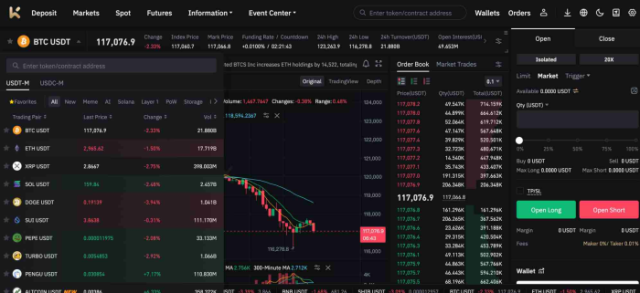
KCEX provides basic trading tools and indicators, adequate for most strategies but lacking the advanced features that institutional traders expect.
The team remains somewhat low-profile, and while KCEX has had smart contracts audited by Hacken, it’s still less transparent than bigger players on proof-of-reserves and regulatory licensing.
KCEX works best for traders who want exposure to newer altcoins with leverage and don’t need white-glove service.
It’s the kind of platform where you keep enough funds to trade, but probably shouldn’t store your life savings. Use it for leveraged access to obscure tokens and maintain realistic expectations about everything else.
9. PrimeXBT – Multi-Asset Trading with 200x Crypto Leverage Options
Trading fees: 0.05% for opening and closing positions on crypto, less for non-crypto instruments
Max. leverage: Up to 200x (for major cryptos like $BTC and $ETH), 1000x (forex)
PrimeXBT decided that limiting trading to just cryptocurrencies was boring, so it created a platform where you can leverage trade crypto, gold, oil, stock indices, and forex all from the same interface.
The platform offers up to 200x leverage on crypto perpetual contracts and an absolutely bonkers 1000x leverage on forex pairs. This extreme leverage attracts professional traders who actually know what they’re doing, as well as beginners who definitely don’t, but think they do until they learn the hard way.
PrimeXBT’s multi-asset approach is genuinely useful for traders who want to diversify beyond crypto. You can hedge Bitcoin positions with gold, trade correlations between S&P 500 futures and $ETH, or just light money on fire across multiple asset classes simultaneously.
The platform charges a simple 0.05% fee on position opening and closing, with no hidden rollovers or funding fees in the traditional sense, though crypto positions do have overnight interest if held for extended periods.
PrimeXBT also offers copy trading called Covesting, where you can follow and automatically replicate other traders’ positions. Combined with its extreme leverage options, this creates the perfect storm of potentially copying someone into a massive loss.
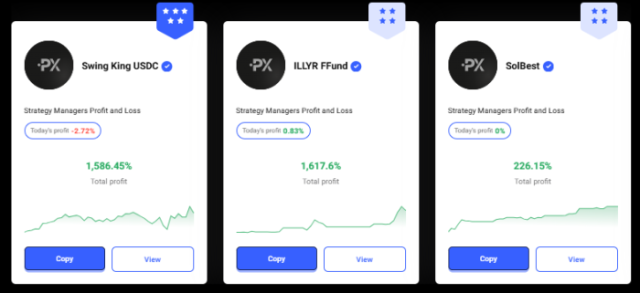
The platform provides detailed performance metrics for traders to copy, but past performance in crypto is about as reliable as a weather forecast for next year.
PrimeXBT operates in a regulatory gray area for many jurisdictions, doesn’t accept US clients, and has faced criticism for aggressive marketing tactics. Even so, it has operated since 2018 without major security incidents.
Liquidity is good but not exceptional compared to pure crypto exchanges, and the multi-asset approach means it’s competing with established players in each vertical.
For experienced traders who want a one-stop shop for leveraged multi-asset trading and understand the risks of extreme leverage, PrimeXBT delivers. For everyone else, it’s probably more leverage than you need to lose money.
10. Bybit – Derivatives Powerhouse with up to 125x Leverage and Excellent UI
Trading fees: 0.02% maker / 0.055% taker (futures)
Max. leverage: 125x ($BTC/$ETH), 75x (other major pairs)
Bybit has evolved from being a derivatives exchange to a legitimate tier-one platform that rivals Binance in futures trading volume.
The platform offers up to 125x leverage on Bitcoin and Ethereum perpetual futures, with most major altcoins supporting 75x. It’s important to note that leverage is tiered: maximum leverage applies only to smaller position sizes. Larger positions automatically reduce leverage to manage risk
Its $USDT-margined and $USDC-margined perpetuals provide flexibility in collateral management, while inverse perpetuals settled in crypto appeal to traders who want to accumulate Bitcoin or Ethereum through profits.
Bybit also supports options trading, spot margin up to 10x, and a variety of structured products for different risk appetites.
The trading interface is clean and responsive, a rare achievement where most crypto platforms seem designed by people who’ve never used their own product.
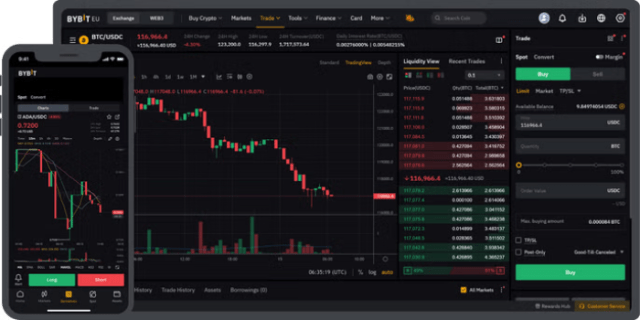
Advanced features like the dual-price mechanism using both last price and mark price to prevent manipulation and unified margin accounts make position management straightforward even during volatile markets.
Bybit’s fee structure of 0.02% maker and 0.055% taker is competitive, with additional discounts available through their VIP program and $BIT token holdings.
The platform offers 24/7 customer support that actually responds, which is almost unheard of in crypto. The platform also provides extensive educational resources, from beginner tutorials to advanced trading strategies, suggesting it prefers users who understand margin trading before getting liquidated.
The trading tools on Bybit are comprehensive: take-profit and stop-loss orders, including trailing stops, conditional orders, and position management features that prevent accidentally opening duplicate positions when frantically clicking during a dump.
The mobile app is equally polished, allowing full margin trading functionality on the go, including opening, managing, and closing leveraged positions from your phone.
Bybit’s copy trading feature connects beginners with experienced traders, though the usual caveats apply about blindly following others.
The platform also regularly hosts trading competitions with substantial prize pools, which are either fun community events or ways to encourage over-leveraged gambling, depending on your perspective.
Bybit doesn’t accept US users due to regulatory uncertainty, and its approach to compliance varies significantly by jurisdiction.
The combination of competitive fees, excellent UX, deep liquidity, and reliable execution makes it the benchmark that other exchanges struggle to match.
How We Review & Choose the Best Crypto Exchanges for Margin Trading
Unlike crypto influencers who’ll shill any exchange that pays for a sponsored tweet, we actually test these platforms using real money. Nothing focuses the mind quite like watching your own capital get liquidated due to a platform’s sketchy execution or hidden fees.
Here’s how we evaluate which exchanges make our list and which ones belong in the digital dumpster.
Available markets and token selection
The best crypto margin trading platform offers diverse markets beyond just Bitcoin and Ethereum. We evaluate the breadth of available trading pairs, including major cryptocurrencies, altcoins, and whether the platform supports margin trading on spot markets or just derivatives.
Platforms like MEXC and Weex excel here with over 800 pairs, while more focused exchanges like Margex deliberately limit selection to liquid markets. More options aren’t always better because a thousand illiquid shitcoins with 2% spreads help nobody except the exchange collecting fees.
Trading fees and total cost of trading
We look beyond advertised trading fees to calculate actual costs, including maker/taker fees, funding rates, rollover charges, and any hidden spreads. 0% maker fees at MEXC and KCEX sound great until you factor in funding costs on perpetual futures.
We also consider whether exchanges offer fee discounts through native tokens or volume tiers, though these rarely benefit retail traders as much as marketing suggests.
Leverage options and risk management
Maximum leverage matters, but so does the platform’s approach to risk management. We test liquidation mechanisms, margin call systems, and whether the exchange uses the last price or mark price for liquidations.
We also evaluate whether platforms force-close positions reasonably or liquidate entire accounts at the worst possible moment.
Liquidity and order execution
Deep liquidity means your orders execute at expected prices without slippage. We test order execution during both calm and volatile markets.
When a Bitcoin flash crash hits, you learn quickly which exchanges maintain functioning order books and which ones conveniently experience technical difficulties.
Binance and Bybit dominate in liquidity, while smaller exchanges can have concerning spreads on anything beyond the top 10 cryptocurrencies.
Security measures and track record
We examine security practices, including cold storage percentages, multi-signature wallets, insurance funds, and proof-of-reserves transparency. Newer exchanges might have solid security but lack the battle testing that proves resilience.
Platform accessibility and user interface
A margin trading platform needs to function during volatility when emotions run high and milliseconds matter. We evaluate interface responsiveness, mobile app quality, and whether advanced features are actually usable or just check boxes on a marketing page.
Bybit has a clean interface that makes complex trades manageable. Some competitors feel like they were designed by someone who actively hates traders.
Customer support quality
When your leveraged position is bleeding out, and you need help NOW, customer support quality stops being an abstract concern. We test response times, knowledge level, and whether support can actually solve problems or just copy-paste generic responses.
Bybit has 24/7 support, which impressed us. Many exchanges view customer service as an unnecessary expense rather than an essential infrastructure. If an exchange takes 72 hours to respond during a crisis, it doesn’t make our list.
Regulatory compliance and reputation
We consider regulatory standing, licensing, and whether an exchange operates transparently or in legal gray areas. US traders need platforms like Kraken that actually follow regulations. Others might prefer exchanges with looser KYC requirements, accepting the additional risk for privacy.
We also evaluate community reputation. If an exchange is constantly embroiled in controversy or has sketchy withdrawal policies, that’s a red flag bigger than a stop-loss getting skipped.
Our recommendations balance these factors based on what matters for margin trading specifically.
We try to match platforms to trader types: beginners may appreciate Kraken’s safety and transparency, degens look for MEXC‘s insane leverage and its selections of the best altcoins, and everyone else gets pointed toward Binance or Bybit‘s balanced excellence.
How to Trade Crypto with Leverage: Step-by-Step Guide
Theory is great and all, but let’s walk through actually opening a leveraged position before you YOLO into 100x and learn these lessons the expensive way.
We’ll use Binance as our example since it’s the most popular platform, but the process is similar across most exchanges once you get past their unique ways of making simple things unnecessarily complicated.
Step 1: Choose an Exchange and Create an Account
First, pick an exchange from our list based on your specific needs. Navigate to its website by typing the URL directly rather than clicking Google ads that lead to phishing sites.
Click the prominent ‘Sign Up’ or ‘Register’ button, usually positioned where even the most distracted trader can’t miss it.
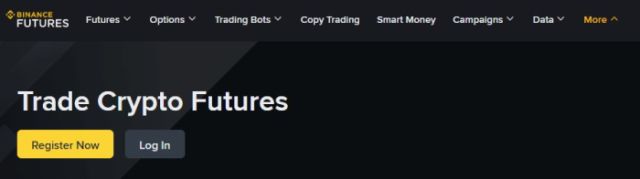
After registering, you’ll receive a verification email. Click the link before it expires and enable two-factor authentication IMMEDIATELY. Use an authenticator app like Google Authenticator or Authy, not SMS, which can be SIM-swapped.
Step 2: Complete KYC Verification and Enable Margin Trading
Navigate to the account verification section, typically in settings or profile. Most platforms require a government-issued ID and a selfie holding said ID.
Upload clear, well-lit photos. Blurry images get rejected and extend the process. Verification can take anywhere from five minutes to several days, depending on the exchange and current backlog.
Once verified, find the margin trading activation page. On Binance, it’s under ‘Derivatives’, then ‘Futures’ or ‘Margin.’
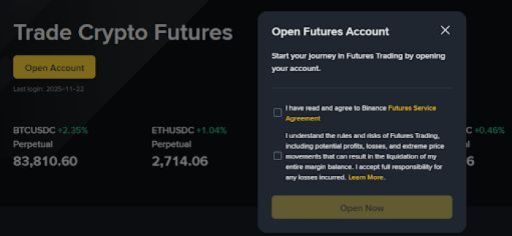
You’ll need to complete a quiz or acknowledge risk warnings before the platform lets you access margin trading.
Step 3: Deposit Funds and Transfer to Your Margin Wallet
Navigate to the deposit section and select your preferred cryptocurrency or fiat currency.
Copy your deposit address, triple-check it matches what’s displayed, and send a small test transaction first if moving significant funds. Yes, this costs extra fees. No, it’s not paranoid when people regularly lose six figures to wrong addresses.
This internal transfer is instant and free, but it’s a step that confuses beginners who can’t figure out why their deposited funds aren’t showing in the trading interface.
Step 4: Select Your Trading Pair and Set Leverage
Navigate to the margin or futures trading interface. It’s usually a separate section from spot trading, accessed via the main menu.
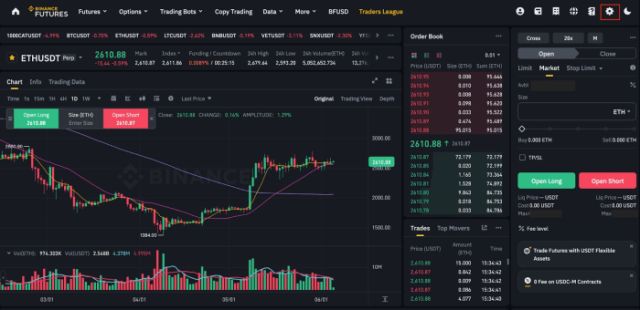 You’ll see a dizzying array of trading pairs. For your sanity, start with $BTC/$USDT or $ETH/$USDT, which have the deepest liquidity and tightest spreads.
Find the leverage selector, typically a slider or dropdown near the order entry form. It’ll show options from 1x up to whatever maximum leverage the pair supports.
Step 5: Place Your Order and Manage Your Position
Time for the moment of truth. Decide whether you’re going for a long-term crypto investment. Enter your order details:
- Market order: Executes immediately at the current market price. Fast, but suffers from slippage on large orders.
- Limit order: Executes only at your specified price or better. No slippage, but might not fill if price moves away.
- Stop limit: Triggers a limit order when the price hits your stop price. Useful for entries and stops.
Set your position size, but set stop-loss and take-profit orders before placing your entry. Don’t rely on doing it after the position opens.
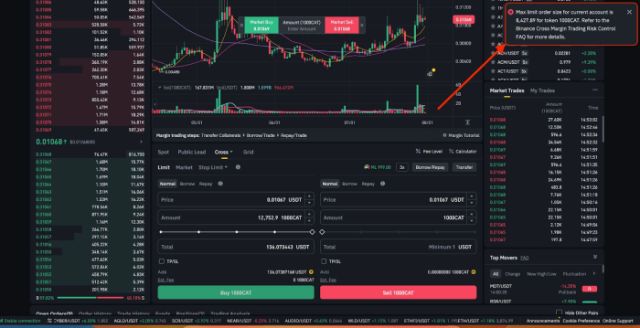
Calculate your stop-loss based on risk tolerance. Never risk more than 1–2% of your total capital on a single trade.
After placing your order, monitor your position in the Positions tab. You’ll see real-time PnL (profit and loss), margin ratio, and liquidation price.
Funding fees on perpetual futures are charged every eight hours. Check the funding rate before leaving positions open long-term. Negative rates mean you’re earning fees, positive rates mean you’re paying them. These fees can quietly drain profitable positions over days.
Step 6: Close Your Position and Evaluate
When your take profit triggers, or you decide to manually close, navigate to your open positions and click Close or Market Sell/Buy to exit.
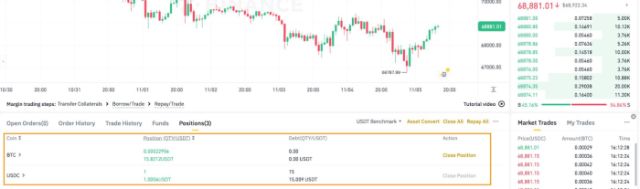
The platform will execute at the current market price, deduct fees, settle funding fees, and return your initial margin plus profits or minus losses to your margin wallet.
Success in margin trading is about managing risk, so winning trades outsize losing ones over time. If you’re getting liquidated more than making profits, the problem is your strategy, risk management, or leverage choices. Fix those before blaming external factors.
Verdict: What’s the Best Crypto Margin Trading Platform of 2026?
There’s no single best exchange for everyone. Your ideal platform depends entirely on your experience level, location, risk tolerance, and whether you value security over features.
For experienced traders seeking maximum leverage and features, Binance offers unmatched liquidity and the most comprehensive ecosystem, while Bybit provides a superior user experience and derivatives-focused tools.
Degen traders chasing altcoin pumps should check out MEXC. Its 200x leverage, near-zero fees, and willingness to list any token that hasn’t been proven to be a complete scam yet make it perfect for high-risk strategies.
New traders can start with Kraken‘s 10x spot margin on actual markets. However, if you’re already comfortable with gambling, enjoy high-risk entertainment, and want the thrill of extreme leverage, CoinFutures delivers a gamified betting platform with real financial stakes.
Choose a platform that supports your strategy, but remember that not even the best exchange in the world won’t fix bad trading decisions.
Stay informed, diversify your risk, and don’t use maximum leverage just because it’s available. Remember, crypto is inherently risky. Never invest more than you can afford to lose and always do your own research.
FAQs
1. Can you trade Bitcoin with leverage?
Yes, Bitcoin leverage trading is available on virtually every major crypto exchange. Most platforms offer 10x to 125x leverage on $BTC perpetual futures, with some like MEXC going up to 500x.
2. What is the best crypto for leverage trading?
Bitcoin and Ethereum are the best cryptocurrencies for leverage trading due to their high liquidity, tight spreads, and predictable volatility. Major altcoins like $BNB, $XRP, and $SOL also work well.
Avoid leverage trading low-cap altcoins or meme coins. Their volatility and thin order books create unpredictable slippage that’ll liquidate positions before you understand what happened.
3. Is margin trading crypto safe?
Margin trading crypto is not safe in the traditional sense, being inherently high-risk by design. Leverage amplifies losses just as much as gains, meaning you can lose your entire investment quickly during adverse price moves.
The safety depends more on your risk management than the platform itself. Many traders lose money because they over-leverage, not because margin trading itself is fundamentally flawed.
4. Which crypto exchange gives the highest leverage?
MEXC and Weex currently offer the highest leverage for crypto, with MEXC providing up to 500x on select cryptocurrency pairs and Weex offering up to 400x on crypto.
