- ➡️ Bullish reported a massive Q4 loss of $563M, triggering a share slide and wider crypto market jitters.
- ➡️ Investors are redirecting attention to BMIC, a quantum-proof wallet offering a full finance stack—from AI security to staking.
- ➡️ Breakthroughs in quantum computing or regulatory shifts could boost BMIC’s narrative strongly.
- ➡️ Execution complexity and market timing could slow adoption, but BMIC’s security-first edge may drive long-term value.
Shares of Bullish tumbled after the firm disclosed a staggering Q4 net loss of $563M, a brutal reversal from the $104.8M profit booked just a year earlier. The timing couldn’t be worse.
The report landed while tech and crypto sectors were already reeling, dragging broader equities down with them. It’s a harsh reminder: even heavyweight, institutional-grade platforms aren’t immune to macro pressure.
Amid the fallout, attention has quietly shifted to BMIC, a quantum-secure wallet project currently in presale. Why? Investors seem to be repositioning toward infrastructure that promises long-term safety rather than just short-term gains.
Frankly, if established platforms like Bullish can stumble on financials, securing assets with post-quantum cryptography suddenly feels less like a luxury and more like insurance.
The context is undeniable: the market is in correction mode. Bitcoin has plunged below $70K (down roughly 20% since January), while Ethereum is off more than 10%, both caught in a wave of tech-sector weakness and policy uncertainty. When majors slip this hard, capital often rotates toward protocols addressing deeper structural risks, like the looming threat of quantum decryption.
BMIC Brings Quantum-Proof Security to Crypto Finance
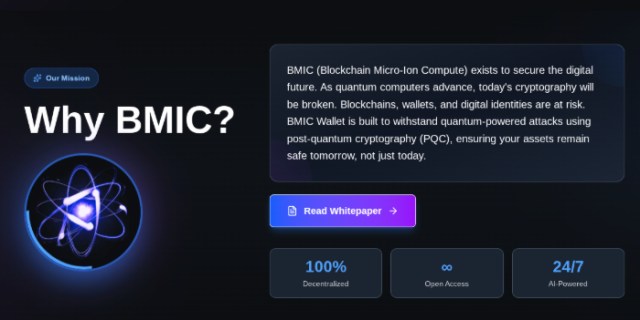
BMIC ($BMIC) isn’t just another wallet and token. It positions itself as the only Post‑Quantum‑Cryptography (PQC)-backed ecosystem for staking and payments on Ethereum.
Its full-stack, RSA-resistant design tackles ‘harvest now, decrypt later’ attacks directly. Sound paranoid? It’s not; it’s a realistic response to advancing quantum capabilities.
With zero public-key exposure, ERC-4337 smart accounts, and AI-enhanced threat detection, the project is building defense for a future that’s approaching faster than most realize.
The numbers are specific: tokens are currently priced at $0.049474, and total raised stands at over $433K.
That suggests solid early demand, nearly half a million dollars, for a security-first offering. We haven’t seen massive whale wallets enter just yet, but that’s typical for this stage. The story here is about preservation and preparedness, not pump mechanics.
The logic is simple. As markets shake, defensive plays aren’t just about ROI; they’re about resilience. BMIC offers asset-level protection that conventional solutions (still relying on old encryption standards) simply lack. The pivot makes sense.
What’s Next and What to Watch
Quantum headlines: Any news about advances in quantum computing, or regulatory chatter on encryption standards, could turbocharge demand for this specific tech stack.
Crypto market stabilization: If $BTC or $ETH recovers, altcoins and infrastructure layers like $BMIC often see inflows shortly after.
Regulatory clarity: Early alignment on post-quantum encryption could deliver institutional confidence and adoption fast.
Risks? Plenty. BMIC faces execution hurdles common to deep-tech projects. Quantum resistance today doesn’t guarantee immunity tomorrow; it’s an arms race that requires continuous evolution. Plus, wallet adoption cycles are notoriously sticky. And let’s be real—even promising token sales can buckle under a deep bear market.
But here’s the second-order effect casual observers might miss: BMIC isn’t just ‘one more alt.’ It’s a modular infrastructure. That positions it for future ecosystem integration, think cold wallets, DeFi rails, and enterprise-grade custody.
LEARN MORE ABOUT THE QUANTUM STACK THAT’S PREPARING FOR THE FUTURE
This article is not financial advice. Presale participation involves high risk, and markets may continue to fall sharply. Evaluate tech maturity and institutional adoption before investing.