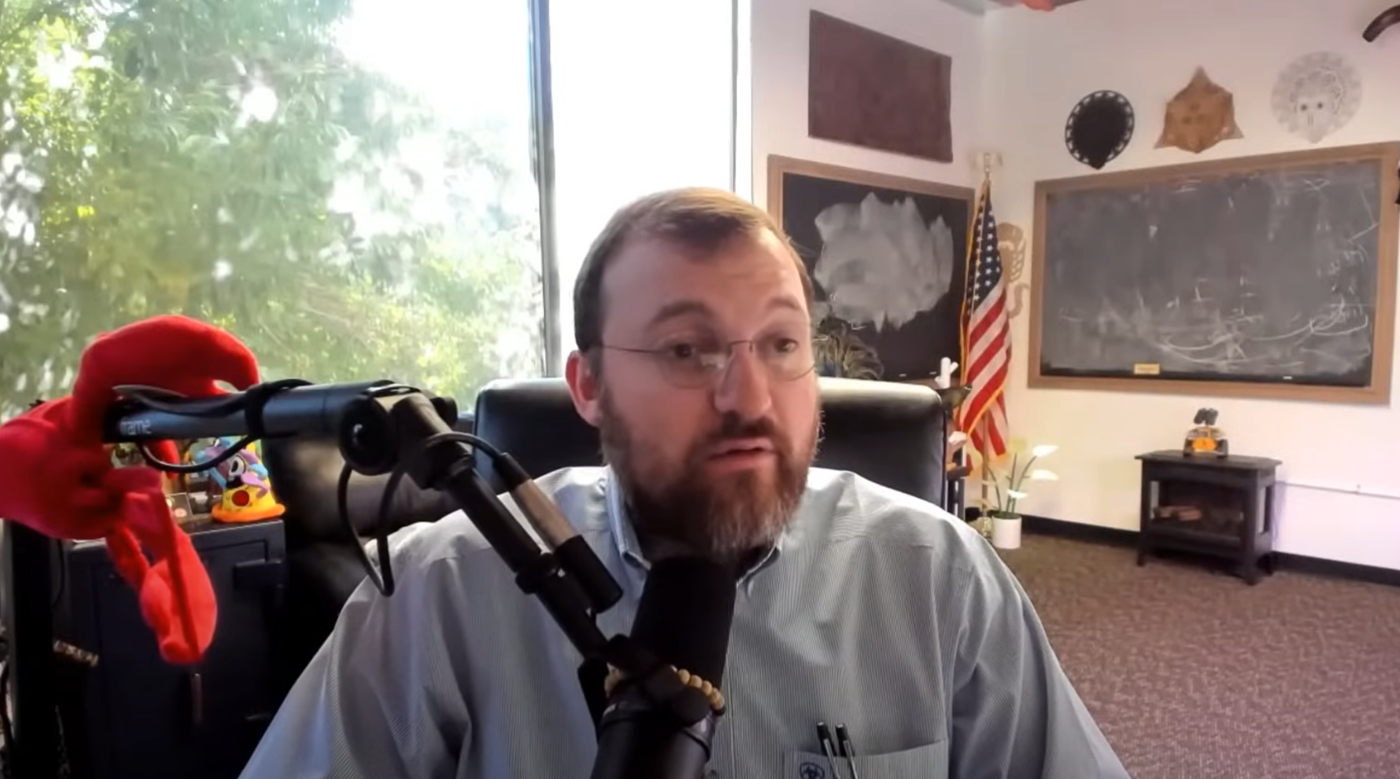


Charles Hoskinson used a March 19 livestream to deliver a defense of crypto as a response to political dysfunction, market weakness, and what he described as a broader collapse in institutional legitimacy.
Broadcasting from Colorado, the Cardano founder framed the current macro backdrop in apocalyptic terms, citing war, layoffs, inflationary pressure tied to energy costs, and a growing sense of social pessimism. Markets, he argued, are reacting to that broader stress rather than suffering from a crypto-specific failure.
“The markets are down a little bit. They should be,” Hoskinson said. “The world is literally on fire and we’re trying to douse the flames by pouring money on the fire, thinking somehow that’ll make the fire go out.” In his telling, weak market conditions across crypto, real estate, and other asset classes are symptoms of a deeper problem: a legacy system losing coherence.
A Bigger Future For Cardano And Crypto
That was the core thesis of the livestream. Hoskinson argued that monetary systems, governance systems, and even shared social meaning are all being contested at once, creating a more structural crisis than a single recession or geopolitical conflict. Against that backdrop, he positioned crypto as infrastructure for whatever replaces the current order.
“If we win, we will bank the unbanked. Everybody will own their own identity and we will for the first time in human history have fair markets for everyone everywhere,” he said. “The billionaires, the three comma club gets the same marketplace as the poorest people in the world.”
The remarks were also a defense of persistence during a weaker market cycle. Hoskinson repeatedly pushed back against what he called cynicism inside and outside crypto, arguing that falling token prices have not invalidated the sector’s long-term purpose. He cast the industry as a toolset for censorship-resistant money, non-custodial ownership, alternative governance, and digital identity, all themes long associated with Cardano’s broader positioning.
At several points, he linked that argument directly to AI. Hoskinson said crypto is not just a monetary alternative but potentially the framework that can regulate increasingly powerful machine systems. “Like has to regulate like,” he said. “It’s the single most important invention in the history of humanity.”
The stream also offered a window into how Hoskinson sees AI changing crypto development itself. He said he recently generated a 40-page internal paper in roughly 90 minutes using an agentic workflow built from Midnight and Sui source code, internal white papers, multiple language models, and adversarial testing agents. According to Hoskinson, the result condensed what would once have been six weeks of architecture analysis into a single afternoon.
That matters because Midnight, Cardano’s privacy-focused partner chain, is nearing launch. Hoskinson said he had been speaking with Shielded Technologies CEO Mike Ward and that “we’re launching at the end of the month,” placing the discussion in the context of active design decisions around consensus, performance, and architecture. The larger point was that AI is compressing research cycles and expanding what small teams can do.
Still, the livestream was less a product update than a manifesto. Hoskinson moved freely between macro history, US politics, AI optimism, and anti-establishment rhetoric, arguing that entrenched elites are less competent than they appear and that new systems will be built by younger, more adaptive actors.
He closed by returning to crypto’s social function. “It’s the control layer for those who cannot control themselves. It’s the trust layer for those who cannot trust each other,” he said. “It is the mirror that keeps the dishonest honest. And it’s the thing that enables everyone to play, not just a few people to play in the global economy.”
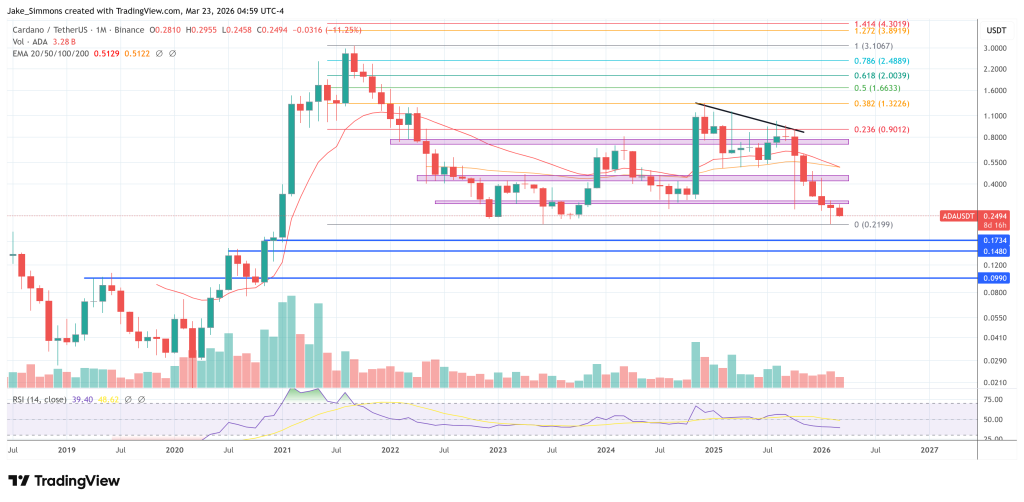
At press time, Cardano traded at $0.2494.