

Business leaders across Europe are no longer just watching the crypto market from the sidelines. Data shows that 42% of business investors already hold some form of digital currency. Another 18% of these institutional players say they plan to buy in soon.
This shift among companies is moving faster than many expected, yet the traditional banks they use every day are struggling to keep up.
While these banks see that the market is changing, very few have actually launched products to meet this demand. Only about 19% of financial institutions currently provide a way for their clients to buy or hold these assets.
This massive gap between what clients want and what banks offer is creating a new kind of friction in the European financial sector.
Banks are facing an internal crisis of expertise rather than a lack of interest. Reports indicate that most institutions know digital assets are important. In fact, 80% of them recognize the growing weight of this asset class.
The problem is they lack the staff and the budget to build the necessary systems. Many banks have not set aside the funds needed to hire experts or update their technology. Even with clear rules now in place through the Markets in Crypto-Assets regulation, banks are hesitating. They are stalled by their own internal hurdles.

Source: Boerse Stuttgart Digital
Meanwhile, their customers are becoming restless. Many people would rather keep their money in one place. Reports show that 27% of investors want to manage crypto through their current bank. Only 14% say they prefer using a dedicated crypto exchange.
Traditional Institutions Risk Losing Loyal Customers
The lack of action from legacy banks is starting to have real consequences for customer loyalty.
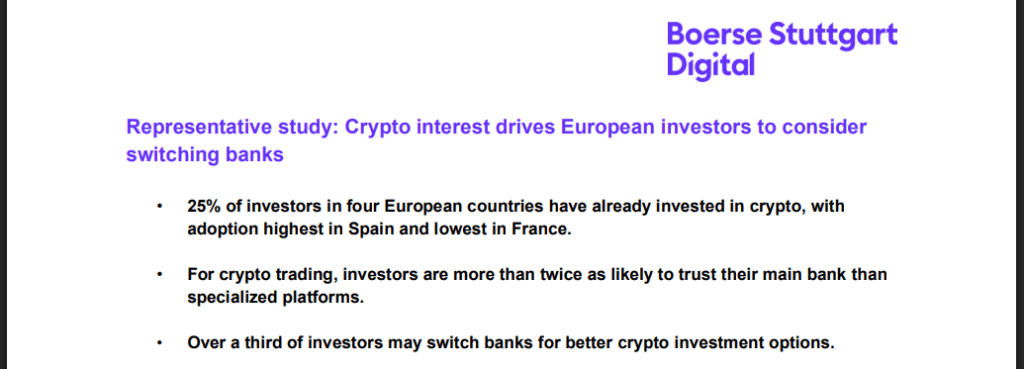
A Boerse Stuttgart Digital survey released Tuesday found that 35% of European investors would consider switching banks if another institution offered better cryptocurrency investment options.

This suggests that digital assets are now influencing how customers choose where to keep their money. People are tired of moving money between different apps and accounts. They want simplicity.
If a bank cannot offer a way to buy Bitcoin or other tokens, the customer will find a competitor who can. This is not just about young retail traders. It affects high-net-worth individuals and large corporations too.
The revenue that banks could make from fees is currently going to crypto-native platforms instead.
The data suggests that the window for banks to act is closing. Investors are already active in the market, with or without their help. Large numbers of retail users have already set up accounts on external exchanges.
These users are getting used to those platforms. Once a customer leaves a traditional bank for a crypto-friendly one, it is very hard to get them back. The cost of winning a new customer is high. Losing one over a lack of basic services is a self-inflicted wound.
Some banks are starting to realize this. They see the potential for new income. However, the majority remain stuck in the planning stages.
Clear Regulations Fail To Spark Immediate Bank Action
European lawmakers have already done their part by creating the MiCA framework. This provides a legal map for how digital assets should be handled. Usually, banks wait for this kind of clarity before they move.
But even with the rules written down, the pace remains slow. Reports note that the struggle is purely operational. It takes time to train staff. It takes even longer to ensure that security measures are tight enough to hold digital keys.
While the banks move slowly, the market moves fast. Investors are not waiting for their local branch to catch up. They are taking their assets elsewhere today.
Featured image from Pexels, chart from TradingView