



With Bitcoin futures’ monthly trading volume nearing $2T, this instrument, unsurprisingly, is attracting investors of all sizes. If you want in on this lucrative market, then this article is for you.
We start with the basic concepts, like how futures markets work, then move on to where you can trade futures. We also cover how to execute a trade and discuss trading strategies you can try, as well as common mistakes to avoid.
You’ll also learn about leverage and how it can allow you to open large positions with a small investment. Be careful, though, as this strategy can easily liquidate your position if the market moves against you.
By the end of this article, you’ll be more confident in trying out Bitcoin futures trading, either using real money or with virtual funds via a demo trading account.
Read on to learn how to maximize crypto exposure, profit from volatile markets, and enhance risk control.
What Are Bitcoin Futures?
Bitcoin futures refer to contracts to buy or sell Bitcoin at a predetermined price and date. In this type of contract, you don’t actually own the asset itself but rather just speculate on its future price.

The futures market is a little more complicated than the spot market, where you directly buy or sell an asset at the current market price.
With Bitcoin futures trading, you might encounter additional unfamiliar terms like the following:
Going Long vs. Going Short
When you go long or open a long position, you speculate that Bitcoin’s price will increase. This is the kind of position we demonstrated in the example above.
Shorting or going short, meanwhile, is where you bet that $BTC’s price will go down.
Here, you buy the crypto contract and sell it immediately at the current price (say $105K), then buy it back later after the price goes down (to $95K, for example). You can then pocket the $10K difference as profit.
Cash-Settled vs. Physically Delivered Contracts
This refers to how you get paid when the contract expires.
Cash-settled means that your profit or loss is paid in cash such as the US dollar or a stablecoin like $USDT.
Meanwhile, a physically delivered contract is settled with the crypto you’re making a speculation on; in this case, Bitcoin.
Perpetual Futures vs. Traditional Futures
Traditional Bitcoin futures contracts have an expiry date, which typically is monthly or quarterly. The contracts will then be settled when they expire.
In contrast, Bitcoin perpetual futures don’t have an expiry date, so you can hold your position indefinitely. But you need to have enough margin to keep it open, unless you decide to close it.
If your margin runs too low, the futures platform will liquidate your position instead (more on that later).
Also, note that there are funding fees (usually settled every eight hours). These are paid not to the exchange but between traders in perpetual futures.
If the funding rate is positive, those holding long positions may pay this fee to shorts. In case of a negative funding rate, shorts pay longs.
Funding fees are designed to help keep the contract price close to the spot price. For example, if the prices of perpetual futures are consistently high, this would suggest too much interest in long positions.
Because of this, the funding rate will turn positive, which incentivizes the longs to close their positions or open short positions.
Doing so brings down the prices of futures and closer to the spot price. Be aware of funding rates as they can eat into your profits.
How Do Bitcoin Futures Work?
To better illustrate how Bitcoin futures trading works, let’s use a fictional scenario. For the sake of simplicity, we’ll choose a perpetual futures contract so it doesn’t expire. We’ll also exclude fees and commissions from the equation.
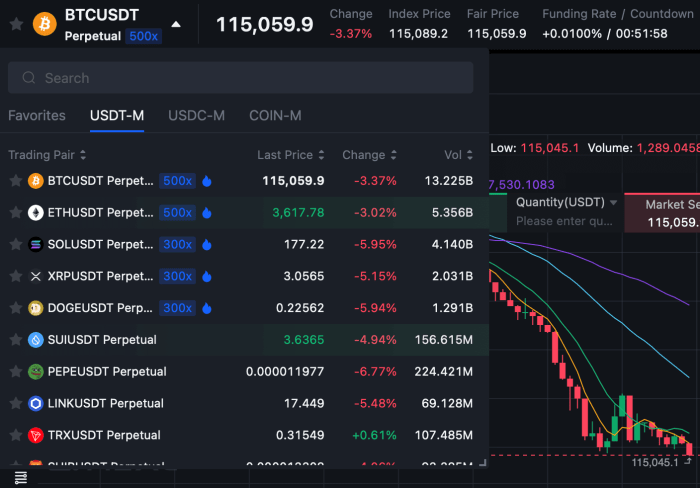 Imagine the current price of $BTC in the spot market is $100K, and you believe it will go up soon. You have $2K to invest, so you go to a Bitcoin futures trading platform and open a long position.
You might also choose to go with 50x leverage, which allows you to control a position 50 times the size of your initial $2K investment (so you’re actually sitting on a position worth $100K, despite your lower initial capital).
The platform might have a 2% initial margin (worth $2K for your $100K position). This will serve as the collateral to back your position so you can open the trade.
Now, having opened a position, you’ll see its value change in real-time. These continuous updates show you your unrealized profits or losses and they’re part of the mark-to-market (MTM) settlement, which constantly adjusts your position based on current market prices.
From here, your success will depend on the price movement of $BTC. If it indeed goes up and you close your position when its value reaches $105K for example, you’ll get a $5K profit. Combined with your $2K investment, you now have a total of $7K in your account.
However, if $BTC drops below $98.5K, your maintenance margin gets wiped out, and your position gets liquidated. In that case, you’ll love your $2K initial margin (your investment).
To summarize:
| Current $BTC Price | $100K |
| Position | Long (you expect the price to go up) |
| Initial Investment | $2K |
| Leverage | 50x |
| Total Position Value (50x leverage added) | $100K |
| Initial Margin | 2% (worth $2K) |
| Maintenance Margin | 0.5% (worth $500) |
| If $BTC Goes Up to $105K | You make $5K profit + your $2K investment |
| If $BTC Goes Down to $98.5K | Your maintenance margin runs out, liquidating your position. You lose your $2K investment. |
Remember the above scenario showcases trading perpetual futures, particularly for long positions. Perpetuals don’t expire, but there are funding and financing fees you’ll have to pay to open and maintain your position. As such, your net profit will be a little lower than the gross $5K profit.
These and other fees differ across platforms, so, for simplicity, we’ve not included them in our example calculations. You’ll learn more about them in the next section.
What Are the Fees Involved with Trading Bitcoin Contracts?
When you trade contracts, you’ll need to pay some fees. Knowing what these are is important to make sure you’re properly prepared to cover all trading-associated costs like:
- Spreads – The spread is the difference between the ask price (the lowest price sellers are willing to accept) and the bid price (the highest price buyers are willing to pay) for an asset. Having a tight spread (i.e., <0.5%) is ideal as it means you lose less money when trading.
- Maker and taker fees. This fee is charged based on your role in a trade: maker if you make an order and wait for someone to match it, or a taker if you buy immediately at the market price. In general, maker fees are lower than taker fees (e.g., 0.019% maker and 0.06% on Margex).
- Funding fees – When you trade perpetual futures contracts, you and other traders are required to pay this fee to keep the contract price close to the actual market price of the underlying asset (i.e., Bitcoin). These fees are paid in between traders, typically every eight hours.
- Overnight financing – If you use leverage, you’re borrowing funds from the platform. Now, if you hold that leveraged position for several days or weeks, the platform will charge this fee daily, with the cut-off time varying from platform to platform.
- Withdrawal and deposit fees – When you move your money out, exchanges will charge a withdrawal fee. Most platforms typically don’t charge deposit fees, but it’s still important to check.
- Inactivity fees – An exchange might charge you this fee if you don’t use your account for a certain amount of time (e.g., a year). The actual amount may vary from platform to platform with some charging a flat monthly fee.
Spot vs. Futures vs. Options: Which Trading Method Suits You?
You can trade crypto in the spot, futures, or options market.
The spot market is where you buy the crypto directly at the current market price, making it ideal if you’re a beginner. Here, you actually own the asset, so you can transfer, hold, or sell it if you prefer.
The futures market lets you enter into a contract to buy or sell crypto at a predetermined price, either on a set date (with traditional futures) or with no expiry date (with perpetual futures). You don’t own the asset in this case but rather speculate on how much it’ll be worth in the future.
Finally, the options market is similar to the futures market, except that here, you get the right but not the obligation to buy crypto at a set price and date.
The table below compares these trading methods along with their advantages and disadvantages. Here’s a balanced look to help you decide which is best for you:
| Trading Method | Pros | Cons | Best For |
| Spot |
|
|
|
| Futures |
|
|
|
| Options |
|
|
|
How to Choose a Bitcoin Futures Trading Platform
So far, we’ve covered what Bitcoin futures are, how they work, and how they differ from spot and options trading. Now, let’s discuss what to look for when choosing Bitcoin futures trading platforms:
Contract Types
Select an exchange that offers a contract type that suits your preferred trading method.
For example, one that trades perpetual contracts works great if you like short-term trading and no expiration dates, and don’t mind paying funding fees.
Also check contract specifications like expiration dates and settlement methods.
Spreads and fees
Ideally choose an exchange with tight spreads (those with <0.5% average spread) so you maximize profits on high-frequency trades.
Most of the platforms on our list in the next section offer excellent spreads.
Also, take into account the platform’s fees and commissions, as these could easily eat into your profits.
Liquidity
Deep liquidity means that you get the best prices via tight spreads, reduced slippage, and faster execution for better timing.
Make sure to check the exchange’s daily trading volume and order book depth.
Leverage and margin requirements
An exchange offering a high maximum leverage can help boost your profit potential, but be aware of the margin requirements so you can avoid liquidation.
When choosing, compare maximum leverage limits and initial margin requirements.
Regulated crypto platforms typically cap leverage at 3:1 to 50:1, while offshore exchanges may offer 100:1 or higher for more aggressive trading.
User experience & interface
Advanced tools are great, but beginners should feel comfortable using the interface as well. Not to mention, a well-laid-out interface can help you easily find what you need (e.g., topping up your account, choosing a leverage) in less time.
It’s also worth checking the platform’s availability across different interfaces.
Desktop apps are great for market research and chart visualization, but mobile apps are equally important if you plan to trade and check balances on the go.
Demo and copy trading
Demo trading is a great feature regardless of your experience level as it allows you to practice trading or try out strategies without using real funds.
Meanwhile, copy trading lets you use trades of more experienced investors making it fantastic if you’re still learning how to buy Bitcoin futures.
Risk management tools
Trading Bitcoin futures is riskier than spot trading, so ensure that your preferred exchange has risk management tools.
These include stop-loss orders and negative balance protection, which help prevent you from losing more money than you have.
Security
At the very least, choose a platform with security features like 2FA to help protect your account.
Also, consider an exchange that keeps your funds in cold storage to protect them from hacking.
Insurance and reserve funds are also essential too to secure your funds and the platform, particularly in volatile markets.
These are the same criteria we used to assess and recommend our top picks in the section below.
Where to Trade Bitcoin Futures? Best Platforms Compared
You can trade Bitcoin futures on various crypto exchanges, though not all platforms are made equal.
While all exchanges facilitate crypto trading, they differ in various areas, such as the maximum leverage, fees, and contract types. Their order book depth is also essential, since you want to trade on an exchange with less slippage and tighter spreads.
With all of this in mind, here are our top platforms to trade Bitcoin futures compared:
| Broker | Max. Leverage | Fees | Order Book Depth | Contract Types | Best For |
| Margex | 100x | – Maker: 0.019% – Taker: 0.06% |
Excellent (<0.5% average spread) | – Perpetual | Beginners |
| CoinFutures | 1000x | – PnL: approx. 5% of total profit, plus 0.5% per extra hour bet is open, or – Flat: 1–3% of wager |
N/A | – Perpetual-style (no expiry; simulates perpetual contracts) | High-speed, gamified crypto futures trading |
| MEXC | 500x | – Maker: 0% – Taker: 0.02% |
Fair (>0.5% but <2% average spread) | – Traditional – Perpetual |
Traders who want one of the highest leverages possible |
| OKX | 125x | – Maker: 0.02% – Taker: 0.05% |
Excellent (<0.5% average spread) | – Traditional – Perpetual |
Automated trading with bots |
| Binance | 125x | – Maker: 0.02% – Taker: 0.05% |
Excellent (<0.5% average spread) | – Traditional – Perpetual |
Trading in the largest crypto exchange |
| BloFin | 150x | – Maker: 0.02% – Taker: 0.06% |
Excellent (<0.5% average spread) | – Perpetual | No-KYC crypto trading |
| KCEX | 100x | – Maker: 0% – Taker: 0.02% | Excellent (<0.5% average spread) | – Perpetual | Chance to win up to 1,800 $USDT daily via Futures Trading Competition |
| Bybit | 100x
(200x with Smart Leverage) |
– Maker: 0.02% – Taker: 0.055% |
Excellent (<0.5% average spread) | – Traditional – Perpetual |
Access to over 600 trading pairs |
Margex is our top pick because it’s well-suited to beginners. Thanks to its clean layout, beginner guides, and video tutorials, you’ll be able to learn how to trade Bitcoin futures within minutes.
Plus, the platform has no KYC requirements for crypto deposits and withdrawals. This is ideal if you prefer to maintain your privacy when trading.
While the platform doesn’t offer demo trading, you’ll get a $50 sign-up bonus to get your trading journey started.
If you’re a more seasoned trader, though, other exchanges might be a better fit for you. MEXC, for example, offers higher leverage (up to 500x), some of the lowest maker/taker fees, and both traditional and perpetual contracts for extra flexibility.
How to Trade Bitcoin Futures: Step-by-Step Guide
Ready to trade Bitcoin futures? You can get started right away by following these steps:
Step 1 – Select an Exchange
First, choose an exchange that lets you trade Bitcoin futures. We’ll be using Margex as an example, but the same steps apply to other crypto exchanges.
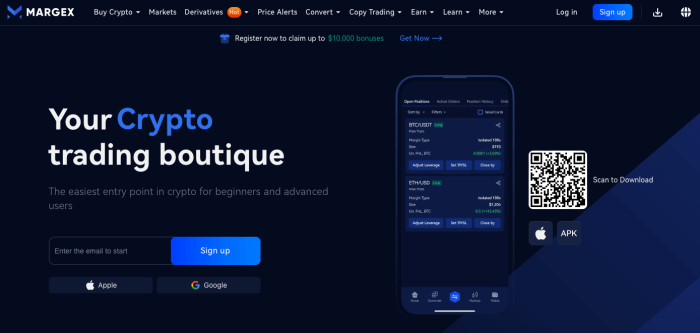 We chose Margex here because it’s the best for beginners. It only features one Bitcoin trading pair (BTC/USD), doesn’t require KYC verification for depositing or withdrawing crypto, and has a user-friendly interface.
Step 2 – Create an Account
Head to the official Margex exchange website to sign up. Margex lets you create an account with your email, Gmail account, or Apple ID. Follow the on-screen instructions to complete your registration.
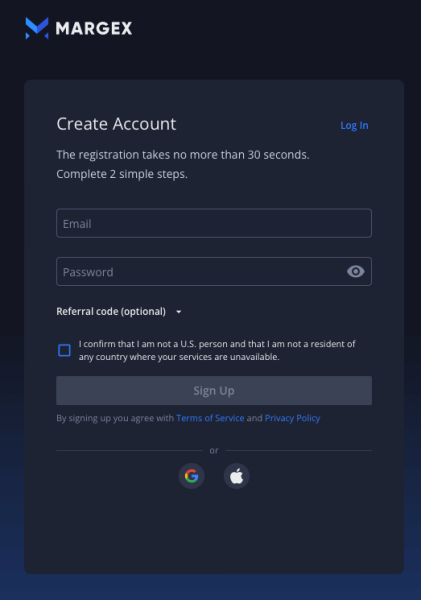 Because the platform doesn’t require KYC verification, you can trade almost immediately. However, take note that you need to get verified if you want to deposit or withdraw fiat on Margex.
Step 3 – Deposit Funds
Before you can open a position, you must first deposit funds into your account. On Margex, you can do this via the ‘Deposit button’ in the upper-right corner.
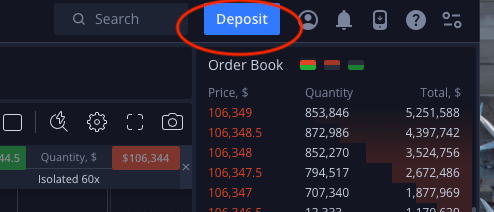 Next, select the cryptocurrency you want to deposit (in this case $BTC), choose the network the coin is on (Bitcoin), and copy the deposit address given by Margex.
Open your crypto wallet and set up the transfer using the address you copied.
Step 4 – Select Your Trading Pair
Find the ‘Derivatives’ tab at the top of the page and click the ‘Perpetual Futures’ page.
On the next page, select your trading pair from the far left corner of the trading terminal.
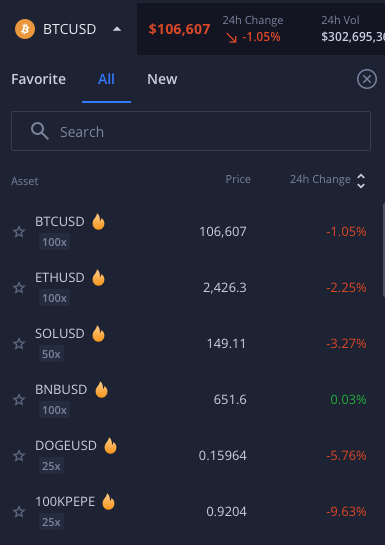 Margex has a BTC/USD pair with up to 100x leverage available.
Step 5 – Place an Order
Now you can set the specifics of your order, including the following:
- Position (long/short)
- Order size
- Order type (limit, market, stop-market)
- Limit price (for limit and stop-market orders only)
- Margin mode (cross, isolated)
- Leverage
 After setting up your order, confirm it to proceed to the next step.
Step 6 – Wait for the Order to Execute
Your order will be executed depending on your order type:
- Limit – Executes at the price you chose or better;
- Market – Executes at the current market price;
- Stop-market – Executes exactly at the price you chose.
When a trade is executed, you’ll see it at the Orders and Positions management section at the bottom of the trade interface.
Step 7 – Close your position
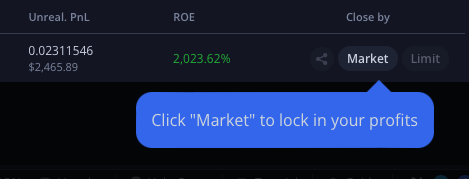
To lock in your profit, you must then close the position. You can do this manually, by clicking on the Market button, or automatically, based on the limit you set previously.
Futures Trading Risk Mitigation Techniques and Tips
The crypto market is highly volatile, which makes trading especially risky if you go for futures. You could be winning one moment and then seeing your position get liquidated in the next.
The good news is that you have ways to mitigate risk and protect profits. Consider the following tips:
- Start small. This involves using only a small part of your capital on each trade (1–2%). Also, limit your total portfolio risk to just 6–8% across open positions. Doing these can help you avoid big losses.
- Choose a low leverage. It can be tempting to select the maximum leverage in the hopes of taking home a huge profit. But if you’re a beginner, try a conservative approach and start with a low leverage. This is especially important for highly volatile assets.
- Prepare your stop-loss and exit strategies. Whether you’re winning or losing, always know when to get out of a trade. You can set stops based on current chart levels rather than targeting a round number (e.g., $901.22 instead of $900).
- Diversify. While trading $BTC futures is attractive considering Bitcoin’s status, you should diversify your contracts, assets, and strategies. Consider also spot trading, trying other cryptos, and mix going long with day trading or scalping to minimize risk exposure.
- Maintain a margin below 50% of your available funds. For example, invest no more than $5K if you have $10K in your account. This gives you some breathing room if the market moves against you and helps you avoid liquidation.
- Keep your emotions in check. It can be easy to panic when the market is down or be greedy when it’s up. Having specific profit goals can help you exit a trade rather than risk whatever money you have already made.
Popular Futures Contract Trading Strategies
Trading futures contracts can be difficult, especially if you’re a complete beginner. But with the following strategies, you’ll be able to reduce guesswork, manage your risk, and adjust your approach depending on current market conditions.
Directional Strategy
As the name would suggest, this is where you take a position based on your expected price movement of an asset. You either go long if you predict that the asset’s price will go up or long if you predict the opposite.
You use this strategy if you want to profit from a strong upward or downward price trend. Here, you essentially follow where the trend is heading, which you can determine using indicators like moving averages (MA) and the relative strength index (RSI).
- Managing Your Risk: In this strategy, it’s ideal to place your stop-loss below support if you’re going long or above the resistance level if you’re going short.
- When to Exit: Consider exiting your position at the resistance/support zones or when the indicators tell you the trend is starting to weaken.
Breakout Trading
When the pair’s price breaks through key support or resistance levels, this suggests the beginning of a strong new trend. You then enter a trading position when this breakout happens, thus the strategy’s name.
Breakout trading is best suited to periods of high volatility. If you get it right, you could be in for a good payday.
- Managing Your Risk: Placing your stop just outside the breakout zone will help you avoid false breakouts or fakeouts.
- When to Exit: When there’s a sudden drop in volume, this can signal slowing momentum, making it the ideal time to exit. You can also refer to MAs to know when to exit (e.g., when the price goes below the MA if you’re long, or when it goes above it if you’re short.
Mean Reversion Scalping
This strategy lets you take advantage of extreme moves in a pair’s price before it reverts to its mean or average price.
To determine your entry point, you can refer to the RSI and the price that is far from its moving average.
You can use this if you can react quickly to price changes whether the asset’s price is going up or down.
- Managing Your Risk: Place your stop-loss just outside the most recent extreme price movement.
- When to Exit: You can do this when the price starts to return to its average based on indicators like RSI or moving averages.
Spread and Arbitrage
More advanced traders use this when they notice that there’s a huge spread between two contracts. Here, you aim to profit from the spread or price difference between two BTC/USD contracts with different expiry dates.
To do this, you go long on a contract you believe is overvalued and go short on one you believe is undervalued. For example:
- You buy/go long on a 1 $BTC contract for September, which trades at $105K, believing it will go up.
- You sell/go short on a 1 $BTC contract for October, which trades at $108K, believing it will go down.
When done right, you can profit from the tighter spread once you close your positions on both contracts. For example, if the September contract eventually ends up at $106K and the October one is $107, these will translate to a $1K profit for each contract, bringing your total profit to $2K.
- Managing Your Risk: Use equal position sizes (e.g., 1 $BTC long and 1 $BTC short) to ensure balanced exposure and you’re only trading the spread between the two contracts.
- When to Exit: Close your positions when the spread narrows or when you hit your profit target.
Pullback Trading
In this strategy, you enter the trade when $BTC’s price goes against the trend (e.g., temporarily dipping in an uptrend, temporarily going up in a downtrend). This counter-trend move is also known as a pullback.
For example, if you buy $BTC when you see its price drop during a strong uptrend, it’s called ‘buying the dip’. Meanwhile, selling the crypto when it temporarily goes up during a strong downtrend is referred to as ‘selling the bounce’.
Pullback trading is perfect if you’re a risk-conscious trader who prefers to plan your entry carefully rather than react emotionally to a trend.
- Managing Your Risk: Place your stop just beyond the recent low in an uptrend or recent high in a downtrend.
- When to Exit: Do this at the previous high or low swing or when you see the momentum fading.
Common Mistakes to Avoid
Trading futures is risky because you’re essentially trying to predict the price movements of an asset.
The use of leverage further amplifies this risk since even the tiniest mistakes can have a massive impact.
Here are several common but totally avoidable mistakes you need to be aware of:
1. Over-leveraging positions
Just because an exchange gives you 100x leverage doesn’t mean you have set it to max. Aim for just around 2x to 5x leverage (or no leverage) when starting out.
The gains may be small but they do add up over time without risking liquidating your account.
2. All-in mentality
Contrary to what some may think, futures trading is different from gambling. Instead of going all in hoping that a trade will work in your favor, risk only 1–2% of your capital with each trade.
3. Emotional trading
FOMO is a real thing when you’re trading, pushing you to buy just because everyone’s doing it.
To avoid this, create your own trading plan and stick to it. Focus on technical indicators rather than market hype.
4. Not taking the time to study technical analysis
You may not want to read charts but it’s an essential skill to learn how to spot support/resistance levels, trend lines, RSI, and other common trading indicators.
These help you eliminate guesswork and create a more solid strategy for when to enter or exit a trade.
5. Ignoring market context
A well-read trader is a good trader. This is why it helps to read news that is relevant to the market and check the economic calendar, especially since $BTC usually reacts strongly to macroeconomic news.
6. Corelation blindness
It’s worth mentioning that just because you have open trades in altcoins like $ETH and $SOL doesn’t mean you’ve diversified your strategy.
That’s because these are often correlated with $BTC, so if Bitcoin slides, you can expect your altcoins to do the same.
7. Neglecting funding costs
Always check the funding rate before you open a position. And if you’re holding a position long-term, take into account this cost. Doing so will prevent funding fees from eating into your profits.
8. Not practicing first
Trading futures contracts is typically reserved for more experienced traders because of the risks involved. That’s why it helps to practice first before you jump into this market.
Platforms like Bybit offer demo trading that will allow you to learn the ropes and try out strategies without using real money.
9. Not using stop-loss orders
As the name suggests, this order is an effective tool for preventing further losses in a negative trade. Consider using stop-losses when trading highly volatile assets like $BTC.
Wrapping Up Our Guide on Bitcoin Futures Trading
To summarize, trading Bitcoin futures lets you bet on future price movements of the world’s most valuable cryptocurrency. You can either go long when you think the price will go up or short when you believe the price will go down.
Leverage is one of the defining elements of futures trading. This allows you to open a position that’s larger than your available capital. But be careful when using this; while it can amplify your profits, it can do the same with your losses.
This is where various trading strategies and awareness of common futures trading mistakes can help manage risk. By combining the two, you increase your chances of profiting from your trades and avoid losing the money you already have invested.
When you feel comfortable with this more advanced type of crypto trading, then you can consider trading on Margex. With only one Bitcoin trading pair, user-friendly interface, excellent spread, and fairly low maker and taker fees, it’s the best Bitcoin futures trading platform for beginners.
If you want to start trading with real money, always remember to trade smart. Use stop-loss orders, technical indicators, and trading strategies we discussed here to minimize downsides and emotional trading.
Crypto trading is high risk, so always do your own research. This information isn’t investment advice.
FAQs
1. What is the best way to trade Bitcoin futures?
The best way to trade Bitcoin futures depends on things like your investment goals and risk tolerance. But in general, it’s ideal to use leverage conservatively and to get your emotion out of your trading decisions.
Using tried and true strategies, like the ones we outlined in our section on ‘Popular Futures Contract Trading Strategies’ can help with that.
2. What are Bitcoin futures?
Bitcoin futures are financial contracts that let you speculate on Bitcoin’s price without actually owning the crypto.
Such a contract is essentially an agreement between you and an exchange to buy or sell Bitcoin at a predetermined price and date. You can trade Bitcoin futures on crypto exchanges like Margex and BloFin.
3. How do you trade $BTC futures?
To trade $BTC futures, you first need to make an account on a crypto exchange that offers futures trading, like Binance. Then, fund your account, navigate to the derivatives or futures section, and set up an order on BTC/USD, BTC/USDT, or similar Bitcoin pairs.
This article’s section on ‘How to Trade Bitcoin Futures: Step-by-Step Guide’ covers the steps in closer detail.
4. Can you trade Bitcoin futures in the US?
Yes, but make sure you trade on a US-regulated platform. Doing so will ensure you get legal protection and prevent your funds from potentially being frozen if you use an unapproved offshore exchange.
