



Solana futures are heating up fast. Open interest has surged past $11B at the time of writing, while derivatives volume on $SOL contracts hit $28B+ in a single day – nearly a 59% spike. Clearly, traders are treating Solana like more than just an alt L1. It’s becoming a prime battleground for leveraged plays.
So, how do you get in on the action?
In this guide, we’ll walk you through everything you need to know to start trading Solana futures confidently. From how the contracts work and what makes them different from spot or Solana options trading, to where to trade them, what fees to watch for, and how to manage risk like a pro.
Whether you’re new to derivatives or want to refine your edge, this page will help you understand the Solana futures market and make smarter trading decisions in 2025.
What Are Solana Futures?
Solana futures are contracts that let you speculate on the future price of $SOL, without actually owning any $SOL tokens.
Instead of buying and holding the asset, you agree to buy or sell it at a fixed price on a specific date. It’s essentially a bet on whether $SOL is going to pump or dump. If you’re right, you profit. If you’re wrong, you take the loss. And because most crypto futures platforms offer leverage, you can open a much larger position than your capital would allow.
This gives traders more flexibility: you can go long if you think $SOL will rise, or short if you think it’ll fall. That’s something you can’t do with spot trading unless you’re borrowing assets.
Unlike spot purchases where you physically own and can withdraw the crypto, a futures contract is just a price agreement. Your exposure is synthetic, but the gains (and losses) are very real.
Key Terms You’ll See
- Underlying asset: The asset that the futures contract is based on. In this case, $SOL, the native token of the Solana blockchain.
- Contract size: The amount of $SOL each futures Solana contract represents. On some exchanges, it’s 1 $SOL per contract;, on others, it might be fractional.
- Expiration date: The date when the Solana contract settles. Some futures expire quarterly or monthly.
- Settlement: What happens when the contract ends. Either it’s cash-settled (you receive or pay the difference in USD/$USDT), or physically-settled (you get actual $SOL, rare in crypto).
- Leverage: The ratio of borrowed funds to your own capital. If you use 10x (also expressed as 1:10) leverage, you control $1,000 worth of $SOL with just $100 in margin.
- Mark price: A fair value estimate based on spot index prices and funding rates. It’s used to trigger liquidations and calculate unrealized Profit and Loss (PnL).
Perpetual vs Traditional Solana Futures
There are two main types of $SOL futures you’ll come across:
- Perpetual contracts: These don’t expire. They stay open as long as you want, unless your position gets liquidated or you close it manually. Exchanges use a funding rate system to keep their prices aligned with the spot market.
- Traditional futures: These do expire, often monthly or quarterly. At expiration, the contract is settled either in cash or, very rarely, in $SOL itself.
Are These Regulated?
Yes, well, kind of. Solana futures, like all crypto derivatives, fall under the “complex financial instruments” umbrella in Europe under MiFID II rules. Similar frameworks exist in the US (CFTC), Australia (ASIC), and Canada (CSA).
Some of these rules require platforms to assess your trading knowledge before you’re allowed to access futures markets. That’s why you’ll often see quizzes or disclaimers during sign-up.
Depending on your region, you might also face:
- Leverage caps (e.g., 2x–30x for retail traders): Limits how much you can amplify your position to reduce risk.
- Position limits: Restricts how large your open futures positions can be at one time.
- Higher margin requirements: Requires you to lock up more collateral per trade to cover potential losses.
- Retail vs. Professional classification: Retail traders get tighter restrictions, while pros may access more leverage and features, but need to meet strict criteria.
On the flip side, offshore platforms like MEXC or CoinFutures can offer higher leverage (up to 500x or even 1000x) and no-KYC trading.
But these typically operate outside formal regulatory oversight, meaning less investor protection if something goes wrong.
In short: Solana futures let you make directional bets on $SOL’s price with flexibility and leverage. But they’re also complex, risky instruments designed for active traders, not for set-it-and-forget-it investors.
How Do Solana Futures Work?
Trading $SOL futures is all about taking a directional bet on the price of Solana, using leverage. Instead of buying $SOL outright, you put down a fraction of the total value (called margin) and control a much larger position size. This setup means you can profit faster… but also lose faster if the market moves against you.
Let’s say you want to go long on $SOL because you think it’s going to pump next week. Rather than buy $SOL directly, you enter into a futures contract at, say, $175 per token.
If the price jumps to $200, you pocket the difference multiplied by your contract size, minus any fees and funding costs. But if it drops to $150, you’re on the hook for the loss.
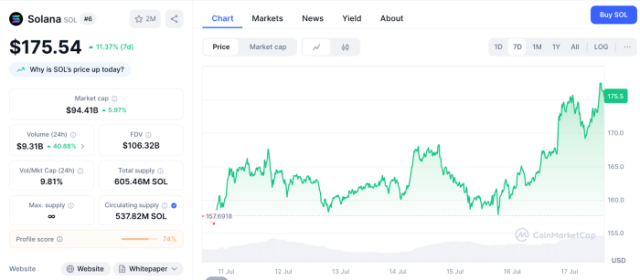 The initial margin is your upfront commitment, usually 1% to 20% depending on the platform and your leverage settings.
Then there’s the maintenance margin, which is the bare minimum required to keep your position open. If your account balance dips below that because of losses, the exchange force-closes your trade. That’s called a liquidation, and yes, it stings.
Futures trades are settled using something called the mark price, not the last traded price. The mark price is based on a calculated fair value of spot $SOL across major exchanges and is necessary to prevent whales from triggering liquidations with spoof orders (large fake orders placed to manipulate price sentiment, then canceled before execution).
If you’re trading perpetual contracts (the most popular kind), you’ll also pay or receive funding fees every few hours. These are small payments exchanged between longs and shorts to keep the futures price in line with the spot price. If lots of people are bullish, longs will typically pay shorts, and vice versa. It’s not huge, but if you hold a big position for days, it adds up.
Meanwhile, traditional futures, the kind with expiry dates, don’t have funding fees, but they do need to be rolled over if you want to keep your exposure past the expiry. This just means closing your current contract and opening a new one further out.
Now, to see how this all works in practice, let’s walk through a real-world example.
You’ve got $200 in your account and want to long $SOL using 50x leverage. The current price is $175.
- Total position size: $200 × 50 = $10,000
- Number of contracts: $10,000 ÷ $175 = ~57.14 $SOL
- Entry price: $175
- Target price: $190
If $SOL hits $190:
- Your position is now worth 57.14 × $190 = $10,856.60
- Profit = $856.60 minus trading fees and any funding charges
- Return on capital = +428%
But if $SOL dips to $167 before recovering:
- Position value = 57.14 × $167 = $9,545.38
- Unrealized loss = $454.62
- Since this wipes out more than twice your margin ($200), your position gets liquidated unless you’ve topped it up
This shows how a small move against you, less than 5%, can kill a leveraged trade. Even if your call is right overall, poor entry timing or lack of risk controls can ruin it. That’s why setting stop-losses and sizing positions carefully is non-negotiable.
What Are the Fees Involved with Trading Solana Futures Contracts?
Trading $SOL futures isn’t free, even if it feels like you’re just moving numbers on a screen. Here’s a breakdown of the key costs you’ll need to factor in before opening a position.
- Maker/taker fees: Every trader is charged a small fee, typically 0.01%–0.05% for makers (limit orders) and 0.02%–0.075% for takers (market orders). These can vary depending on your VIP level or 30-day volume.
- Funding rates (perpetual contracts only): A small fee paid between longs and shorts every 8 hours. If you’re long and the funding rate is positive, you pay. If it’s negative, you get paid.
- Spreads: The gap between the bid and ask price. Wider spreads = higher cost to enter/exit, especially on low-liquidity pairs or smaller exchanges.
- Liquidation fees: If your position gets auto-closed by the platform, expect an additional charge, often around 0.3% to 0.5% of the position value.
- Withdrawal fees: These don’t apply to your trades directly, but getting your crypto off the platform will usually cost a fixed amount in network fees, depending on whether you’re withdrawing $SOL, $USDT, or another asset.
- Conversion slippage: If you fund your account in $BTC or $ETH and need to convert to $USDT or another margin asset, you may lose a small % on the internal conversion rate.
- Inactivity fees: Rare for crypto derivatives platforms, but worth checking. Some offshore exchanges charge small monthly fees after 6–12 months of no trading activity.
Fees can eat into your edge quickly, especially with high leverage or frequent trades. Always read the fine print on your chosen platform’s fee page and calculate how much your position needs to move before it’s actually profitable.
Spot vs. Futures vs. Options: Which Solana Trading Method Suits You?
There’s more than one way to trade $SOL, and each method comes with its own vibe, strategy, and level of risk.
Here’s a quick overview…
Spot trading is the most straightforward. You buy $SOL at the market price and actually own the asset. You can withdraw it, stake it, or just sit on it and hope for a moonshot.
Futures trading lets you speculate on the price of $SOL using leverage. You don’t own the token; you’re just betting on the price movement. This opens the door to shorting and bigger positions, but also bigger risks.
Solana options trading gives you the right, but not the obligation, to buy or sell $SOL at a specific price in the future. It’s more complex, with pricing influenced by volatility, time decay, and other factors. But it also allows for advanced strategies like hedging and spreads.
So which method suits you best? Here’s how they stack up:
| Trading Method | Pros | Cons | Best For |
| Spot | ✅ Own actual $SOL
✅ Can stake, lend, or use in DeFi ✅ No liquidation risk |
❌ No leverage
❌ No profit on downside moves ❌ Slower capital growth |
Long-term holders, crypto beginners, passive investors |
| Futures | ✅ Trade with leverage (e.g. 10x, 50x)
✅ Go long or short ✅ High capital efficiency |
❌ Liquidation risk
❌ Requires active management ❌ Funding fees (for perpetuals) |
Active traders, swing traders, scalpers |
| Options | ✅ Strategic flexibility (hedging, spreads)
✅ Defined risk (you can’t lose more than the premium) ✅ Can profit from volatility, not just direction |
❌ Complex pricing (volatility, Greeks)
❌ Steep learning curve ❌ Lower liquidity on $SOL options |
Advanced traders, hedgers, volatility-focused strategies |
Each approach has its place, and plenty of traders combine all three depending on the market. If you’re just getting started, spot trading is the easiest on-ramp. If you’re looking for more firepower, and know how to control the burn, futures and options can take your strategy to the next level.
How to Choose a Solana Futures Trading Platform
Solana futures trading can be fast-paced and high-stakes, so picking the right platform isn’t just about brand recognition; it’s about choosing the right tool for how you trade.
When we ranked the top platforms for Solana futures, we used the same key metrics you’ll find below. So you can trust that our reviews weren’t just pulled from promo pages. They’re based on actual performance, trading conditions, and features that matter.
Regulation
If you’re moving serious capital, look for platforms that operate under trusted regulatory oversight. Licensed exchanges like Binance (under VARA and other regional bodies) offer better fund protection, dispute resolution, and security protocols. That said, offshore exchanges like MEXC or CoinFutures trade regulation for flexibility: higher leverage, no KYC, and easier access, but come with more risk.
Spreads and fees
Tight spreads and low fees can make or break your strategy, especially if you scalp or trade frequently. For example, MEXC offers 0% maker and 0.02% taker fees, which means more profits stay in your pocket. In contrast, CoinFutures uses a flat PnL-based fee model – great for short-term punts but expensive for larger positions. Always read the fine print.
Liquidity
Deep liquidity means better fills and less slippage, especially important for high-leverage or large-volume trades. Binance consistently tops global futures volume and has excellent order book depth on SOL/USDT. OKX also performs well on major pairs. Platforms with low liquidity can cause unexpected price spikes or poor execution.
Available contract types
Not every platform offers the same instruments. If you want to trade Solana perpetual futures, most platforms like OKX, MEXC, and Binance have you covered. But if you’re into options or quarterlies, your best bet is Binance or OKX. If you just want quick directional bets with fixed multipliers, CoinFutures is a simpler, no-frills alternative.
Leverage and margin requirements
Leverage gives you firepower, but it’s a double-edged sword. Regulated platforms usually cap leverage between 20x and 50x. MEXC offers up to 500x on select pairs, while CoinFutures pushes the envelope with 1,000x prediction contracts. High leverage isn’t for everyone. If you’re just starting out, stick to lower ratios like 5x–10x and always use stop-losses.
Risk management tools
Make sure your platform offers proper risk controls: things like stop-loss orders, take-profit limits, trailing stops, and especially negative balance protection. Platforms like BloFin and Margex offer strong coverage here, which helps reduce the chance of losing more than your deposit during wild market swings.
Platform features
Want more than just Buy/Sell? Look for tools like copy trading, grid bots, or multi-collateral support. OKX offers a full suite of automated strategies. Binance supports advanced order types and margin modes. Some platforms like BloFin even provide demo accounts so you can test setups with zero risk.
Account types
Beginners benefit from simple UIs and low minimum deposits, while advanced traders need pro tools, APIs, and cross-margin setups. Margex keeps things clean and beginner-friendly. OKX and Binance offer separate pro dashboards for high-frequency or institutional traders. Choose a platform that matches your experience level.
Security & reputation
Security is non-negotiable. Look for platforms with 2FA, cold wallet storage, and insurance funds to cover user losses from platform failures. Binance has a solid (though not perfect) track record with the SAFU fund, while MEXC and BloFin also offer transparency reports and account-level protections. Do a quick search for past hacks or downtime.
User experience & interface
If the interface feels clunky, your trading will be too. Whether you’re new or pro, UX matters. OKX and CoinEx have sleek dashboards and mobile apps for smooth execution. Platforms like Binance can feel overwhelming to first-timers but offer powerful depth once you’re used to the layout. Test a few UIs before committing real capital.
Where to Trade Solana Futures? Best Platforms Compared
If you’re looking to long or short $SOL with leverage, you need a crypto futures exchange that offers deep liquidity, tight spreads, and robust trading tools.
But with so many platforms offering different margin models, fees, and leverage levels, the real question is: which one suits your style?
Below is a side-by-side comparison of the top platforms for trading Solana futures, including their fee structures, max leverage, and who they’re best for.
| Broker | Max. Leverage | Maker/Taker Fees | Order Book Depth | Contract Types | Best For |
| MEXC | 500x | 0.00% / 0.02% | Deep | USDT-M, COIN-M | Traders wanting high leverage & 0% maker fees on $SOL |
| OKX | 100x | 0.02% / 0.05% | Very deep | USDT-M, COIN-M, Options | Hands-off traders using bots, copy trading & a polished mobile app |
| Margex | 100x | 0.019% / 0.06% | Moderate | USDT-M Futures | Low-volume traders seeking simple UI & competitive fees |
| BloFin | 150x | 0.02% / 0.06% | Moderate | USDT-M Futures | Diversified traders needing multi-collateral margin & strong security |
| CoinFutures | 1,000x | 1-3% flat or 5% PnL + 0.5%/hour | No order book – prediction-based pricing | Prediction Contracts | Simplified high-leverage prediction trading without order books or KYC |
| Binance | 125x | 0.02% / 0.05% | Very deep | USDT-M, COIN-M, Options | Experienced traders needing deep liquidity, options, and margin flexibility |
| CoinEx | 100x | 0.03% / 0.05% | Moderate | USDT-M Futures | Newcomers and analysts wanting trading insights & moderate leverage |
MEXC remains our top pick for trading Solana futures thanks to its 0% maker fees, up to 500x leverage, and consistently high liquidity on major pairs like SOL/USDT. It’s built for active traders who want capital efficiency without getting wrecked on fees.
And with both USDT-M and COIN-M contracts available, you can run anything from short-term momentum trades to long-term hedges with flexibility.
That said, your best pick depends on your trading style.
If you’re into automation, OKX is hard to beat with its built-in trading bot marketplace, copy trading, and a slick mobile app. Prefer simple, fast bets without KYC? CoinFutures lets you take high-leverage prediction trades (up to 1,000x) without dealing with traditional order books.
And if you’re looking for top-tier liquidity, advanced order types, and multi-asset margin support, Binance still delivers one of the most complete futures setups in the game.
It really comes down to how you trade, and what matters most: speed, control, or sheer firepower.
How to Trade Solana Futures: Step-by-Step Guide
Trading Solana futures might sound complex, but once you’ve picked the right platform, the actual process is surprisingly straightforward. Below is a step‑by‑step walkthrough to help you get started – from setting up your account to placing your first leveraged trade.
Step 1 – Select an Exchange
Choose a futures exchange that supports Solana contracts.
MEXC is our top pick, as it offers up to 300x leverage on Solana, zero maker fees, strong liquidity for SOL/USDT, and a smooth interface for beginners and advanced users alike.
 Step 2 – Create an Account
- Go to the MEXC website or install the mobile app.
- Click ‘Sign Up,’ enter your email or phone number, and set a strong password.
- You’ll receive a verification code. Enter it to confirm.
- Complete KYC by uploading your government ID and a selfie. This takes a few minutes and gives you full access to futures markets.
- Once approved, you’re almost ready to trade.
Step 3 – Futures Trading Quiz / Qualification
Some regions (EU, UK, Australia, Canada, US) require a brief knowledge quiz before you can trade complex instruments like futures or options.
- This is part of MiFID II in the EU. A standardized test to ensure traders understand leverage, risks, and fees.
- Other markets use similar checks to prevent inexperienced users from taking on excessive risk.
On MEXC, you might encounter questions about your trading experience or margin awareness. Answer truthfully to qualify – this step takes just a few minutes.
Step 4 – Deposit Funds
Click the blue ‘Deposit’ button at the top right of the screen. You’ll see several funding options in the dropdown menu.
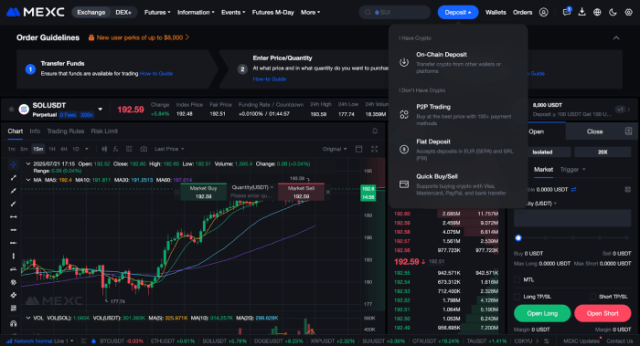 If you already have crypto, choose ‘On-Chain Deposit’ to transfer $USDT or another token from an external wallet or exchange.
If you don’t, pick from:
- ‘P2P Trading’ to buy $USDT directly from other users,
- ‘Fiat Deposit’ to fund via SEPA or PIX,
- or ‘Quick Buy/Sell’ to purchase using Visa, Mastercard, PayPal, or bank transfer.
Once you’ve selected your preferred method, follow the on-screen steps to deposit funds into your MEXC wallet.
Step 5 – Transfer to Futures Wallet
Go to Wallet → Futures section.
Click Transfer, move $USDT from your Spot wallet into your Futures wallet.
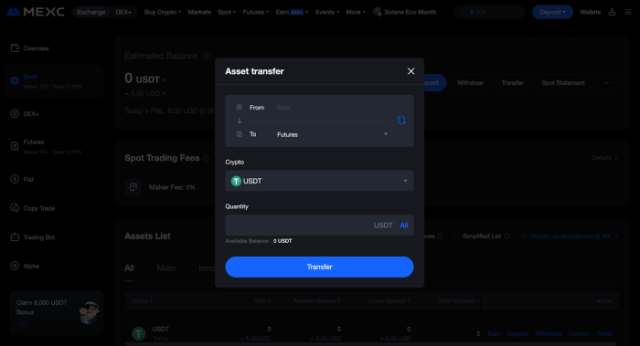 That’s it. Your account is now ready for contract trading.
Step 6 – Select a Solana Futures Contract
Head to the Futures tab and search for ‘SOL’ to view all available Solana contracts. You’ll see multiple options:
- SOL/USDT Perpetual – USDT-margined, no expiry
- SOL/USDC Perpetual – USDC-margined, ideal if you prefer stablecoin diversification
- SOL/USD COIN-Margined – Settled in $SOL itself, for those holding spot $SOL and looking to hedge or earn more $SOL
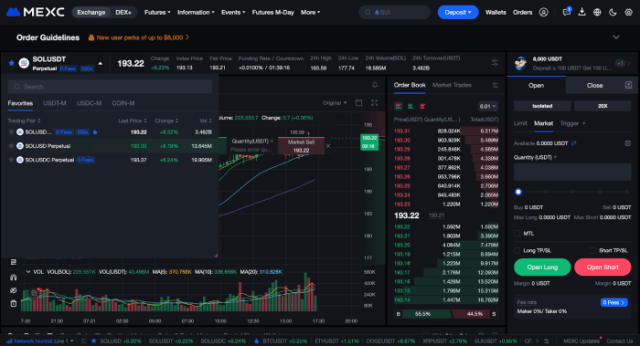 Choose the contract that matches your margin preference. Most traders stick with USDT-M for simplicity, but COIN-M and USDC-M give you more flexibility depending on your strategy and collateral.
Step 7 – Choose Leverage
Under the contract details, select your desired leverage (e.g., 10x, 50x, up to 300x – 500x isn’t available on $SOL).
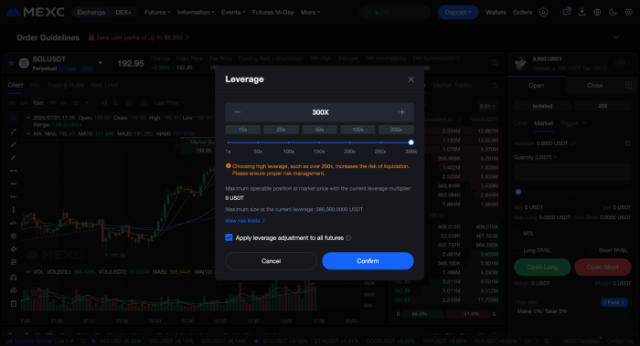 Balance your risk. Higher leverage means higher profit and higher risk.
Step 8 – Place Your First Order
MEXC offers multiple order types:
- Market Order: buy/sell instantly at current price
- Limit Order: set the price you want to enter
- Stop‑Loss / Take‑Profit Orders: set triggers for controlling risk or securing gains
 For beginners, start with a market or limit buy on SOL/USDT:
- Choose Buy/Long
- Enter order size (+ leverage)
- Review liquidation price, estimated margin
- Click Buy/Long to execute
Step 9 – Monitor & Close Position
Track your open position in the bottom panel: entry price, maintenance margin, unrealized P/L.
When ready to exit, use Close to open an opposite position (e.g., Sell/Short) or set a take‑profit or stop‑loss.
Monitor everything from your portfolio – simple, transparent.
Futures Trading Risk Mitigation Techniques and Tips
If you’re going to get into futures, you better know how to protect your capital. Futures can blow up accounts faster than you can say “liquidated.”
Here’s how smart $SOL traders stay alive long enough to learn the game:
- Size your positions right: Don’t risk more than 1–2% of your total capital on a single trade. That includes potential losses from slippage and liquidation, not just your stop-loss. Keep total portfolio exposure under 6–8% unless you’re scalping with tight controls.
- Start small, scale up: Use pyramid sizing. Begin with a smaller entry and add only when the trade moves in your favor, not before.
- Go easy on leverage: More leverage ≠ more profit. It also multiplies risk. Beginners should cap leverage at 3x–5x max, especially on volatile assets like $SOL.
- Keep margin usage under 50%: If your account has $10k, try not to use more than $5k in margin at any one time. This gives you breathing room if the market turns choppy.
- Use smart stop-losses: Don’t place stops at round numbers (like $200 or $150). Anchor them around real support/resistance levels or recent candle highs/lows.
- Diversify your approach: Mix short-term and long-term strategies. You could scalp $SOL during high volume hours, swing trade $BTC futures, and hold an $ETH options spread. Diversification isn’t just asset-based; it’s time-frame and strategy-based, too.
- Use instrument-specific tools: For options, watch the Greeks, especially delta and theta. For futures, monitor funding rates and contract rollovers. Know your tools.
- Don’t skip mental game: Greed and revenge trades destroy more accounts than bad technical analysis ever will. Lock in partial profits, predefine exits, and know when to walk away. Discipline is a skill. Practice it like you’d practice setups.
Trading without risk controls is gambling. If you’re serious about growing your account, focus less on catching tops and bottoms and more on keeping yourself in the game.
Popular Futures Contract Trading Strategies
Trading $SOL futures isn’t just about picking a direction, it’s about having a clear plan. Here are five proven strategies used by futures traders to navigate volatility and maximize edge:
Directional Momentum Trading
- What it is: You’re following the trend. If $SOL is pumping, you ride the wave. If it’s dumping, you ride the slide. The key is spotting strong momentum and jumping in with it, not against it.
- How it works: Use basic indicators like moving averages or RSI to confirm strength. For example, if $SOL breaks above its 50-day moving average with strong volume, that’s a signal to go long.
- Exit: Use a trailing stop-loss to lock in gains as the trend continues. Close the trade if the trend weakens or reverses.
- Risk tip: Don’t fight momentum. Keep risk to 1–2% of your capital per trade and set your stop just below the last price swing.
- Best for: Traders who are comfortable holding positions for hours to days and prefer clear trend conditions.
Breakout Trading
- What it is: You’re waiting for $SOL to break out of a tight range, then you trade the breakout.
- How it works: Watch key support and resistance levels. If $SOL has been stuck between $170 and $175 for a while, and suddenly it rockets through $175 with volume, that’s a potential breakout. You buy in.
- Exit: Target the next major level above (like $180), or close the trade if price snaps back below the breakout point.
- Risk tip: Use tight stops. False breakouts happen a lot, especially in sideways markets.
- Best for: Volatile days, big news releases, or after long periods of price consolidation.
Mean Reversion Scalping
- What it is: You’re betting that $SOL won’t stay ‘too high’ or ‘too low’ for long. Prices tend to snap back to their average – this strategy tries to catch that snap.
- How it works: Wait for the price to stretch far away from an average (like the VWAP or 20 EMA). If $SOL suddenly jumps or dips 5–10% away from the average without strong news, odds are it’ll revert.
- Exit: Close the trade once price returns to the average or loses momentum.
- Risk tip: Don’t do this during strong trends. It works best when the price is choppy or range-bound.
- Best for: Fast, low-risk trades. Perfect for scalpers or traders with limited time.
Calendar Spread Arbitrage
- What it is: This is a market-neutral strategy. You’re not betting on $SOL going up or down. You’re betting on the price gap between two futures contracts to shrink.
- How it works: If the near-term $SOL futures contract is trading at $175, and the far-term one is at $185, you short the expensive one and go long the cheaper one. When the prices converge, you close both.
- Exit: Close when the gap returns to normal historical levels.
- Risk tip: Requires a margin for both positions and a solid understanding of futures pricing. Market spikes can widen the spread temporarily.
- Best for: Experienced traders who want low-risk, low-return setups and access to multiple contracts.
Funding Rate Farming
- What it is: This one is about collecting free money from funding payments, assuming you manage risk correctly.
- How it works: In perpetual futures, funding fees are paid between longs and shorts every eight hours. If the rate is +0.1%, longs pay shorts. If you’re short at that moment, you get paid just for holding the position.
- Exit: Hold your position through the funding interval, then reassess.
- Risk tip: Don’t ignore the price direction. A 0.1% funding payment means nothing if $SOL moves 3% against you. Hedge your exposure if needed.
- Best for: Traders who understand how funding works and don’t mind holding through flat or slow markets.
Common Mistakes to Avoid
Every blown account leaves a clue. If you learn from others’ mistakes, you won’t have to pay tuition in the form of your own balance. Stay systematic, stay defensive, and trade to survive another day. Even the best $SOL setup won’t save you if you ignore the basics.
Here are the most common ways futures traders blow up their accounts, and how you can avoid stepping on the same landmines:
1. Over-leveraging positions
A 50x or 100x leverage sounds tempting, but normal intraday volatility in $SOL can be 5–10%. At that level, even a small move against you nukes your margin. Statistics show 65–95% of over-leveraged traders lose most of their accounts within a few months.
➡️ How to avoid it: Stick to 3x–5x leverage unless you’re scalping with experience and tight risk controls.
2. Going “all-in”
Risking 20–50% of your account on one trade might feel like conviction, but it’s actually just poor risk management. One bad entry, and you’re out of the game.
➡️ How to avoid it: Never risk more than 1–2% of your total capital per trade. Position sizing matters more than being right.
3. Trading on emotion or FOMO
Chasing green candles or revenge-trading after a loss usually leads to overtrading and poor entries. The market doesn’t care about your feelings. It will punish impulse.
➡️ How to avoid it: Stick to your plan. Use a trading journal. Take breaks when you feel tilted.
4. Misusing technical analysis
Placing stops at obvious round numbers (like $150 or $200) or too close to entry gets you wicked out because market makers and bots target these zones to trigger liquidations and stop hunts. Similarly, entering on unconfirmed breakouts, especially without volume, can leave you stuck in a fakeout just before the price reverses.
➡️ How to avoid it: Base entries and exits on actual price structure, volume, and confirmation. Use real support/resistance, not just numbers that look clean.
5. Ignoring macro and market context
Trading $SOL futures without knowing if the broader market is risk-on or risk-off can leave you fighting trends. Even great setups fail in the wrong conditions.
➡️ How to avoid it: Watch $BTC and $ETH for trend cues, track major news events (Fed, CPI, ETF flows), and understand what’s driving volatility.
6. Correlation blindness
Holding $SOL, $AVAX, and $MATIC futures and thinking you’re diversified? Spoiler: they all move together in most risk-on/risk-off environments.
➡️ How to avoid it: Diversify across asset classes (e.g., crypto, stocks, forex) or across uncorrelated strategies (e.g., trending + mean reversion).
7. Ignoring funding costs
Holding a perpetual $SOL long for days in a high funding environment can slowly bleed your PnL, even if price barely moves.
➡️ How to avoid it: Check funding rates regularly and factor them into your cost of holding. Consider switching to dated futures if you’re holding for longer.
Wrapping Up Our Guide on Solana Futures Trading
Solana futures are no longer just a speculative playground for crypto risk-takers – they’ve evolved into a serious market with deep liquidity, advanced tools, and billions in open interest.
Whether you’re trying to hedge, speculate, or squeeze more out of your capital, futures give you that leverage (literally and figuratively).
But let’s be real. With great power comes, well, a decent chance of blowing up your account. Trading leveraged contracts isn’t a game. Retail traders lose money on derivatives every day. And it’s not because they picked the wrong coin. It’s because they oversized their trades, didn’t set stops, and let emotions run the show.
The good news? You don’t have to be that person. Use tight sizing. Respect your stop-loss. Know your platform, know your contract, and above all, know why you’re in the trade before you click ‘Buy.’
Solana futures offer real opportunity. But they also demand real discipline. So trade smart, protect your capital, and don’t skip the boring parts like reading the funding rate or brushing up on macro. That’s what separates pros from liquidation emails.
And remember: this guide is a starting point, not a substitute for experience. Always do your own research (DYOR) before diving in.
FAQs
1. Can you trade futures on Solana?
Yes, you can trade Solana futures on most major crypto derivatives exchanges. These contracts let you speculate on SOL’s price with leverage, without owning the underlying asset. Popular platforms like MEXC, OKX, and Binance offer SOL/USDT perpetual futures with adjustable leverage and advanced risk management tools.
2. Where can I buy Solana futures?
You can buy Solana futures on exchanges that offer crypto derivatives, such as MEXC, Binance, OKX, and CoinFutures. These platforms support SOL/USDT perpetual contracts with varying leverage options, fees, and trading tools. MEXC is a top choice for high leverage and low fees.
3. How to trade futures for beginners?
To trade futures as a beginner, start by choosing a user-friendly exchange like MEXC or OKX. Create an account, complete KYC, and deposit funds (usually $USDT). Open a futures account, select your contract (e.g., SOL/USDT), choose your leverage, and place a simple market or limit order. Always use stop-losses to manage risk.
4. What is the best platform to trade Solana futures?
The best platform to trade Solana futures depends on your trading style. MEXC is great for high leverage and 0% maker fees, while OKX stands out for automated strategies and a clean mobile app. Binance offers deep liquidity and advanced features for experienced traders. Each has strengths depending on what you value most.
