This is the second article of the “How to” series we launched with the Qbein company. Last week we discussed AI usage and today’s topic is Web3 solutions from the world’s biggest companies and how to integrate Web3 technologies into your business.
Web3 has been gaining a lot of attention in recent years, especially in the world of business. With the rise of blockchain technology and cryptocurrencies, Web3 has become a powerful tool for companies looking to innovate and create new opportunities.
Nike: In 2019, Nike received a patent for a blockchain-based system that would enable users to verify the authenticity of its products. This system would use a unique identification code for each product, which would be stored on a blockchain and could be accessed by scanning a QR code.
IBM has been actively exploring blockchain technology for a few years now and has developed several solutions for businesses. One example is TradeLens, a blockchain-based global supply chain management platform developed in partnership with shipping company Maersk.
Microsoft has developed several blockchain-based solutions, including the Azure Blockchain Service, which allows businesses to build and deploy blockchain applications on the Microsoft Azure cloud platform. Microsoft is also a member of the Ethereum Enterprise Alliance focused on developing business blockchain solutions.
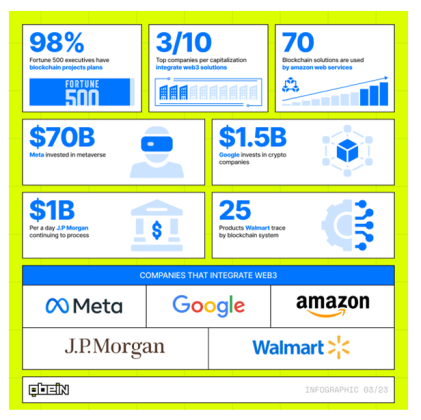
Coca-Cola used SAP’s blockchain solution to develop a blockchain-based solution for tracking its supply chain. This solution would enable Coca-Cola to track its ingredients from farm to bottle, providing greater transparency and efficiency in its supply chain.
Walmart has been exploring blockchain technology for a few years and has developed several blockchain-based solutions for its supply chain. One example is the Walmart Food Traceability Initiative, which uses blockchain technology to track the origin of its food products and improve food safety.
So, how can your business leverage Web3 to enhance its operations, reach new audiences, and potentially increase revenue? That’s up to you. But what we can help you with now is to write a few simple steps to start implementing web3.
1. Understand Web3 Technology
You must understand the underlying technology to use Web3 for your business effectively. Web3 is based on the principles of blockchain, a distributed ledger technology that enables secure and transparent transactions without intermediaries. This means that transactions can be conducted directly between parties, and the data stored on the blockchain is immutable and transparent. Some of the key features of Web3 include smart contracts, decentralized applications (dApps), and non-fungible tokens (NFTs). Smart contracts are self-executing contracts that automatically execute when certain conditions are met. dApps run on a blockchain network and are not controlled by any central authority. Finally, NFTs are unique digital assets representing ownership of a digital or physical asset.
2. Identify Opportunities for Web3 in Your Business
Once you have a good understanding of Web3 technology, the next step is to identify potential opportunities for your business. Here are a few examples of how Web3 can be used in different industries:
- Finance: Web3 can be used to create decentralized finance (DeFi) applications, such as decentralized exchanges and lending platforms.
- Gaming: NFTs can be used to represent in-game items and assets, creating a new revenue stream for game developers.
- Supply Chain: Web3 can be used to create a transparent and secure supply chain, tracking products from production to delivery.
- Real Estate: Web3 can be used to create a decentralized real estate market, allowing buyers and sellers to transact directly without intermediaries.
3. Build a Web3 Strategy
Once you have identified potential opportunities for your business, the next step is to build a Web3 strategy. This should include a clear roadmap of how you plan to integrate Web3 into your business, what resources you will need, and what success metrics you will use to measure your progress.
Some key elements to consider when building your Web3 strategy include:
- Infrastructure: You will need to identify which blockchain network(s) you will use and what tools you will need to build on that network.
- Talent: You may need to hire developers and other experts with experience in blockchain and Web3 technology.
- Marketing: You will need to create a marketing plan to reach your target audience and promote your Web3 products or services.
- Regulatory Compliance: Depending on your industry, you may need to comply with certain regulations when using Web3 technology.
4. Start Small and Iterate
When integrating Web3 into your business, it’s important to start small and iterate. This means that you begin with a small pilot project or proof-of-concept to test the waters and get feedback from your target audience.
As you gain more experience and insights, you can then scale up your Web3 initiatives and expand your offerings.
5. Stay Up-to-Date with Web3 Developments
Finally, staying up-to-date with the latest Web3 developments and trends is important. Web3 technology is still evolving rapidly, and new tools and applications are constantly being developed. By staying informed and up-to-date, you can ensure your business remains competitive and innovative in the rapidly changing Web3 landscape.
In conclusion, Web3 technology offers a wealth of opportunities for businesses looking to innovate and create new revenue streams. By understanding the underlying technology, identifying opportunities, building a Web3 strategy, starting small and
iterating and staying up-to-date with the latest developments, businesses can leverage Web3 to enhance their operations, reach new audiences, and potentially increase revenue.
About Qbein
QBEIN is a blockchain technology provider specializing in web3 and AI solutions for games and finances with more than 5 years of developing decentralized solutions for our clients and partners.
Image by Gerd Altmann from Pixabay