
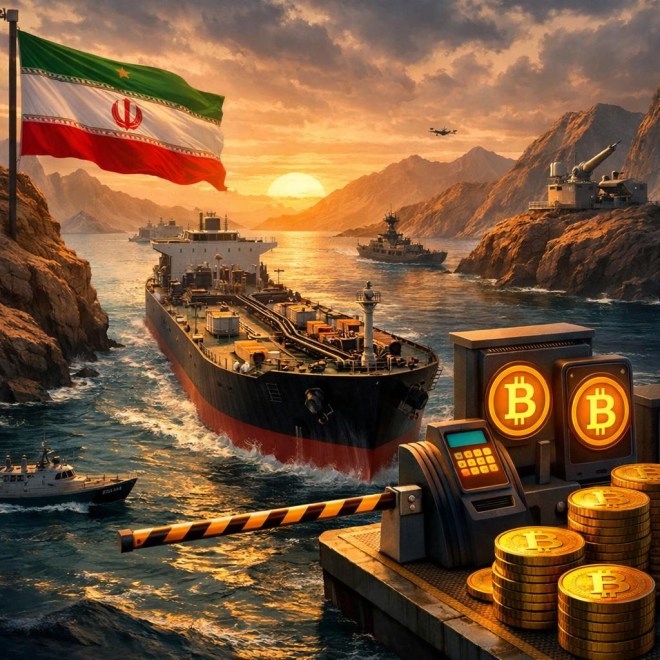
As markets reacted to Tuesday evening’s ceasefire announcement, Iran moved to assert control over passage through the Strait of Hormuz by saying it will demand crypto tolls — chiefly Bitcoin (BTC) — from oil tankers transiting the vital waterway during the two‑week pause in hostilities.
Tankers Must Pay In Bitcoin Within Seconds
Hamid Hosseini, a spokesperson for Iran’s Oil, Gas and Petrochemical Products Exporters’ Union, told the Financial Times that Tehran intends to assess each vessel seeking passage and levy a fee, communicated by email, that must be paid in digital currency.
“Iran needs to monitor what goes in and out of the strait to ensure these two weeks aren’t used for transferring weapons,” Hosseini said, noting his industry association works closely with the state.
Hosseini described a process in which ship operators must disclose cargo details by email, after which Iran will determine the crypto toll and give the vessel only a few seconds to complete payment in Bitcoin so the transaction cannot be traced or seized under sanctions.
The announcement follows President Donald Trump’s post on Truth Social in which he said he would suspend strikes on Iran for two weeks, provided Tehran agreed to the “COMPLETE, IMMEDIATE, and SAFE OPENING of the Strait of Hormuz.”
Trump said that conversations with Pakistan’s Prime Minister Shehbaz Sharif and Field Marshal Asim Munir, who asked him to hold off on military action, helped shape the decision.
Iran’s Supreme National Security Council has set out a 10‑point basis for negotiations, including a new “protocol for secure passage” developed in coordination with Iran’s armed forces, signaling Tehran’s intent to retain leverage over the waterway even while talks proceed.
Historic Real‑World Use Case
While Bitcoin has broken the consolidation range below $70,000 amid short-term relief for the market, some analysts argue that accepting digital currency for strategic tolls is an unprecedented real-world use of a censorship-resistant asset.
Analysts at TFTC wrote on social media platform X that this represents “the largest real‑world stablecoin use case ever recorded,” contrasting sovereign adoption to prior crypto activity such as decentralized finance (DeFi) yield farming or non-fungible token (NFT) speculation.
Their comment underscores the notion long advanced by some in the crypto community: when a state is shut out of the dollar system, it may turn to alternative payment rails to sustain trade and collect revenues.
Already, only a handful of vessels — mainly those with ties to Iran and not connected to the US, Israel, or Gulf states that supported recent strikes — have received approval to transit on restricted routes in the past fortnight.

At the time of writing, Bitcoin was trading at around $71,570, having recorded gains of 4.6% over 24 hours. Ethereum (ETH), XRP, and Solana (SOL) have followed suit, achieving gains of 6%, 4%, and 5%, respectively, in the same period.
Featured image from OpenArt, chart from TradingView.com