A former Kaspa employee just dropped a detailed analysis exposing a serious vulnerability in how Kaspa handles UTXO commitments. The post, written by Shai Wyborski, explains that quantum computers can break Kaspa’s MuHash system, potentially allowing attackers to forge entire UTXO sets and rewrite the chain’s history. While Kaspa has been praised for its blockDAG technology and speed, this quantum flaw raises questions about its long-term security model.
BMIC ($BMIC) takes a completely different perspective. Built from the ground up with post-quantum cryptography and signature-hiding smart accounts, BMIC addresses the exact vulnerabilities that threaten projects like Kaspa. The BMIC presale is active now, with the current price at $0.0521787 per token. Over $510,000 has already been raised.
What Shai Wyborski Just Revealed About Kaspa
Shai Wyborski, a former Kaspa employee and current DAG Knight, published a detailed thread explaining why Kaspa’s UTXO set commitments are a quantum achilles’ heel. The issue centers on MuHash, an incremental hash function that Kaspa uses to commit to its UTXO set. Unlike standard hash families like SHA or Keccak, which are considered quantum-secure, MuHash relies on elliptic discrete log assumptions.
Wyborski explains that a quantum adversary using Shor’s algorithm can invert the hash commitment. This means they could find a completely different UTXO set that produces the same MuHash commitment as the legitimate one.
The consequences are severe. An attacker could locate the UTXO commitment of the latest pruning block, use a quantum computer to find another UTXO set with the same commitment, and then build a competing heavier chain that assumes the manufactured UTXO set is the real one.
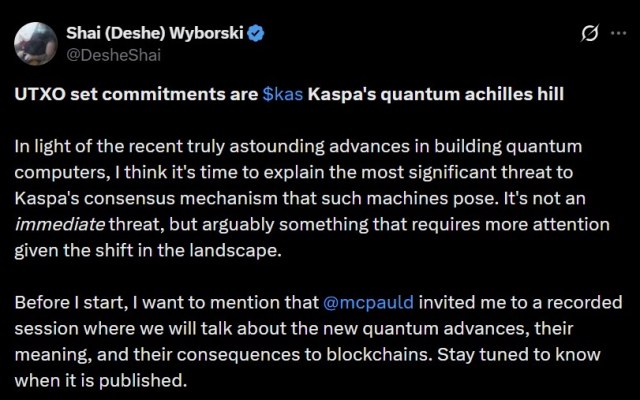

Source: X/@DesheShai
This would effectively allow a 51% attack within a single pruning window. The attack could rewrite Kaspa’s entire history. Wyborski stresses two critical points. First, the attack only requires one application of Shor’s algorithm to find a preimage. Factors like blocks per second or difficulty do not make the attack any harder. Second, the attack cost is directly proportional to the length of a pruning window, meaning shorter pruning windows actually mean less quantum security.
The analysis also points out that Kaspa currently relies on social consensus in the short term, followed by cryptographic security in the long term. Breaking MuHash means the cryptographic backbone of this model no longer holds. UTXO commitments become unreliable, compromising Kaspa’s entire trust model.
Potential solutions come with their own problems. Relying on archival nodes would make Kaspa de-facto centralized, removing one of its key advantages over Bitcoin. Switching to a post-quantum hash like LtHash would make headers 9 to 10 times larger, drastically increasing storage costs. Even then, a quantum adversary could simply go back far enough to split from a block that still uses MuHash.
How BMIC Solves the Quantum Problem
BMIC is built differently. The project is the first complete quantum-secure finance stack, combining a wallet, a staking system, and a payment layer all protected by post-quantum cryptography and signature-hiding smart accounts. Unlike Kaspa, which relies on MuHash with known quantum vulnerabilities, BMIC was designed from day one for a quantum world.
The core innovation is zero public-key exposure. Traditional wallets like MetaMask or Ledger expose public keys on-chain for anyone to see. That creates a vulnerability that quantum computers can exploit. BMIC uses ERC-4337 smart accounts, hybrid PQC signatures, and private L2 routing to keep those keys hidden. Even if quantum computing advances to the point where it can break standard cryptography, there is nothing for an attacker to target.

BMIC also includes quantum-secure staking, where users can earn yield without ever exposing their keys. A quantum-safe payment and credit card system uses post-quantum authentication to prevent fraud. AI constantly monitors activity, detects threats, and optimizes cryptographic performance so the system improves over time without requiring manual updates.
The token itself has real utility. Holding or spending BMIC is required to access advanced features of the quantum-resistant wallet. Businesses integrate BMIC-powered APIs for custody, encryption, and secure communications. BMIC acts as the unit of value for workloads across the Quantum Meta-Cloud, linking adoption directly to token demand.
Staking plays a key role in network security. Institutions and service nodes stake BMIC to support and secure wallet infrastructure, reinforcing reliability for enterprise partners. Participants who stake are rewarded with BMIC for contributing to the ecosystem’s stability.
The burn-to-compute model adds a deflationary layer. Tokens can be burned to generate BMIC Compute Credits, which are used to run quantum workloads. Each workload reduces circulating supply, creating long-term scarcity. As adoption of compute grows, so does the need for BMIC.
BMIC Presale – Current Price and Trend
The BMIC presale’s initial price was $0.048485 per token. The current price is $0.0521787, still near the bottom of the range. The final presale phase will reach $0.058182, and the launch price after presale is expected to exceed that final tier.
Over $510,000 has now been raised, with momentum building as more investors recognize the quantum threat. The team took only 3% of the supply, which is significantly lower than industry standard, signaling real alignment with long-term holders. Fifty percent of the supply goes to the presale, giving the public the largest share at the earliest stage.
The roadmap shows clear milestones. Phase one is already in progress, with core wallet architecture and PQC integration underway, plus a top ten CEX listing announcement. Phase two in mid-2026 brings the wallet alpha release and the first burn event. Later phases add quantum compute integration and the full mainnet launch.
Why BMIC Is the Best Quantum-Resistant Crypto to Buy
Kaspa’s vulnerability is not an isolated issue. Many projects rely on cryptographic assumptions that quantum computers will eventually break. The difference is that BMIC was built specifically to withstand these attacks. It is not retrofitting old systems with patches. It is quantum-native from day one.
For investors looking for the best crypto to buy in 2026, BMIC offers something no other project does: true quantum protection combined with real utility and tokenomics designed for long-term value. The presale offers entry at prices that will not last. With each phase, the price increases. The current price is $0.0521787, but that will not stay the same for long.
The window to get in at the lowest levels is closing. Over $510,000 has already been raised, and as awareness of the quantum threat grows, so will demand for the only project truly built to handle it. This is not hype. It is infrastructure for the next era of digital assets, available at presale prices before the broader market catches on.
Meet the future of quantum-secure Web3 with BMIC:
Presale: https://bmic.ai/
Social: https://x.com/BMIC_ai
Telegram: https://t.me/+6d1dX_uwKKdhZDFk