South Korean payments giant BC Card has completed its pilot project to verify the stability and convenience of card-integrated stablecoins in collaboration with domestic and international digital asset companies.
BC Card Completes Stablecoin Payment Pilot Project For Foreigners
On Tuesday, South Korea’s largest payment processing company, BC Card, announced it had concluded its two-month pilot project enabling foreigners to use stablecoins as a payment method at domestic merchants.
The project was conducted alongside blockchain financial firm Wavebridge, overseas digital wallet company Aaron Group, and remittance fintech company Global Money Express.
According to BC Card, the pilot focused on “verifying whether foreign currency-based stablecoins held by foreigners could be practically used within the domestic payment environment, while also assessing payment convenience and stability.”
For the project, foreign users converted their stablecoins held in oversea wallets parented with BC Card into digital prepaid cards that could be used at domestic affiliated merchants using a QR code, without requiring a physical card or currency exchange procedures.
The company integrated stablecoin payments into the existing card authorization and settlement structure using a digital prepaid card as an intermediary, the announcement explained, noting that “this design enables both paying customers and merchants to transact in the same manner as with conventional card payments.”
BC Card’s President, Choi Won-seok, stated, “Stablecoins, due to their technical characteristics, are particularly useful for cross-border payments and hold significant potential to improve the domestic payment experience for foreign consumers.”
South Korean Companies Prepares For 2026 Framework
The payments giant affirmed that the pilot was not a “short-term technical verification” but a “process to prepare a stablecoin payment structure responsive to future domestic legal and regulatory changes.”
Notably, the South Korean government recently failed to submit the highly anticipated bill for the Second Phase of the Virtual Asset User Protection Act, which will address the issuance and distribution of won-pegged stablecoins.
As reported by Bitcoinist, the Financial Services Commission (FSC) did not meet the ruling party’s December 10 deadline to submit the government’s legislation to the National Policy Committee.
According to local media, the government bill was delayed after the FSC and the Bank of Korea (BOK) failed to resolve their differences over the issuance of won-denominated stablecoins.
The financial authorities reportedly agree that financial institutions must be involved in the issuance of the tokens but disagree on the extent of banks’ role. While the central bank has been pushing for a consortium of banks owning at least 51% of any stablecoin issuer seeking approval in the country, the FSC has expressed concerns that giving a majority stake to banks could reduce participation from tech firms and limit the market’s innovation.
Recent reports affirmed that the government’s proposal is expected to be announced by early next month at the latest, as the integrated bill must be submitted in January 2026. “To protect the public’s right to know, there will be a separate opportunity to explain the government’s proposed bill to the public while submitting it to the National Assembly,” an FSC official stated last week.
Ultimately, BC Card pledged to strengthen its cooperation with relevant agencies while considering the flow of virtual asset legislation, aiming to “lead the establishment of a ‘Korean-style stablecoin payment infrastructure’ by progressively advancing a payment model compliant with domestic regulations.”
“BC Card will leverage its card payment infrastructure to progressively prepare a stable stablecoin payment model that aligns with Korea’s legal and regulatory environment,” the company’s president concluded.
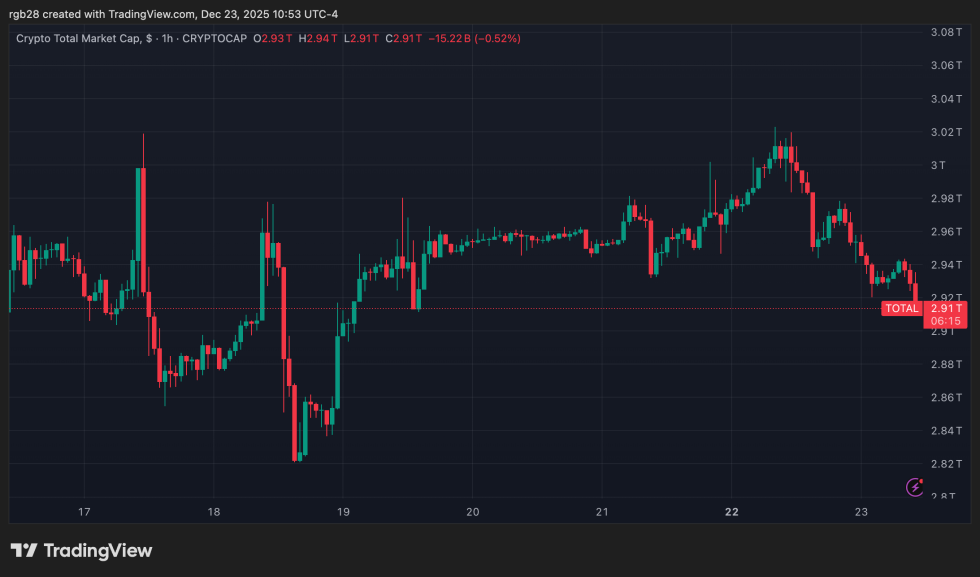
The total crypto market capitalization is at $2.91 trillion in the one-week chart. Source: TOTAL on TradingView