Quick Facts:
- ➡️ Tether’s $150M investment in Gold.com signals a major institutional pivot toward digitizing real-world assets (RWAs).
- ➡️ Current blockchain infrastructure suffers from severe liquidity fragmentation, making it difficult to move assets like tokenized gold between Bitcoin, Ethereum, and Solana.
- ➡️ LiquidChain solves this by providing a Layer 3 unified execution environment, allowing developers to deploy once and access liquidity across multiple chains.
- ➡️ The project has raised over $529,000 in its ongoing presale, highlighting growing demand for secure cross-chain interoperability solutions.
Tether’s push into commodities just got real.
A reported $150M strategic investment in Gold.com isn’t just about buying a premium domain or securing bullion reserves; it marks a pivot in how the world’s largest stablecoin issuer views the future of on-chain value.

By marrying deep liquidity with physical gold infrastructure, Tether is effectively building a bridge between traditional safe-haven assets and the high-velocity world of DeFi.
This move does two things immediately. First, it validates the Real World Asset (RWA) narrative that has been simmering all cycle. When the issuer of USDT, an entity holding more US Treasuries than many sovereign nations, bets nine figures on gold digitization, institutions have to pay attention. Second, it exposes a glaring inefficiency in the current crypto architecture: liquidity fragmentation.
While Tether can mint gold tokens (XAUT) on Ethereum or TON, moving that value across ecosystems remains a clunky, high-risk endeavor involving wrapped assets and trusted bridges. This infrastructure gap is precisely where the market’s focus is shifting.
As RWAs flood the chain, the demand for seamless cross-chain interoperability is skyrocketing, creating a tailored narrative for infrastructure plays like LiquidChain ($LIQUID).
This Layer 3 protocol has begun attracting early capital by promising to solve the exact liquidity silos that complicate deals like Tether’s gold expansion.
Real World Assets Hit A Wall Of Fragmentation
The core issue limiting the potential of Tether’s gold push, and the RWA sector generally, is that liquidity doesn’t flow freely.
A gold token issued on Ethereum is practically stranded there. To use it on Solana or Bitcoin layers, users must rely on ‘wrapping,’ a process that historically introduces significant centralization risk. Sound familiar? It’s been the vector for billions in bridge hacks over the last few years.
This matters because institutional capital, the kind backing Tether’s $150M injection, is risk-averse. They won’t deploy billions into an ecosystem where moving assets requires trusting a multisig wallet controlled by anonymous developers.
The industry is currently operating on what can be described as an archipelago of liquidity: distinct, rich islands of value (Bitcoin, Ethereum, Solana) with very few safe ferries between them.
Current solutions like Stacks (for Bitcoin) or traditional bridges are band-aids rather than structural fixes. They patch the connection but don’t unify the execution environment. This fragmentation forces developers to choose a single chain, effectively cutting off their application from the user base and liquidity of other networks.
The market is signaling a desperate need for a unification layer, an environment where assets from different chains can interact natively without the friction of traditional bridging.
LiquidChain Unifies Liquidity Across Bitcoin, Ethereum, And Solana
Entering this vacuum is LiquidChain ($LIQUID), a Layer 3 infrastructure protocol designed to fuse the fragmented liquidity of the industry’s three giants: Bitcoin, Ethereum, and Solana.
Unlike traditional bridges that merely shuttle tokens, LiquidChain provides a unified execution environment. This allows developers to deploy their application once and access users and liquidity across all connected chains simultaneously.
The project’s architecture centers on a ‘Deploy-Once’ philosophy, utilizing a Cross-Chain Virtual Machine (VM) that abstracts the complexities of the underlying chains.
For a developer, this means writing code that can tap into Bitcoin’s security, Ethereum’s smart contracts, and Solana’s speed without maintaining three separate codebases.
For the end user, it offers single-step execution, swapping $BTC for an SPL token (Solana) happens in the background, with verifiable settlement, eliminating the need to manage multiple wallets or gas tokens.
Smart money appears to be positioning for this infrastructure shift.
According to the official presale data, LiquidChain has already raised over $529K, with the native token $LIQUID currently priced at $0.01355.
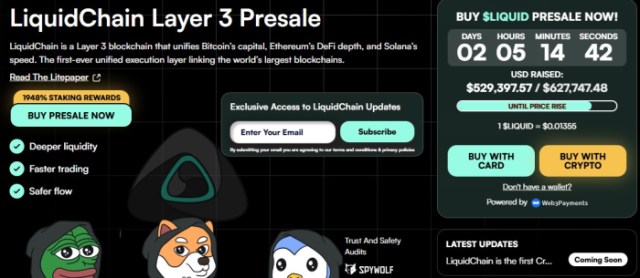
The steady capital inflow suggests that investors are looking beyond the meme coin supercycle and identifying infrastructure that enables the next phase of DeFi scalability.
By serving as a cross-chain liquidity layer, LiquidChain acts as the connective tissue for an RWA-heavy future. If Tether wants its gold tokens to flow seamlessly from an Ethereum vault to a Solana lending protocol, infrastructure like LiquidChain isn’t just a luxury, it’s a technical necessity.
Disclaimer: This article is for informational purposes only and does not constitute financial advice. Cryptocurrency investments, including presales, carry high risks, including the potential for total loss. Always verify contract addresses and conduct your own due diligence.