



There are hundreds of Ethereum exchanges out there. This can make it hard to choose the best one for your needs, especially if you’re a beginner in the crypto space. In this article, we’ll narrow the list down and bring you the best Ethereum exchanges around.
We’ll look at centralized options like Binance and Weex, as well as decentralized options like Uniswap and SushiSwap for the more privacy-focused traders. We’ll also cover hybrid solutions like OKX to bring you a comprehensive guide on the top $ETH trading platforms.
By the end of this article, you’ll have enough knowledge to make an informed decision. Let’s get started.
Overview – Our Top Picks as the Best Ethereum Exchanges for $ETH Trading
Before we get into the crux of the article, below is a table highlighting the top Ethereum exchanges around. All of these solutions allow you to trade Ethereum fast and efficiently.
| OKX Exchange | Centralized trading power with seamless integration with DeFi and Web3 tools |
| Binance | Unparalleled ecosystem breadth and user empowerment through the BNB chain |
| Weex Exchange | High-leverage futures trading with AI-driven tools and copy trading |
| Pionex Exchange | Offers 16 no-code bots for 24/7 trading strategy execution |
| Uniswap Exchange | The original permissionless automated market maker on Ethereum |
| SushiSwap Exchange | A community-governed, multi-chain yield powerhouse |
Types of Ethereum Exchanges: What’s the Best One for You?
There are many different types of exchanges out there, but most fall under two main types:
Centralized Exchanges (CEX)
These work similarly to traditional brokers. They offer more convenience, higher liquidity, and are generally easier to use. However, they have Know Your Customer (KYC) requirements, and because a third party holds your tokens and facilitates trades, they require your trust.
This puts them in a position where they hold vast amounts of user data and significant amounts of crypto, which makes them attractive targets to cybercriminals.
Decentralized Exchanges (DEX)
DEXs are better if you prioritize privacy and self-ownership of your assets. However, they can be more complicated to use. These generally don’t require KYC for smaller trades. However, in terms of transaction speeds, they are slower than their counterparts.
DEXs are inherently P2P platforms as there are no intermediaries. Trades take place between users with no middleman managing the transaction. However, most are unregulated, which brings its own level of risk. That said, ‘unregulated’ doesn’t necessarily mean ‘illegal’, although you should look into jurisdiction-specific rules.
Which Type of Exchange Should You Opt For?
The answer to which is better for trading Ethereum and other ERC-20 tokens really lies in what you prioritize.
If you’re just getting started in the crypto space, it’s best to go for a CEX like OKX, although OKX also offers a decentralized version as well, which makes it more of a hybrid exchange.
That said, if you’re looking for a DEX, Uniswap or SushiSwap are both popular options.
Reviewed & Analyzed – Best $ETH Exchanges for Seamless Trading
Now that you have a better idea of which option might be perfect for you, let’s take a deeper look at some of the best Ethereum exchanges around.
1. OKX Exchange – Centralized Trading Power With Seamless Integration with DeFi and Web3 Tools
Trading Fees: 0.08% Maker | 0.1% Taker (regular users)
Liquidity: High liquidity, represented by a 24-hour trading volume of $3B
Number of Ethereum Trading Pairs: 100+
The OKX exchange was launched in 2017 and now serves more than 50M customers worldwide. It’s a centralized crypto exchange (CEX), although it has features that you’d also see in decentralized exchanges, making it a hybrid crypto trading solution.
It blends high-speed centralized trading with easy DeFi and Web3 integrations through its non-custodial wallet.
Its list of trading features includes perpetual and expiration futures using stablecoins like $USDT and $USDC, as well as crypto-margined contracts like $ETH/$USDC and $BTC/$USDC.
If you’re a beginner, you can take part in options trading with up to 500+ supported trading pairs, with more than 100 of them being $ETH specific. This makes it a standout option for Ethereum and ERC-20 token enthusiasts.
More than that, OKX offers aggregated DEX swaps through its wallet, which pulls the best rates from Uniswap and SushiSwap without extra fees.
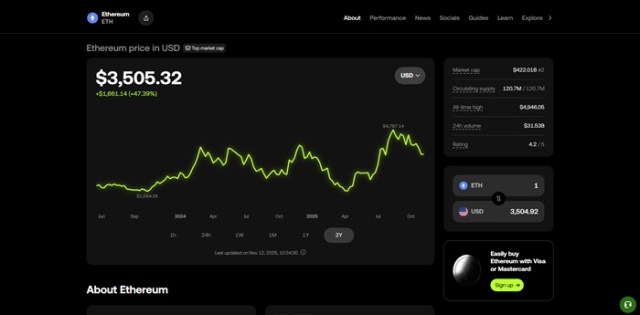
Speaking of the wallet, it supports 130+ chains with a focus on Ethereum L1/L2s like Optimism and Arbitrum. Moreover, it facilitates cross-chain bridging and offers staking on more than 100 assets, with an APR of between 1.7% and 3.1% for $ETH.
Trading fees are tiered and tied to your 30-day trading volume. The higher your trading volume is, the lower your fees will be. Additionally, holding $OKB comes with extra discounts.
For example, maker/taker fees are 0.8%/0.1% for regular users and drop to 0.0675%/0.08% for Level 1 VIP members. That said, to qualify for VIP Level 1, your 30-day trading volume must be at least $100K or more.
2. Binance – Unparalleled Ecosystem Breadth and User Empowerment Through the BNB Chain
Trading Fees: 0.1% Maker and taker fees (regular users)
Liquidity: High liquidity, represented by a 24-hour trading volume of $103.5B+
Number of Ethereum Trading Pairs: 100+
Binance was founded in 2017 and quickly became one of the most popular crypto exchanges for enthusiasts. Its 24-hour trading volume peaked at over $217B across spot and futures markets in mid-2025, making it the largest crypto exchange in the world.
Today, its trading volume currently sits at $103.5B+ around and it serves just under 300M customers in more than 180 countries.
What makes Binance unique is its broad ecosystem, which spans everything from centralized trading and DeFi to Web3 tools, NFTs, staking, and more. It’s powered by the BNB chain, its very own native blockchain that delivers one of the biggest ecosystems in the industry.
Furthermore, when it comes to trading $ETH, there are over 200 options to choose from and it offers up to 125x leverage on $ETH perpetuals. So if you’re a first-time $ETH buyer or you’re looking to invest in lesser-known ERC-20 tokens, Binance is an excellent choice.
Speaking of lesser-known ERC-20 tokens, Binance offers a feature called Binance Alpha. This feature acts as a launchpad for new and promising tokens, giving you the chance to invest early before they are listed on Binance’s spot market.
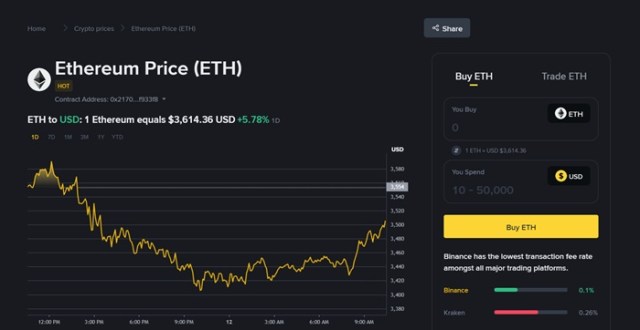
If you prefer trading without any intermediaries, you can use Binance’s P2P service, which allows you to buy and sell crypto directly with other users. However, US users don’t have access to this feature due to regulatory challenges.
Its security consists of various features and tools to ensure your funds are kept safe. There’s 2FA, which is a vital second layer of protection, especially if your password has been compromised.
If the worst were to happen, and you lose your funds due to Binance itself being compromised, the platform has a Secure Asset Fund for Users (SAFU), a $1B insurance fund.
3. Weex Exchange – High-Leverage Futures Trading with AI-Driven Tools and Copy Trading
Trading Fees: 0.1% Maker | 0.1% Taker (VIP level 0)
Liquidity: Medium liquidity, represented by a 24-hour trading volume of $3.5B+
Number of Ethereum Trading Pairs: 100+
Next on our list, we have Weex. This exchange was established back in 2018 and is now serving over 6.2M customers across 130+ countries. At the time of writing, it had a 24-hour trading volume of $3.5B+, which is small compared to the likes of Binance. This makes it somewhat of an underdog in the industry, but that in no way means it’s a bad exchange.
In fact, Weex supports more than 600 cryptocurrencies and 1.7K trading pairs, which gives it a competitive advantage over the likes of Binance in terms of variety. For $ETH and ERC-20 enthusiasts, you can choose from more than 100 $ETH-specific trading pairs, making it a strong option for Ethereum and ERC-20 traders.
When it comes to the various services on offer, you can expect the typical features that you’d get in most reputable exchanges. These features include spot and futures trading, with up to 400x leverage on certain perpetual contracts like $ETH/$USDT.
You can also choose from a pool of more than 5K pro traders to copy if you prefer a more hands-off approach.
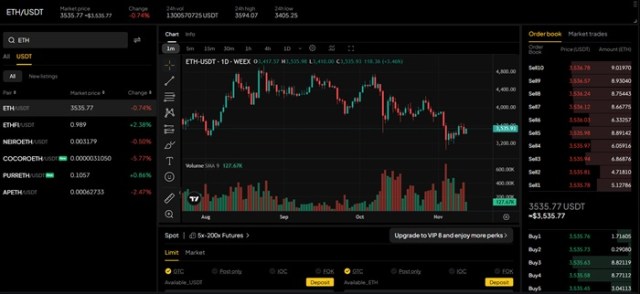
Other features include Over-the-Counter (OTC) and Peer-to-Peer (P2P) trading. P2P can be used as a fiat onramp feature, while OTC trading is better suited to professional traders or whales moving large amounts of $ETH.
In case of liquidation errors or system failures, Weex has a 1K $BTC fund, which is currently worth over $100M. To be transparent and build trust, this fund is fully verifiable through its Proof of Reserves.
Finally, in an effort to attract more users, Weex runs various promotions. One of them is exclusive to new users, where you can get up to 30K $USDT for completing certain tasks, like following them on social media, making deposits, and inviting friends.
4. Pionex Exchange – Offers 16 No-Code Bots for 24/7 Trading Strategy Execution
Trading Fees: 0.05% takers/makers (Spot trading)
Liquidity: Medium liquidity, represented by a 24-hour trading volume of $7.18B+
Number of Ethereum Trading Pairs: 100+
Pionex Exchange is a leader when it comes to crypto trading bots. It’s known for its 16 free built-in trading bots. The platform was launched in 2019 and quickly became one of Asia’s fastest-growing exchanges. Today, it serves over 5M customers across more than 100 countries.
While its $7B+ trading volume is dwarfed by the likes of Binance, it’s in no way a bad exchange. In fact, Pionex Exchange has positioned itself as a smart and efficient solution, making it best suited for those who prioritize automation over sheer scale.
Spot and futures trading allows for up to 100x leverage, and its no-code trading bots range in functionality from Grid (range-bound $ETH) and trading, to Dollar Cost Averaging (DCA), to Spot and Futures Arbitrage, all without a single line of code.
This makes it a great choice for beginners. Its demo mode and intuitive interface add to its simplicity.
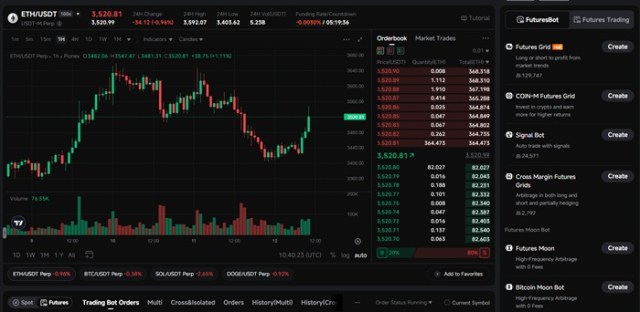
Fees are simple and beginner-friendly, with no hidden costs for bot use. That said, spot trading incurs a flat fee of 0.05% for makers and takers alike. Leverage trading fees are 0.1% for makers and takers, while futures trading costs 0.02% for makers and 0.05% for takers.
However, there is a tiered VIP system that rewards users with lower fees.
Security is another strong point with Pionex. There have been no major hacks since launch, and, like Weex, it stores up to 95% of user funds in cold storage. Moreover, there’s mandatory 2FA, as well as biometrics and everything else you’d expect.
That said, unlike Weex, there’s no dedicated insurance fund. However, Pionex has established a liquidity partnership with Binance to ensure reserves remain stable.
5. Uniswap – The Original Permissionless Automated Market Maker on Ethereum
Trading Fees: 0.3% for token swaps + gas fees
Liquidity: Medium liquidity represented by a TVL of $4.19B across chains
Number of Ethereum Trading Pairs: Unlimited by design
The next exchange on the list is Uniswap, rated as the number one DEX in the world, and which sees a daily trading volume of approximately $2.32B. It’s easily among the biggest DEXs in the world, and it stands out thanks to its automated market maker model.
While Uniswap is categorized as a decentralized crypto exchange, it’s really more of a digital marketplace that facilitates the swapping of Ethereum-based tokens across various Layer-2 blockchains.
Decentralisation is important to many crypto enthusiasts because it allows you to maintain ownership of your digital assets, unlike a centralized platform that requires a certain level of KYC and the handover of your keys to strangers. This is why it’s called a permissionless platform.
Furthermore, Uniswap being built on the Ethereum blockchain means it’s probably the best platform for $ETH and ERC-20 token enthusiasts. Through it, you’ll get access to a plethora of Ethereum-based tokens. It’s also compatible with Layer-2s like Arbitrum, Base, and Optimism, among others.
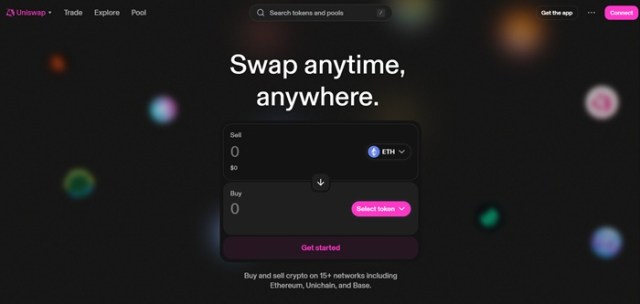
In place of traditional order books, Uniswap pioneered a new approach called the automated market maker framework. This allows you to swap ERC-20 tokens via liquidity pools with other users.
What’s interesting is that Uniswap uses an advanced mathematical algorithm to set prices.
Essentially, if you take $ETH out of a pool, the supply drops, which increases the price of $ETH in that pool. If $ETH is added, the supply increases and the price drops. It’s a constant give and take. You can choose to create your own liquidity pool, or you can add to an existing one.
Those who provide liquidity get a ticket called a liquidity-provider (LP) token. This essentially acts as a receipt for your share of the trading fees. This approach completely removes the need for a middleman, making Uniswap run by the people, for the people.
It also has its own native token ($UNI), which allows holders to vote on platform upgrades.
6. SushiSwap – A Community-Governed, Multi-Chain Yield Powerhouse
Trading Fees: 0.3% for swaps + gas fees
Liquidity: $110.5M TVL
Number of Ethereum Trading Pairs: 350+
SushiSwap originally started as a fork of Uniswap. Therefore, it is another decentralized exchange where you can directly swap one crypto for another with no middleman taking a cut.
It works very similarly to Uniswap, but has added extra bells and whistles in an effort to attract a loyal and dedicated community.
One of the features it added was yield farming, which is what caused it to explode in popularity shortly after its launch in 2020. Yield farming is the act of lending out your tokens to earn interest. In response to this, Uniswap launched its own liquidity mining program to remain competitive.
Some of the core features of SushiSwap include cross-chain token swaps through SushiXSwap, the aforementioned farming, and even lending through BentoBox – a free smart wallet with no gas fees on deposits and instant flash loans.
Furthermore, liquidity providers have lower trading fees, down to 0.25% from 0.3%. The 0.05% taken from the standard fee of 0.3% goes towards $SUSHI stakers. Similar to Uniswap, $SUSHI holders also have governance rights.
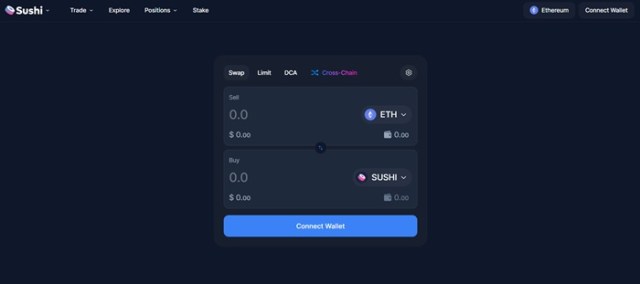
While SushiSwap is one of the biggest DEXs in the world, it had a rough start.
Early hype boosted the popularity and, therefore, the value of $SUSHI, resulting in the founder, known as Chef Nomi, cashing out a significant chunk of $SUSHI tokens. This caused the price to crash and send out rug pull vibes.
Despite this, the platform managed to pull through and now has a 24-hour Ethereum spot trading volume of more than $4.4M. This is nothing when compared to big names like Binance; however, it’s perfect if you’re looking for DeFi $ETH farming.
There’s a lot more to this platform than meets the eye. However, it’s important you do independent research into SushiSwap before moving forward.
Keep in mind that DEXs are inherently more risky. To mitigate some risks, SushiSwap has implemented multi-signature wallets, $200K bug bounties, and the FailSafe blocker to protect you from shady trades.
How We Review and Choose the Best Ethereum Exchange
There are many aspects to consider when choosing the best Ethereum exchange. To make things easier, we’ve highlighted some vital things to investigate before making your decision.
Security
This is arguably the most important aspect to consider when it comes to crypto exchanges. Limited functionality can always be improved, but security breaches erode user trust, which is very difficult to get back. A reputable exchange should offer security features like cold storage, 2FA, and biometrics. Also, look for any history of breaches or hacks, and what their policy is if you were to lose your funds due to security failures.
Supported Assets
If you’re looking for the best Ethereum exchange, the platform should obviously support a broad range of Ethereum and ERC-20 tokens. These platforms should also have support for Layer-2s like Base and Arbitrum to allow for cross-chain swaps. This is important because, without deep ERC-20 and $ETH coverage, you could lose out on potential opportunities. Moreover, Layer-2 support can reduce gas fees significantly.
Fees and Pricing
High fees can eat away at your profits. Look for platforms with low trading fees or platforms that support Layer-2 networks, as these tend to reduce gas fees significantly. Many platforms also offer native tokens, which come with benefits, including lower fees or VIP discounts.
Trading Strategies
Depending on your trading experience, you might want access to various trading strategies that can cater to your requirements. While not all exchanges are equal, any exchange worth its salt should offer spot and futures trading with at least 100x leverage on $ETH pairs. You’ll also want Layer-2 bridging for lower costs and instant transfers. As a bonus, you can look for built-in automation tools like trading bots.
Accessibility
The platform should offer convenience. While this is not a dealbreaker, look for exchanges that work on mobile as well as desktop, with applications that work on iOS and Android for on-the-go trades. It should also provide various fiat on-ramps like Apple Pay and Google Pay, as well as debit/credit card payments for those who don’t own any crypto.
Ease of Use
Crypto trading can be a complicated task, especially for beginners. Look for platforms that offer clean and intuitive interfaces. Moreover, many exchanges offer demo modes or learning materials. If you’ve never made a trade before, it’s important to look for exchanges that allow you to practise or learn through an educational section.
Regulatory Compliance
Different platforms have different regulatory compliance stipulations, depending on their offering. With that said, the exchange you’re interested in should be registered with the relevant regulatory body, such as FinCEN in the US or the FCA in the UK, among others.
Those who prefer using a DEX need not worry about regulation, although you should look to see if it’s been allowed to operate in your region. Moreover, DEXs have more risk than CEXs due to the lack of regulation. Always do your own research (DYOR) before making any commitments.
When looking for the best Ethereum exchanges, these aspects are among the most important to look for. We’ve applied this framework to help you find the top platforms for your trading requirements. It’s important to note that none of this is financial advice, and you should always do your own research.
How to Trade on Ethereum Exchanges – Step-by-Step Guide
Now that we’ve highlighted which aspects you should keep in mind before choosing an Ethereum exchange, let’s take a look at how you can get started. For this guide, we’ll go through how to begin trading $ETH on OKX Exchange. The process, however, is very similar to other exchanges.
Step 1: Create an Account
The first thing you should do is navigate to your choice’s official website. If you’ve selected a CEX, you’ll need to complete the KYC process. This usually involves uploading a government-issued ID document as well as a selfie proving your identity.
If you’re using a DEX, KYC is generally not needed, as these platforms are non-custodial and let you trade Ethereum and other tokens directly from your wallet.
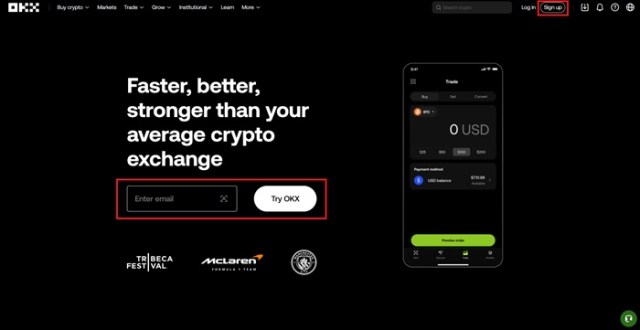
Step 2: Add Funds Using Fiat or Transfer from an Existing Wallet
With that out of the way, now you need to deposit some funds. You can do this by either buying some with fiat, like USD or EUR. Alternatively, you can transfer existing crypto (if you have any) to the exchange of your choice.
Many exchanges offer various methods for deposits, which include bank transfers, credit/debit cards, and even PayPal. Choose the deposit method that’s easiest for you.
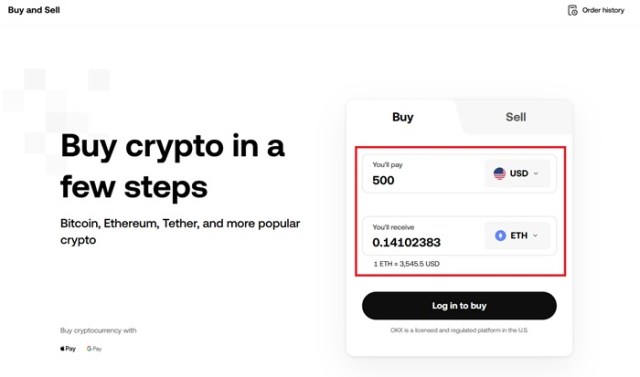
Step 3: Select an Ethereum Trading Pair
Now that your funds have been deposited, navigate to the ‘Trade’ or ‘Exchange’ section. Here, you’ll find various trading pairs for $ETH, like $ETH/$USD or $ETH/$USDT. Choose your preferred trading pair.
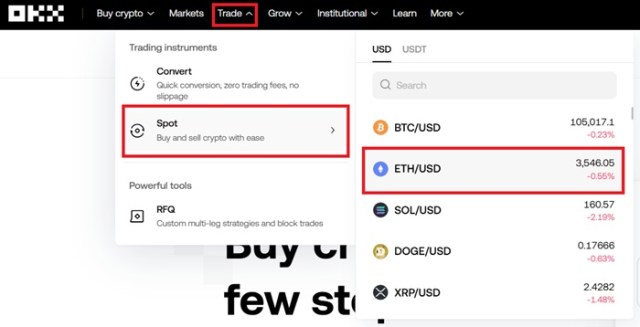
Step 4: Make a Trade
If you’d like to purchase $ETH, simply click on ‘Buy’, enter the amount you want to spend, and review the order. If you’re happy with the applicable fees, confirm the order. If you want to sell, tap on ‘Sell’, enter the amount you plan to sell, and confirm.
Summing Up the Best Ethereum Exchanges to Use
There you have it, a comprehensive list covering the best Ethereum exchanges out there. If centralized options are more your style, look into solutions like Binance and Weex. If you prefer a more hands-off approach, a good choice is Pionex, with its 16 built-in trading bots able to take the reins.
Alternatively, for those looking to maintain control over their assets and keys, decentralized options like Uniswap or SushiSwap might be for you.
With all that being said, you should always DYOR before making any commitments. Furthermore, nothing in this article should be taken as financial advice.
FAQs
1. Where can I exchange Ethereum?
You can exchange Ethereum on various crypto exchanges, as most of them offer $ETH trading. Some top centralized platforms include Binance, Weex, and Pionex. If you’re looking for a decentralized option, you can use Uniswap or SushiSwap. And for the best of both, OKX is a CEX that also offers a decentralized version.
2. What is the best place to buy $ETH?
The best place to buy $ETH depends on your investment goals. Binance is a top choice; it has low fees and offers over 300 $ETH pairs. Leverage traders should look into Weex as it offers up to 400x leverage and deep $ETH liquidity. Finally, DEXs like Uniswap are a top option for the more privacy-conscious traders.
3. Where to swap Ethereum tokens?
DEXs like Uniswap or SushiSwap are top options for swapping $ETH. They don’t require KYC and remove the middleman that normally facilitates trades on CEXs like Binance. That said, options like Binance or OKX are also great choices for swapping $ETH.
4. How to exchange Bitcoin for Ethereum?
You can exchange $BTC for $ETH by choosing a reputable exchange like OKX or Binance. These solutions have $BTC/$ETH pairs. Next, simply deposit $BTC, navigate to spot trading, and select a $BTC/$ETH pair. With that done, you can exchange the required amount of $ETH and withdraw it to your wallet immediately.
