Hardware wallets earned their reputation by solving real problems at the right moment. But crypto has outgrown the moment it was designed for.
What’s different now is how wallets are actually used. They’re no longer occasional tools that you open only occasionally. They sit at the center of everything, signing transactions, managing identities, interacting with DeFi, and staying connected across chains. At the same time, the systems that watch and interact with those wallets have become more sophisticated, driven by automation, analytics, and increasingly, AI.
BMIC starts from that reality. Instead of treating security as a fixed setup, it uses AI as a supporting layer to assist with monitoring activity and flagging unusual patterns as conditions change. The idea isn’t to replace cryptography with AI, but to utilize it where static rules fall short, especially in environments where threats evolve faster than firmware updates can be implemented.
That’s why the comparison between Ledger and BMIC goes deeper than hardware versus software. It’s really about whether long-term crypto security can afford to remain static in a world that’s becoming increasingly automated, data-driven, and interconnected. Also, the project just launched a presale for their native token-$BMIC.
Ledger’s Model: Security Through Isolation
Ledger’s approach is built around a clear principle: keep private keys offline and away from internet-connected environments. That idea dramatically reduced attack surfaces and helped millions of users take control of their assets without relying on exchanges.
For a long time, that model worked extremely well. Hardware wallets have made self-custody a practical rather than intimidating option, and they remain a crucial part of the ecosystem today.
However, hardware also comes with built-in constraints when we consider that devices age. Firmware support eventually slows or ends. While updates can extend the usefulness, the security model itself remains tightly tied to a physical product with its own lifecycle.
That raises a quiet but important question for long-term holders: what happens when the assets are meant to last indefinitely, but the device protecting them isn’t?
BMIC’s Perspective: Security as a Living System
BMIC approaches the same problem from a different angle. Instead of anchoring security to a single device or fixed setup, the project frames security as something that needs to evolve together with the technology.
According to what the team has shared publicly, BMIC is being built around a wallet architecture that supports layered and hybrid cryptography. Rather than relying on a single standard to remain unchanged forever, the system is designed to accommodate upgrades as assumptions evolve.
The idea isn’t to rip out what works today. It’s to avoid locking users into models that can’t adapt tomorrow.
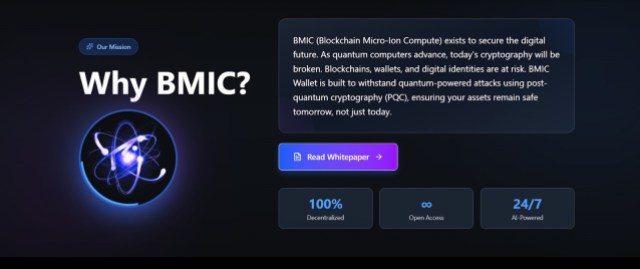
BMIC approaches security as an ongoing service designed to quietly protect users in the background, anticipating both current and future threats by incorporating post-quantum cryptography from the start.
Different Assumptions About the Future
According to BMIC, the main difference between Ledger and BMIC lies in the assumptions each company makes about future security challenges.
Ledger assumes that strong isolation and current cryptographic standards will remain sufficient for the foreseeable future. That’s a reasonable position, and one that continues to protect a large portion of the market.
According to BMIC, the company designs its wallet security to anticipate both existing and emerging threats by integrating post-quantum cryptography from the outset, providing protection against both conventional and quantum attacks. From that viewpoint, long-term security depends less on freezing a setup in time and more on building systems that can adjust without forcing users to constantly migrate assets or rethink custody.
Neither approach is “wrong.” They’re simply answers to different versions of the same problem.
Where Tokens and Utility Come In
Another key difference between Ledger and BMIC is the structure of the utility.
Ledger is a product company. You buy the device, and that’s largely the end of the relationship, aside from updates and optional services.
BMIC is building an ecosystem where its token plays an active role. Based on project materials, the token is intended to unlock advanced wallet features, support staking, and enable access to future security-related services. Usage and participation are intended to align directly with how the system operates over time.
This model shifts security from a one-time purchase to something more dynamic, where incentives, access, and protection are linked.
Why This Comparison Is Coming Up More Often
As crypto matures, the center of gravity shifts. Early on, the focus was speed, accessibility, and growth. Now the focus is on durability.
Long-term holders aren’t only asking how to secure assets today. They’re asking how those security decisions hold up five or ten years down the line.
That’s why comparisons between BMIC and Ledger are starting to surface. Not because one is replacing the other, but because they represent two different philosophies about how crypto security should work in an ecosystem designed to last.
BMIC vs Hardware Wallets- Verdict
Ledger earned its place by solving a very real problem at the right time. It gives people control of their crypto when most alternatives are risky or confusing. That foundation still matters, and it’s why hardware wallets still play a role in crypto security.
BMIC isn’t trying to rewrite that history. It’s responding to how people actually use crypto now. Wallets don’t sit idle anymore as they used to. Nowadays, wallets stay connected, manage multiple roles, and protect assets people expect to hold long after today’s devices are outdated.
BMIC is really pushing a shift in mindset. Instead of asking whether a wallet is secure at the moment you set it up, it asks how security holds up as everything around it changes, including usage, threats, and technology. That’s a more demanding standard, but it’s also one that fits where crypto seems to be headed.
Learn more about BMIC:
Presale: https://bmic.ai/
Social: https://x.com/BMIC_ai
Telegram: https://t.me/+6d1dX_uwKKdhZDFk