Hardware wallets have long been seen as the gold standard for crypto security, and Ledger has played a major role in that story. For years, storing assets offline felt like the safest possible option. But the crypto landscape has changed. Users now interact with DeFi, staking, payments, and multi-chain apps on a daily basis. In that environment, static devices are starting to show their limits.
This is exactly why BMIC ($BMIC) is becoming popular after launching a presale for its native token. BMIC approaches security from a completely different angle since it’s actually not competing with hardware wallets.
This new web3 project is about securing how crypto is held, used, staked, and moved in a future where threats are becoming more advanced. For investors scanning the market for the best crypto to buy now during a slower cycle, this difference matters.
Why Ledger’s Model Is Starting to Fall Behind
Ledger and similar hardware wallets were built for a time when crypto usage was simple. Assets were stored, occasionally sent, and mostly left untouched. That model struggles in today’s environment, where users constantly sign transactions, interact with smart contracts, and expose keys across multiple chains. Even with offline storage, public keys still appear on-chain, creating long-term risks.
Another issue is usability and recovery. Seed phrases remain a single point of failure. Lose them, and assets are gone. Damage the device, and recovery becomes stressful and error-prone. While Ledger improves hardware security, it does not solve the structural weaknesses tied to how keys and signatures work on-chain.
Perhaps most importantly, hardware wallets are reactive. They protect against known threats today, but they are not designed for what comes next. As quantum computing moves closer to practical use, classical cryptography becomes a ticking clock rather than a permanent solution.
How BMIC Takes a Different Approach
BMIC is built as a security system, not a device. From day one, it is designed to be quantum-native, which means it does not rely on cryptography that will need emergency patches in the future. This directly addresses the “harvest now, decrypt later” threat that hardware wallets are exposed to by design.
A major advantage of BMIC is its signature-hiding architecture. Unlike Ledger-style wallets that expose public keys on-chain, BMIC uses smart account structures and private routing to remove that exposure entirely. This closes the main attack vector future quantum systems are expected to target. It is a structural shift, not an incremental upgrade.
BMIC also extends protection beyond storage. Staking and payments are often overlooked security risks. BMIC secures staking without exposing classical keys and enables quantum-safe payments, protecting both long-term holders and active users. Ledger protects assets at rest. BMIC protects assets in motion.
Full Stack Security, Not Just a Wallet
One of the clearest differences between BMIC and Ledger is scope. Ledger is a wallet. BMIC is a full quantum-secure finance stack. It combines custody, staking, and payments under one architecture, all protected by post-quantum cryptography.

BMIC also integrates AI-driven threat detection and optimization. The system continuously monitors activity, balances workloads, and adapts as standards evolve. This allows security to improve over time instead of becoming obsolete. For enterprises, BMIC offers Quantum Security-as-a-Service, making it possible for banks, fintechs, and institutions to integrate advanced custody and key management without rebuilding their infrastructure.
This broader vision is why BMIC is increasingly discussed among best altcoin to buy candidates. Its value does not depend on short-term market hype, but on real services that users and institutions actually need.
Tokenomics and Crypto Presale Structure
BMIC’s crypto presale is one of the best structured ones on the market right now. The total supply is capped at 1,500,000,000 tokens. Of that, 50% is allocated to the presale, ensuring wide distribution. A further 10% is reserved for private sale participants, while 12% is dedicated to rewards and staking.
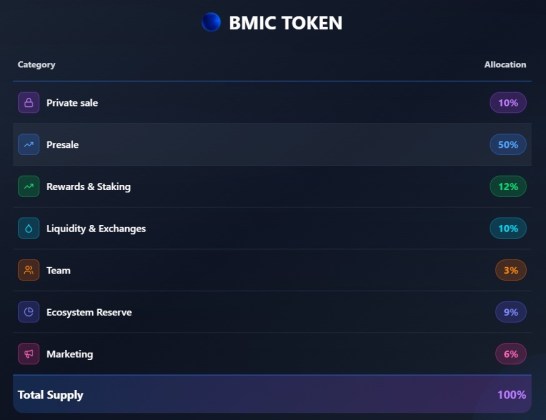
Liquidity and exchange listings account for 10%, helping support post-launch trading. The team allocation is limited to just 3%, which is relatively low compared to many projects, while 9% is reserved for the ecosystem and 6% for marketing. This structure reflects a focus on development, adoption, and network participation rather than excessive insider allocation.
The presale pricing model is designed to reward early conviction, with multiple phases and a launch price set above the final presale tier. This structure is one reason BMIC is being mentioned more often in discussions around the best crypto presale opportunities ahead of 2026.
Why the Comparison Matters Now
Ledger helped define crypto self-custody, but the market is moving beyond hardware-only security. As users think more seriously about long-term risks, especially quantum-related ones, systems built for the future start to stand out.
This is the essence of BMIC. It replaces device-based trust with protocol-level security, extends protection to staking and payments, and backs it all with a clear token model and growing ecosystem. In a market where patience is replacing hype, that combination is why many are starting to view $BMIC as one of the best crypto to buy, not just for the next cycle, but for the next era of crypto security.
For those looking beyond legacy wallets and into infrastructure that can last, BMIC’s crypto presale is becoming harder to ignore.
Discover the future of quantum-secure Web3 with BMIC:
Presale: https://bmic.ai
X (Twitter): https://x.com/BMIC_ai
Telegram: https://t.me/+6d1dX_uwKKdhZDFk