



Are you looking to maximize your crypto exposure with precise risk control? If so, Bitcoin options trading could be for you.
That’s because trading Bitcoin options gives you leverage to tap into big $BTC moves with minimal capital, unlock gains in rising or falling markets, and act as insurance when volatility strikes.
For traders, that means bigger profit potential, solid hedging tools, and the chance to capitalize when volatility jumps over 15%.
Read on to discover everything you need to know about trading Bitcoin options – from cash-settled trades and covered calls to complex spreads. We’ll also delve into how to select the right platform, as well as risk-management strategies to help you navigate volatility profitably.
What Are Bitcoin Options?
In the ever-changing world of crypto, there’s a lot to get your head around. Throw into the mix Bitcoin options, and you may find yourself wanting to head for the hills.
But don’t panic. While they are considered complex financial instruments, Bitcoin options are actually fairly straightforward once you know the basics.
Here’s a quick example: Bitcoin’s current (spot) price is around $110K. Say, hypothetically, you buy a call (buy) option with a strike price of $115K and a one-month expiry date for a premium of $1K. In other words, you expect the Bitcoin price to go up.
If at any time before the expiration date the $BTC price hits $115K, success! You can use your option to buy Bitcoin for $110K, even though it’s now valued at $115. Minus your premium, that’s a settlement of $4K in profit.
You can opt for either a cash settlement (often in USD or $USDT, which is the simplest and most convenient option) or physical delivery. This is your settlement (profit) in actual $BTC.
The same theory applies to Bitcoin put options, but in this instance, you are placing your bet that the $BTC price will decrease. So – again, hypothetically – you pay a $1K premium to buy a Bitcoin put option with a strike price of $105K and a one-month expiry date.
If at any time the $BTC price drops to $105K before the contract expires, you can use your option to sell your $BTC for the price it was when you bought the option – $110K. Again, that’s a $4K profit in your pocket.
That said, trading does not come with a crystal ball, and there’s always the chance the $BTC won’t behave the way you want it to. If your contract expires before $BTC has reached the milestone you bought an option for, that means no profit. And you kiss your premium goodbye, too.
Bitcoin options are all about timing – the $BTC spot price (that’s its current market price) must move before the contract expires to make your contract worth something. The beauty of options, though, is that you are not obligated to buy or sell. Do it only if it plays in your favor.
Now, let’s touch on contract sizes, which is another term synonymous with options. This is the set amount of Bitcoin that one option/contract represents. It’s the best way to see exactly how much $BTC you are buying or selling, and how much money you stand to gain or lose when the $BTC price moves.
And in case you’re wondering, the contract size is determined by the exchange on which you trade your Bitcoin options. That same exchange also sets the expiration date of the contract.
There’s one last thing to bear in mind about Bitcoin options. As derivatives, they are classified as complex financial instruments under EU MiFID rules, with similar regulatory treatment in the US, Australia, and other jurisdictions.
Those regulations are designed to boost transparency, protect investors, harmonize financial markets, and ensure fair, efficient, and competitive trading across all regions.
👇 Click for a glossary of some common terminology in trading options contracts. 👇
| Term | Definition |
|---|---|
| Strike price | The price that Bitcoin needs to hit to make a profit |
| Call price | The premium paid for a Bitcoin buy (call) option |
| Put price | The premium paid for a Bitcoin sell (put) option |
| Spot price | The current market price |
| Expiration date | The date the contract expires, as set by the exchange |
| In the money | The strike price is better than the spot price |
| At the money | The strike price is identical to the spot price |
| Cash settlement | Profit that is returned to the trader in $USD or $USDT |
| Physical delivery contract | Profit that is returned to the trader in $BTC |
| Underlying asset | The currency on which the option is based – in this instance, $BTC |
| Contract size | The amount of $BTC that a single options contract controls |
How Do Bitcoin Options Work?
Remember, trading Bitcoin options gives you the right to buy (call) or sell (put) $BTC at a set price and date. But you are under no obligation. And if you’re buying a $BTC option, you pay a premium for that right. That’s where risk comes into play. If the timing and price don’t work in your favor, you’ll lose that premium.
However, if you’re selling (also known as writing) Bitcoin options, then a margin system comes into play. This is collateral you have to post to cover potential losses, and there are two aspects to it.
The initial margin is applied to open a position, and it is based on the option’s price, strike, implied volatility, and your account leverage. Then there’s the maintenance margin, which keeps it open.
Then there are the leverage mechanics. This lets you control a bigger $BTC position than your capital outlay to magnify profits. Say, for instance, you opt for 10x leverage. That means posting $1K in margin to write an option that represents $10K of $BTC exposure.
This may sound like a win, but be warned. If the trade doesn’t go your way, you’re in for a more brutal loss.
And because Bitcoin futures have expiries, you may want to close your current contract and open another one with a later expiry. This is what’s known as ‘contract rollover,’ and it can involve additional premiums, as well as new levels of volatility.
👇 Click for a Bitcoin options trading example. 👇
So, let’s put all of the above into an example. Right now, the $BTC is around $110K. Say you believe that $BTC will hit a strike price of $115K within 30 days. You pay an upfront $300 premium for a one-month call option. Trading fees could also apply – let’s say around $0.15.
Fast forward to your Bitcoin options expiry date. If the $BTC price behaves itself, you’ll be in the money, so to speak. For instance, if $BTC is at $115K when your option expires, your option payoff will be $416.65. Take off your $300.15 premium and trading fee, and you’ll have made a net profit of $116.29.
However, if the trade doesn’t go your way and the $BTC stays below $115K, your option will be worth sweet nothing. Plus, you’ll lose your $300.15 premium and trading.
What Are the Fees Involved with Trading Bitcoin Options?
Just like when trading traditional options, Bitcoin options also entail costs. It’s important to be aware of and understand what fees you will be charged. You don’t want any unwelcome surprises. Here’s a quick look at the typical fees you will come across:
- Premium/Funding: This is the amount of capital needed to open or maintain a trade. If you’re buying options, this is the one-time premium you pay when you enter a trade. And if you’re selling a $BTC call, your capital will be locked while the trade is open.
- Commission: This is the fee charged by the exchange you’re trading on each time you enter or exit a trade. This can add up quickly, especially if you’re trading small-sized or short-term spreads. Make sure you know the commission fees upfront.
- Spreads: This is when you buy one option and simultaneously sell another, typically of the same type – call or put – but with different strike prices and/or expiries. Spreads are a good way to manage risk, reduce cost, and still profit from $BTC price swings.
- Withdrawal: Most options trading platforms won’t charge you a fee to deposit funds, although network fees still apply. However, the majority of platforms do charge a flat withdrawal fee to cover blockchain transaction costs, and perhaps a little extra padding for the platform.
- Inactivity: While not common practice for the major trading platforms, some platforms charge inactivity fees. That’s something to look out for in the fine print, as it can eat into your balance if your account is idle for a while.
Spot vs Futures vs Options: Which Trading Method Suits You?
Options aren’t the only trading avenue available when it comes to Bitcoin. Spot and futures are other trading options, each with its own pros and cons. Here’s a quick look at those, and the types of traders each one is best suited for.
| Trading Method | Pros | Cons | Best For |
|---|---|---|---|
| Spot | ✅ Actual crypto ownership ✅ Can stake/lend holdings ✅ No expiry dates |
❌ No leverage available ❌ Can’t profit from falling prices ❌ No hedging mechanisms to reduce risk |
Beginners and long-term investors (HODLers) |
| Futures | ✅ Potential profit in both bull and bear markets ✅ Amplified gains through leverage ✅ Enables you to hedge against market volatility |
❌ Potentially amplified losses ❌ High risk ❌ Complex trading, not suited to beginners |
Active traders with market experience |
| Options | ✅ Good leverage by controlling a sizeable amount of $BTC with a small investment ✅ Potential profit, whether the $BTC spot price goes up or down ✅ Protects holdings from price fluctuations |
❌ Highly volatile ❌ Potential of losing your premium ❌ Complex trading that requires skill ❌ Lack of liquidity in some options markets |
Strategic traders with good market knowledge and experience |
How to Choose a Bitcoin Options Trading Platform
Ready to try your hand at trading contracts? Your starting point – other than this guide – is choosing the right platform to trade those contracts on. That in itself can be a daunting task. But relax, we’ve got you covered.
Here are the most important factors to consider when selecting a trading platform. In fact, these are the same metrics we use to identify our top picks, too.
Regulation
Decentralized shouldn’t mean deregulated. A well-regulated platform will follow legal standards and protect your funds. It also enforces fair trading while reducing the risk of fraud.
You want a platform that gives you peace of mind, security, and transparency. That said, offshore platforms, like Deribit (which is based in Panama), operate under looser regulations. That’s why they tend to offer higher leverage.
Spreads and fees
These directly impact your trading costs and profit. Ideally, you want low spreads. That means less slippage in the fast-moving Bitcoin options markets. Keep an eye out for hidden commissions, too. It’s part of doing your own research (DYOR).
Liquidity
The higher the platform’s liquidity, the less risk of slippage and price manipulation risks. It guarantees enough buyers and sellers, which means quick, fair trades at stable prices, even during market volatility.
Available contract types
Whether options, futures, or perpetuals, the more contract types available means more flexibility for you. Variety means being able to tailor your trade strategy to hedge, speculate, or diversify your risk. Be sure to also check contract specifications, like expiry dates and settlement options.
Leverage and margin requirements
These shape your buying power and risk exposure. And remember, higher leverage increases potential gains and losses. Many regulated platforms cap leverage at 50x. That said, offshore platforms, like Margex, for instance, tend to cap leverage at 100x and above.
Risk management tools
It’s no secret that the crypto market can be highly volatile. So look for a platform that offers stop-loss and take-profit tools to limit losses and secure gains automatically. They’re geared to help you make smart, disciplined trading decisions.
Platform features
These can go a long way in determining your trading edge. Advanced tools like depth-of-market, custom charting, and automated strategies boost precision.
So look for a platform with MT4/5 support. It means access to Expert Advisers, which are automated trading bots. Copy trading and options analytics will also come in handy.
Security and reputation
Is the platform secure and well-established? Look for features like 2FA, cold storage for user funds, insurance/reserve funds for user protection, research past security incidents or hacks
User experience and interface
Is the platform intuitive and beginner-friendly? Advanced tools are great – but beginners should feel comfortable using the interface. Mobile app availability for trading on the go.
Where to Trade Bitcoin Options? Best Platforms Compared
If you’re wondering where to buy Bitcoin options, there are many options available. But here’s a quick look at the best options-trading platforms where you can trade Bitcoin options. That’s in addition to futures and spot trading.
| Broker | Max. Leverage | Maker/Taker Fees | Contract Types | Best For |
|---|---|---|---|---|
| Margex | 100x | Maker: 0.019% Taker: 0.060% |
Standard futures, perpetual futures | Beginners |
| MEXC | 500x | Maker: 0.01% Taker: 0.04% |
Perpetual futures | Beginners |
| OKX | 200x | Maker: 0.030% Taker: 0.030% |
Options, futures | Traders with some experience |
| Binance | 100x | Maker: 0.02% Taker: 0.04% |
Options, futures | All levels, from beginners to pros |
| BloFin | 150x | Maker: 0.02% Taker: 0.06% |
Futures | All levels, from beginners to pros |
| KCEX | 125x | Maker 0% Taker 0.01% |
Futures | Experienced traders |
| Bybit | 100x | Maker: 0.02% Taker: 0.03% |
Options, futures | All levels, from beginners to pros |
| CoinFutures | 1,000x | N/A | Futures | Beginners looking for a no-KYC platform |
Margex is our top pick if you’re looking for a good mix of trading options. That includes Bitcoin futures. It’s also a user-friendly platform, making it ideal for new traders.
That said, experienced traders will appreciate KCEX’s zero maker/taker fees and maximum leverage of 125%.
How to Trade Bitcoin Options: Step-by-Step Guide
Ready to start contract trading? Read on as we explain how to buy Bitcoin options, step by step, on one of our top exchanges.
Step 1: Select an Exchange
Select an exchange that supports crypto contracts trading – be it options or futures. In this example, we’ll use Binance because it offers options and futures trading, and it’s designed to suit all types of traders – from novices to experts.
Step 2: Create an Account
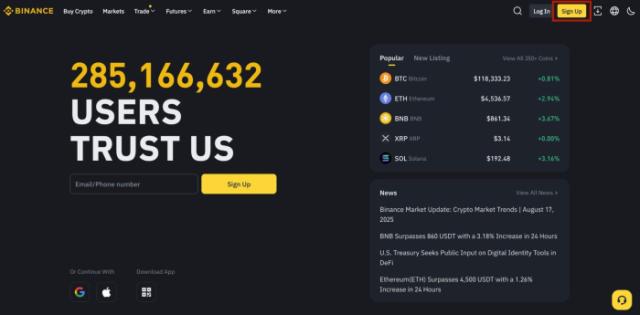
Go to the official Binance website and select ‘Sign Up.’ You’ll be prompted to enter your email address or telephone number. Once you’ve done that, select a strong password. A verification code will be sent to the email address or telephone number you entered.
 Now you need to verify your ID. Most CEXs – like Binance – have KYC (know your customer) policies. That means you need to supply and verify information specific to you, and you won’t be able to trade on the platform without doing this.
Bybit and CoinFutures, on the other hand, are among the best no-KYC crypto exchanges and platforms.
The region you’re in will determine what is required to verify your identity. You might need to upload a copy of your passport; provide your country of residence, nationality, and your ID number, and disclose your source of wealth with supporting documents.
Yes, KYC can be quite laborious.
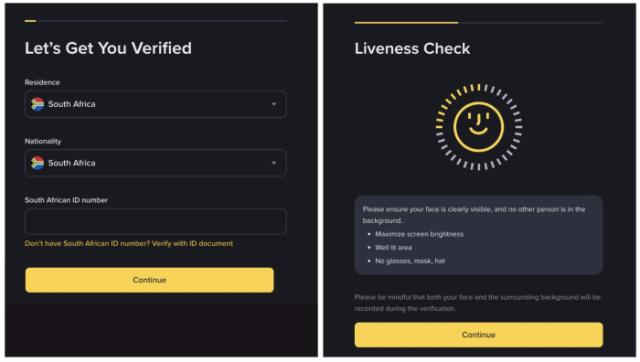 Next, you need to do a Liveness Check. This entails allowing Binance to use your device’s camera to take a live video of you. You’ll be required to nod your head and blink your eyes to pass the check.
Once you’ve completed your verification requirements, Binance will review the information you submitted. This could take between 15 minutes to 24 hours, by which time you’ll be notified whether you’ve passed the verification section.
Step 3: Enable Options and Complete the Quiz
Activate options trading by selecting ‘Futures’ (which you’ll find at the top of your Binance account) and then ‘Options.’
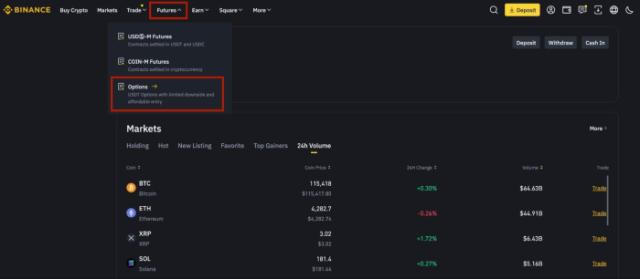 Then complete the trading quiz. This checks your knowledge of risks, settlement, and how calls and pulls work.
Why do you need to pass the quiz before you can trade options? Well, the top trading platforms adhere to the EU MiFID II ‘appropriateness’ rules. These require platforms to assess your options trading knowledge.
Other countries – including the US, Canada, and Australia – also apply their own checks. The EU’s MiFID II, however, is more uniform, often presented as a structured, test-style questionnaire.
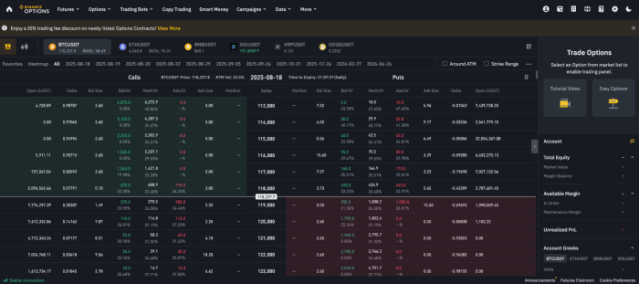 Once that’s done, you’ll be taken to the market view, where you’ll find all traded options and the order book.
Step 4: Fund Your Options Wallet
To trade Bitcoin Options, first, you need to transfer funds from your spot wallet to your options wallet. This is to cover premiums, fees, and margin.
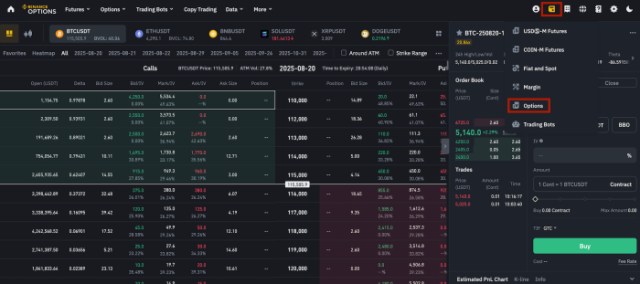 Click on the wallet icon in the top-right corner and select ‘Options,’ and then ‘Transfer.’
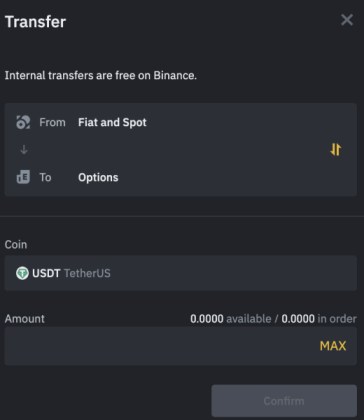 Input the amount of funding in your spot wallet that you want to put in your options wallet and select ‘Transfer.’
Step 5: Begin Trading Bitcoin Options
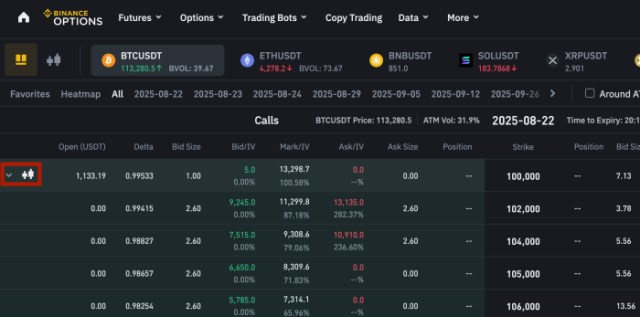
With funds in your options wallet, you can now begin trading. Select Bitcoin options from the top of the screen and select a call or put option to open a position. This will bring up the trading panel.
Want to see market details? Click the arrow icon on the far right. Or click on the candlestick icon next to it to switch to the trading interface.
 Next, choose your order type – best bid and offer or a limit order. Then enter the price and amount, and click ‘Buy’ or ‘Sell’ to place your call or put option.
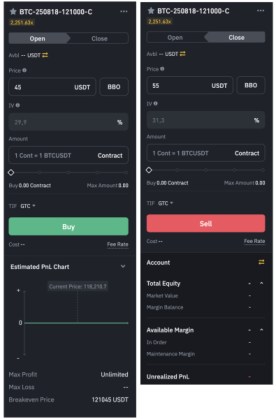 At that point, the premium will be deducted from your options wallet, and you can consider yourself a Bitcoin options trader.
Options Trading Risk Mitigation Techniques and Tips
Options are powerful because they give you leverage with defined risk. But you have to manage that risk correctly.
While all trading carries inherent risk, you want to be especially cautious if you’re new to Bitcoin options trading. Here are some ways to mitigate your risk:
- Capital allocation and position sizing: Never bet the farm. Allocate only a small fraction – say, 1% to 2% – of your portfolio to a single option trade. The same applies to positions. Start small with initial positions limited to between 6% and 8%.
- Leverage: When it comes to leverage, leave the big numbers for the pros, especially if the asset is particularly volatile. If you’re new to options trading, a conservative approach to leverage can significantly lower your risk.
- Diversification: Diversification shouldn’t be limited to the digital assets you invest in; the same goes for strikes and expiry dates. Opt for a mix of short-term and longer-term options.
- Stop-loss and exit strategies: The top exchanges provide tools such as stop losses and alerts. Use them to your advantage and hedge options positions to cap the downside. Speaking of hedging, use option spreads, like verticals, to offset your cost and risk. For instance, buy a $BTC $130K call, and sell a $140K call.
- Options-specific techniques: Be sure to monitor the Greeks to anticipate risks. Keep an eye on Delta for price sensitivity, Vega for volatility shifts, and Theta for time decay. You can combat that last one by avoiding unnecessary short-term contracts.
- Psychological discipline: You can’t control the market, but you can control your actions. Emotional control reduces impulsive decisions. So be sure to set clear profit targets and resist greed-driven overtrading. Stick to pre-defined strategies instead of chasing losses. Small, consistent gains are the way to go.
Popular Options Contract Trading Strategies
When it comes to trading Bitcoin options, there are a few strategies you can follow to help minimize your risk. Read on for the most popular strategies:
Directional Strategy
This strategy involves taking positions based on an expected price move – upward or downward. The logic is simple. Buy calls if you expect the $BTC price to rise, or buy puts if you anticipate a drop.
In terms of entry signals, keep an eye out for breakout patterns, momentum indicators, or news catalysts. Minimize your risk by limiting your position size and monitoring the Greeks – Delta and Theta in particular. Also, set your maximum loss level to the same amount as the premium you paid.
Exit your position when you reach your profit target. However, if the market takes a turn in the opposite direction you expected it to go, or if time decay starts eroding the option value, that’s when it’s time to exit.
That’s why directional strategies are best suited for traders with a clearer directional bias. They work well during strong trends or high-volatility events, but they require strict discipline.
Breakout Trading
This strategy works best for active traders during periods of market consolidation before news or events. If you’re comfortable with fast-moving markets and willing to act decisively, breakout trading has your name all over it.
Breakout trading involves targeting sharp moves that occur when the $BTC price breaks key support or resistance levels. Here, the thinking is that once Bitcoin escapes a price range, volatility tends to surge. This makes calls attractive in upside breakouts and puts in downside ones.
Entry is usually confirmed by high trading volume, when candlestick patterns close beyond resistance/support, or when there are volatility expansion indicators. That said, false breakouts are common, so keep your sizing small and set pre-defined premium loss limits.
It’s time to exit when you hit your profit target, when there’s waning momentum, or those candlesticks start reversing.
Mean Reversion Scalping
This is a short-term strategy that bets the $BTC price will snap back toward its average after a quick spike. That’s because extreme moves often retrace, so traders use short-dated options to profit from volatility compression.
Entry signals include overbought/oversold readings on the Relative Strength Index, Bollinger Band touches, or sudden price dislocations.
The mean reversion scalping strategy works best in choppy, range-bound markets where the $BTC price fluctuates between support and resistance. For that reason, it’s better suited to advanced intraday traders.
Spread and Arbitrage
Spread and arbitrage strategies focus on exploiting price differences between contracts or markets. These entail controlling exposure with balanced positions and monitoring margin for sold positions.
Unusual price gaps, skewed implied volatility, or misaligned strikes/expiries are the entry signs to look for, in conjunction with comparing Greeks and the order book depth. And it’s time to exit when spreads normalize or your profit hits your target.
Spread and arbitrage strategies suit disciplined, analytical traders, particularly when markets move fast and temporary inefficiencies appear.
Common Mistakes to Avoid
🔶 It’s said that around 95% of traders fail, and over-leveraging positions is a big contributing factor. Higher leverage can mean higher profit, but it also means higher risk. Remember, even small market moves can trigger large losses or liquidation.
💡 Rather, limit your position size and set yourself strict exit rules.
🔶 All-in mentality, emotional trading, and FOMO are a recipe for disaster, as they involve risking large portions of your account on a single trade driven by fear or greed.
💡 Trade with your head, not your heart. Set low position limits and stick to a predefined strategy.
🔶 Correlation blindness can kick in if you ignore how different assets move in relation to each other. After all, if $BTC is down, $ETh, for instance, is also likely to go down. And if you have a diversified portfolio, that could mean concentrated risk.
💡 To avoid this, monitor correlations, adjust your position sizes, and avoid taking multiple positions that react similarly to the same market events.
🔶 Keep an eye on the rolling fees, especially when holding perpetual positions. Those small recurring fees can accumulate fast and eat away at your profit – or magnify losses.
💡 To avoid this, always factor cumulative funding rates into your position sizing, hold time, and profit targets before committing to longer-term option strategies.
Wrapping Up Our Guide on Bitcoin Options Trading
There you have it – everything you need to know to get you started on your Bitcoin options trading journey.
From the basic definition of Bitcoin options, the fees involved, and how to choose a trading platform, to the top trading strategies and how to minimize your risk, we hope you find this guide a useful starting point, particularly if you’re new to crypto trading.
We can’t emphasize this enough, though. It’s important to trade smartly. Choose a strategy and stick to it, put your emotions aside, keep your capital allocation and position sizing low, and use stop-loss and exit strategies to lower your risk.
Bitcoin options trading can be rewarding, but there’s always an inherent risk, too. So be sure to always DYOR. After all, this guide should not be considered financial advice.
FAQs
1. Is it possible to trade options on Bitcoin?
Absolutely. Many platforms, including Margex, Binance, and other top trading hubs, give the option to trade Bitcoin. Some also offer options trading for other crypto giants, such as Ethereum. Whichever asset you choose to trade options in, the process is the same for each.
2. Can you buy Bitcoin options on Robinhood?
No, you cannot. At least, not yet. Robinhood offers options trading for traditional finance, but when it comes to crypto, you can buy and/or sell digital assets, but you can’t trade Bitcoin futures.
But with institutional adoption of digital currencies growing at an unprecedented rate and retail investors following suit, we wouldn’t be surprised if Robinhood offers options trading in the near future.
3. Can I trade options on Coinbase?
Options, no. However, in addition to buying and selling crypto at spot prices, Coinbase also offers derivatives trading – futures and perpetuals. Remember, futures trading is very similar to options trading, but, unlike the latter, futures trading comes with the obligation to buy/sell when it expires.
That said, Coinbase acquired leading options exchange Derebit back in May 2024. And in July alone, Derebit’s options-trading volume stood at $109.45B.
4. Which Bitcoin ETF has options trading?
Popular Bitcoin ETFs that have options trading include BlackRock’s Shares Bitcoin Trust (IBIT); Bitwise Bitcoin ETF (BITB); Ark Invest’s ARK 21Shares Bitcoin ETF (ARKB); Fidelity Wise Origin Bitcoin Trust (FBTC); and Wisdom Tree Bitcoin Fund (BTCW).
