

Bitcoin has reclaimed the $63,000 level after losing the $60,000 mark last Friday in a breakdown that forced the most significant reassessment of market structure since the February lows. The recovery is tentative but meaningful — and XWIN Research Japan has published an analysis that addresses the question now circulating across every corner of the market with a directness the data supports.
Have institutions abandoned Bitcoin?
At first glance, the evidence points toward yes. Bitcoin has fallen sharply from its cycle highs. ETF outflows have persisted across multiple sessions. Altcoins across the ecosystem are down more than 70% from their peaks. The institutional enthusiasm that defined the post-ETF approval era appears to have cooled into something considerably more cautious.
The CryptoQuant data tells a more nuanced story. Spot trading volume across centralized exchanges fell to $679 billion in April 2026 — the lowest level since October 2023. Compared to the late-2025 highs, trading activity has declined by approximately 67%. Perpetual futures volume has fallen alongside spot volume as speculative leverage exits the market. The data describes a market with a buyer problem rather than a seller problem — participants stepping back rather than actively distributing.
But institutions have not disappeared — and the distinction between reduced participation and full abandonment is the most important analytical question the current recovery attempt requires answering before any conclusions about Bitcoin’s next major direction can be drawn with confidence.
Prices Are Weak But Foundations Are Not Breaking
The XWIN Research Japan analysis identifies the institutional presence that the headline ETF outflow numbers obscure. CryptoQuant’s average trade size data shows that exchanges including Gate, Kraken, and OKX continue processing large institutional-sized transactions — professional capital that has not exited the market but has reduced its visible activity in the metrics most commonly cited as institutional demand proxies.


Bitcoin Exchange Reserve | Source: CryptoQuant
Exchange reserves confirm the same reading from a different angle. Bitcoin held across all exchanges has fallen to approximately 2.7 million BTC — near multi-year lows. Investors continue withdrawing coins rather than moving them toward the sell side. The long-term conviction that was built during the ETF era has not reversed into distribution. It has retreated into patience.
The convergence of traditional finance and crypto infrastructure adds the structural dimension that the price weakness cannot erase. Trading in gold, silver, oil, equities, and ETFs on crypto exchanges reached record levels in 2026 — digital asset platforms evolving into broader financial marketplaces that serve institutional needs well beyond Bitcoin speculation.
The honest summary the analysis delivers is balanced without being falsely optimistic. Prices are weak. Demand is weak. The current market is genuinely bearish and the data reflects that without softening it.
But institutions remain active in the transaction data. Exchange reserves continue their structural decline. Market infrastructure keeps expanding. The next cycle’s foundation is being assembled during the current cycle’s weakness — quietly, persistently, and in the data rather than in the price.
Bitcoin Defends February Lows As Bulls Fight To Rebuild Structure
Bitcoin is attempting to stabilize above the $63,000 level after last week’s violent breakdown briefly pushed price below $60,000. The rebound has relieved some immediate selling pressure, but the daily chart still reflects a market operating within a clear bearish structure.
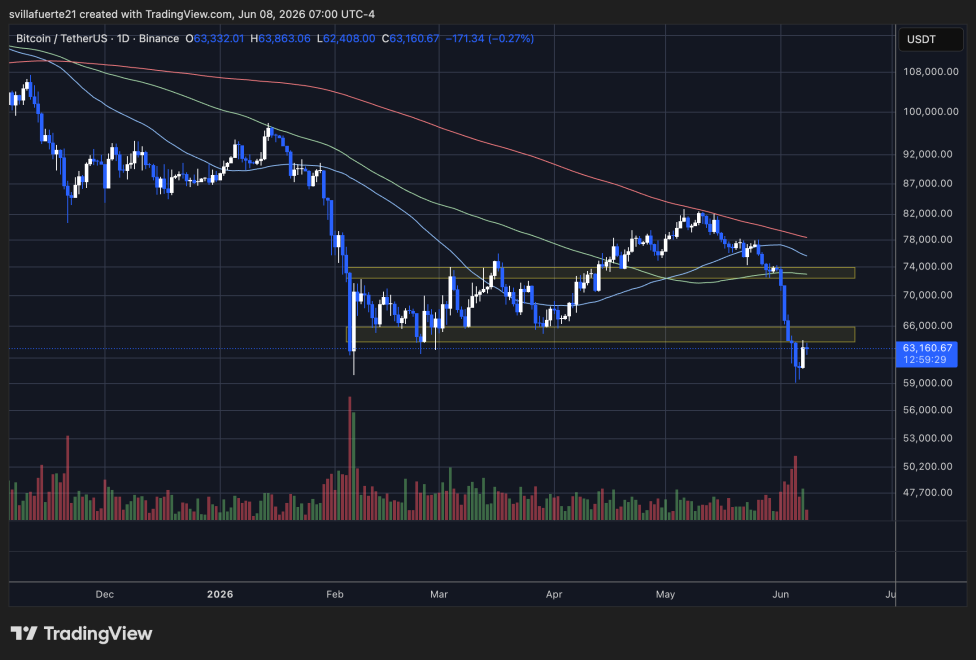

BTC consolidates below $65K mark | Source: BTCUSDT chart on TradingView
The most important development is Bitcoin’s recovery from the $60,000-$62,000 support region, which coincides with the February lows and represents the strongest demand zone visible on the chart. Buyers stepped in aggressively after the breakdown, producing a sharp bounce that prevented a deeper decline toward the mid-$50,000 range. However, the recovery remains incomplete.
Price continues trading below the former support area between $64,000 and $66,000, highlighted on the chart as a key supply zone. This region previously acted as support during the March and April consolidation and is now likely to attract sellers on any further rally attempt. Reclaiming that range is the first requirement for bulls to regain control of the short-term trend.
The broader technical picture remains weak. Bitcoin is trading below the 50-day, 100-day, and 200-day moving averages, all of which are sloping downward. The recent selloff was accompanied by a notable increase in volume, confirming strong participation behind the move rather than a low-liquidity decline.
The market appears to be building a relief rally from oversold conditions. As long as Bitcoin holds above $60,000, the possibility of a larger recovery remains intact. A failure to reclaim $64,000-$66,000, however, would leave the door open for another test of the recent lows.
Featured image from ChatGPT, chart from TradingView.com