

Wednesday, 17 December 2025 – Bitcoin (BTC) could be heading toward a deep correction, with veteran trader Peter Brandt warning of a potential 71% drawdown. In that scenario, BTC would fall from roughly $86,000 to around $25,000.
Even so, most market participants see this outcome as unlikely and far from a final verdict on Bitcoin’s trajectory. The broader view is that downside risk exists, but it does not define the long-term picture.
Supporters of Bitcoin Hyper (HYPER) argue the real constraint is not Bitcoin’s security or brand, but its limited functionality. For years, BTC has behaved more like a passive store of value than a practical monetary network. As adoption matures, that limitation is becoming harder to ignore.
Bitcoin Hyper does not attempt to alter Bitcoin’s core design. Instead, it builds alongside it, introducing a Layer-2 environment that allows BTC to be used at scale. As activity increases, more Bitcoin is drawn into the system, effectively locking value into productive use and creating sustained economic pull. Over time, that utility-driven demand could represent billions of dollars in network value.
This mechanism also defines the role of HYPER, the ecosystem’s native token. As Bitcoin usage within the Layer-2 expands, HYPER is structured to grow in parallel, offering exposure to Bitcoin’s functional adoption rather than pure price volatility.
Early traction suggests the narrative is gaining momentum. The presale has already raised $29.5 million, with demand picking up as investors position ahead of scheduled price increases.
At present, HYPER is priced at $0.013435. That level remains available for roughly eight more hours before the next presale phase pushes the price higher.
Bitcoin’s Parabolic Rally Shows Signs of Strain
After climbing to $94,000 earlier this month, Bitcoin has slipped back into a declining trend. Price action now suggests a potential retest of the November 21 low near $82,000, down from current levels around $86,000.
That downside scenario is not as remote as it may appear. Veteran trader Peter Brandt says Bitcoin has crossed a critical technical line, describing the moment as the point where “the current parabolic advance has been violated.”
Historically, Bitcoin’s major bull cycles have followed a familiar pattern. Price accelerates into a steep parabolic rise, only to reset sharply once that structure breaks. In past cycles, a break of the parabolic trend has not signaled a pause, but the end of the advance itself.
Bitcoin investors, do you know:
1. Bull cycles have experienced exponential decay
2. BTC's bull cycles have undergone parabolic advances
3. The violation of previous parabolas have all declined <80%
4. The current parabolic advance has been violated20% of ATH = $25,240 pic.twitter.com/0hWAaEd6Dy
— Peter Brandt (@PeterLBrandt) December 14, 2025
Brandt adds that while Bitcoin’s upside gains have diminished over successive cycles, the corrections that follow these breaks have remained aggressive. Previous drawdowns after similar technical violations have ranged between 60% and 80%.
Using Bitcoin’s most recent all-time high near $126,000 as a reference point, Brandt’s framework implies a return toward roughly 20% of that peak. That would place Bitcoin near $25,200, translating into a decline of approximately 71% from current prices around $86,000.
From this angle, the concern is not short-term volatility. The deeper issue is that once Bitcoin’s parabolic structure fails, history shows price struggles to find stability unless a new, durable source of demand enters the market.
That search for sustained demand is why a growing segment of investors is turning attention toward infrastructure-driven projects such as Bitcoin Hyper.
Creating the Conditions for Bitcoin to Function as Money
Bitcoin Hyper is built around a simple premise, Bitcoin should not remain a static asset. The goal is to make BTC usable, not just holdable.
The project introduces a Layer-2 execution environment powered by the Solana Virtual Machine, or SVM. This setup allows applications to process transactions quickly and at low cost, something Bitcoin’s base layer was never designed to support.
The obvious concern is whether this comes at the expense of Bitcoin’s core strengths. Bitcoin Hyper’s approach avoids that trade-off. Bitcoin itself remains unchanged, preserving its decentralization, security, and resistance to manipulation. Those attributes are treated as foundations to build on, not obstacles to work around.
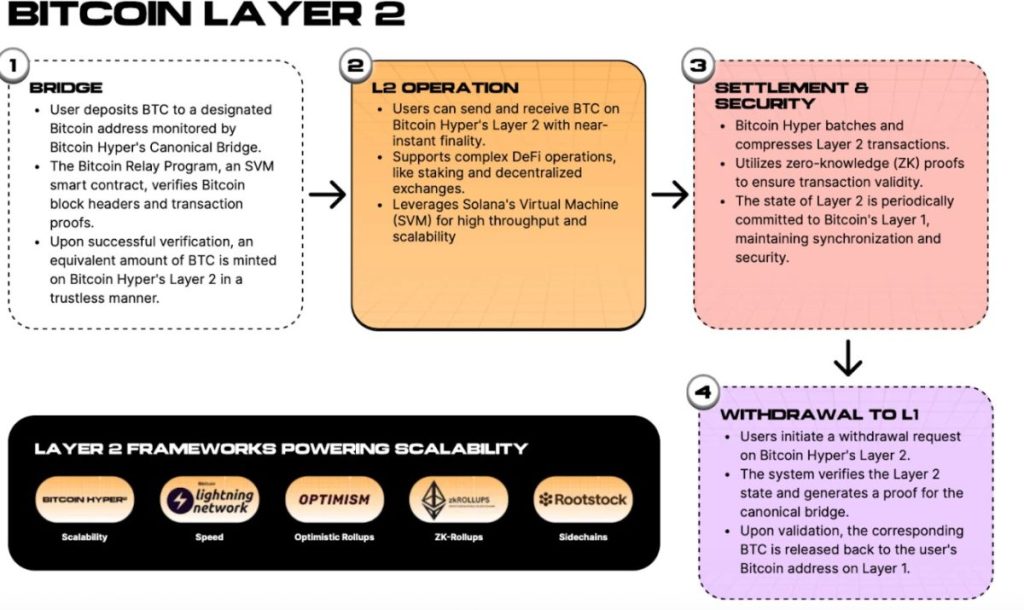
Because Bitcoin and Solana operate on different technical standards, a direct connection is not possible. Bitcoin Hyper bridges that gap using a canonical bridge that locks BTC on the base layer and issues a wrapped version within the Layer-2. Once inside the SVM-powered environment, Bitcoin is no longer constrained by base-layer throughput limits.
This Layer-2 BTC becomes the primary medium of exchange across the ecosystem. Applications rely on it to operate, transact, and scale. If development continues on schedule, and if Bitcoin Hyper succeeds in attracting applications used beyond the crypto-native crowd, the result could be a steady, structural source of demand.
Under those conditions, Bitcoin’s value would be supported by real economic activity, not just speculative price cycles. That shift, if it materializes, would mark a meaningful evolution in how Bitcoin functions within the broader digital economy.
The Early Case for HYPER
One of Bitcoin Hyper’s defining features is that it does not rely on a single-token structure. Instead, the network operates a dual-asset model, with each token serving a clear and separate function inside the ecosystem.
On one side is Bitcoin itself. As activity expands within Bitcoin Hyper, BTC becomes the settlement layer, anchoring value transfer across the Layer-2 environment. It remains the monetary backbone, used for exchange and economic activity rather than sitting idle.
On the other side is HYPER, the token that supports the network’s internal mechanics. HYPER is used for governance, staking, and transaction fees, positioning it as the asset most directly exposed to growth in on-chain usage. As applications scale and transaction volume rises, demand concentrates around HYPER.
This is where the project’s economic leverage becomes clear. Even a modest share of Bitcoin’s circulating supply moving into Bitcoin Hyper would translate into billions of dollars flowing through the system. As usage increases, pressure shifts toward execution, coordination, and fees, all areas where HYPER plays a central role.
That structure has helped drive strong early interest. More than $29.5 million has already been raised in the presale, with tens of thousands of participants backing the project at an early stage.
The model has also caught the attention of well-known crypto commentators, including ClayBro and Borch Crypto, both of whom have highlighted Bitcoin Hyper as a project with significant upside potential if adoption continues to build.
How to Buy HYPER During the Presale
Investors who want early exposure can purchase HYPER directly through the official Bitcoin Hyper website. The presale supports multiple payment options, including SOL, ETH, USDT, USDC, BNB, as well as credit card purchases.
For storage and access, Bitcoin Hyper recommends using Best Wallet, which is widely recognized as a leading Bitcoin and crypto wallet. HYPER is already listed in Best Wallet’s “Upcoming Tokens” section, allowing users to buy, monitor, and later claim their tokens once trading goes live.
Those looking to follow project updates can join the Bitcoin Hyper community on Telegram and X, where announcements and development milestones are shared regularly.
To explore the project in more detail, visit the Bitcoin Hyper website.