

Kalshi has taken a major step in restructuring how prediction markets operate by moving its event contracts onto the Solana blockchain.
The transition brings U.S.-regulated prediction markets directly into decentralized finance, positioning the platform to compete more closely with its on-chain rival, Polymarket, while targeting deeper liquidity and broader user access.
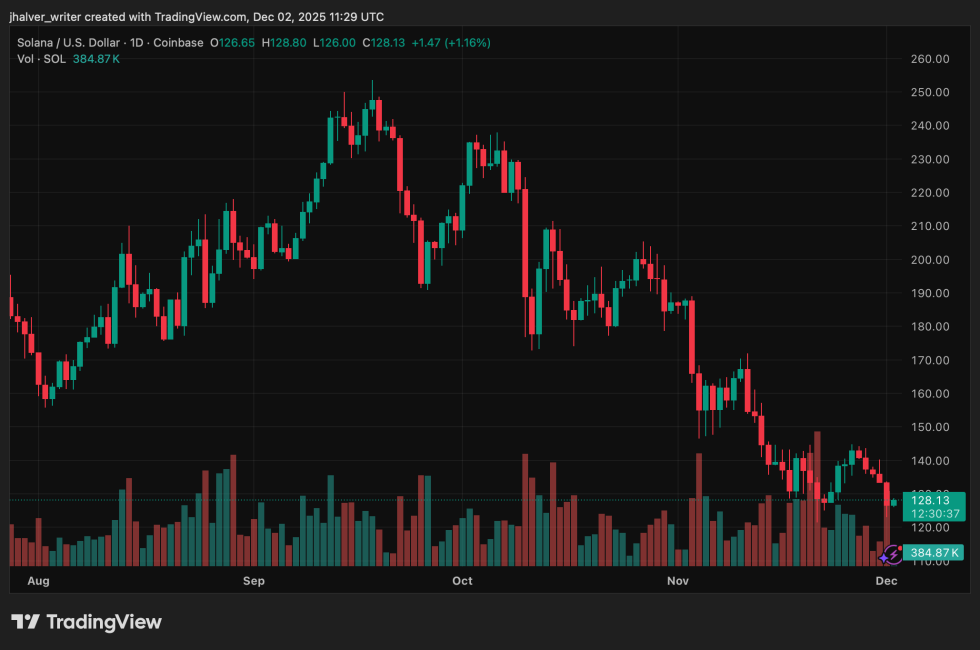
SOL's price trends to the downside on the daily chart. Source: SOLUSD on Tradingview
Prediction Contracts Move On-Chain
Kalshi’s event markets now operate as Solana-based SPL tokens rather than entries on a centralized exchange. Through an integration with Solana protocols DFlow and Jupiter, users can trade “yes” and “no” positions via crypto wallets, tap automated liquidity, and settle outcomes through on-chain logic.
The shift enables contracts to be traded, borrowed, lent, or used as collateral within DeFi systems. Kalshi is supporting developer participation with a $2 million grants program and a new Builder Codes system that rewards teams for driving trading volume through custom applications.
Executives describe tokenization as the platform’s long-term strategy, arguing that on-chain access offers speed, transparency, and programmability while preserving Kalshi’s CFTC-regulated framework. The hybrid model links decentralized liquidity with an off-chain matching engine.
Will the Move Capture Liquidity and Challenge Polymarket?
Prediction-market activity has surged in 2025, with sector-wide volume nearing $28 billion by late October. November saw Kalshi record $5.8 billion in trading, while Polymarket handled $3.7 billion following rulings that reopened U.S. access.
Liqudity has become the core competitive factor. By issuing markets as standard Solana tokens, Kalshi expects automated market makers, trading bots, and cross-protocol liquidity systems to tighten spreads and improve pricing accuracy.
Enhanced privacy is another draw, with tokenized markets offering wallet-based trading rather than identity-verified accounts. Industry analysts note that the move puts Kalshi in direct competition with Polymarket’s fully on-chain model.
Solana Expands Multi-Chain Prediction Economy
Kalshi believes Solana is the first step toward a broader on-chain architecture. The company plans to add EVM-compatible networks and deeper integrations with DeFi protocols to build a multi-chain forecasting ecosystem.
Additional partnerships, including earlier collaborations with Zero Hash and stablecoin custody support from Coinbase, reflect an effort to streamline global accessibility.
With its valuation recently rising to $11 billion after a major funding round, the company is signaling confidence that tokenized prediction markets will become a standard format for forecasting and derivatives tied to real-world events.
As prediction markets evolve toward decentralized models, Kalshi’s Solana rollout marks a turning point in how regulated platforms interact with crypto liquidity and sets the stage for intensified competition across the sector.
Cover image from ChatGPT, SOLUSD chart from Tradingview