



The best crypto ETFs in Australia allow investors to participate in the crypto economy without having to actually own the asset.
ETFs derive their prices from their underlying cryptocurrency, which is either Bitcoin or Ethereum as of now in Australia. As regulations ease, we can expect to see ETF products tied to other cryptos such as Solana.
Since their approval in 2022, several crypto ETFs have become available for Australian investors on the ASX and Cboe. Given the number of choices, it can be difficult to pick the right one.
We’ve done the digging to find the 9 best crypto ETFs in Australia, including IBIT, CRYP, and QBTC. Keep reading to uncover everything about crypto ETFs – their regulation, pros, cons, and how you can actually buy a crypto ETF in Australia.
At a Glance – 9 Best Crypto ETFs in Australia
Before we jump into the details of crypto ETFs in Australia, here’s a quick glance at the best crypto ETFs you can buy right now.
| iShares Bitcoin Trust ETF (IBIT) | Largest Spot Bitcoin ETF from BlackRock with an AUM of $46.41B and exceptional liquidity |
| Betsshares Crypto Innovators ETF (CRYP) | Crypto-equities ETF that invests in crypto-related businesses such as crypto mining, exchanges, and data centers |
| BetaShares Bitcoin ETF (QBTC) | Offers indirect exposure to the US-affiliated Bitwise Bitcoin ETF at a management fee of 0.45% |
| BetaShares Ethereum ETF (QETH) | Invests in the physically-settled Bitwise Ethereum ETF with an AUM of $17.4M |
| VanEck Bitcoin ETF (VBTC) | The first ETF to be listed on the ASX with a current AUM of $302.33M |
| Monochrome Bitcoin ETF (IBTC) | Buy and hold exposure in Bitcoin with a low management fee of 0.25% |
| Monochrome Ethereum ETF (IETH) | Buy and hold exposure in Ethereum with a low management fee of 0.25% |
| Global X 21shares Bitcoin ETF (EBTC) | Physically backed Bitcoin spot ETF with strong institutional custody backing from Coinbase. |
| Global X 21Shares Ethereum ETF | Physically backed Ethereum spot ETF with an AUM of $61M |
How Do Crypto ETFs Work?
Exchange-traded funds (ETFs) are investment vehicles that derive their price from an underlying asset’s price. In the case of crypto ETFs, the underlying asset is usually a cryptocurrency such as Bitcoin, Ethereum, and so on.
Let’s say you want to invest in Bitcoin. Sure, you could buy $BTC directly, but that requires using a crypto exchange and handling the complexities of crypto custody – managing wallets, private keys, and protecting against hacks or mismanagement.
By contrast, an ETF gives you regulated, stock exchange-like exposure to Bitcoin, meaning it’s a familiar and safer option, especially for traditional investors.
ETPs may or may not hold the physical asset in custody depending on their structure.
For example, ETPs tracking debt instruments (Exchange Traded Notes) may not hold actual T-bills. However, gold-backed ETPs (Exchange Traded Commodities) may hold physical gold in custody.
An ETF is a specific type of ETP that usually requires physical backing. So, a Bitcoin ETF will hold actual Bitcoin in custody, with the ETF provider handling compliance requirements like secure storage and registration.
| Pros of Crypto ETFs | Cons of Crypto ETFs |
|
|
Are Crypto ETFs Available in Australia?
Yes, crypto ETFs are available on the Australian Stock Exchange (ASX) and Cboe Australian.
The ETFS 21Shares Bitcoin ETF and the ETFS 21Shares Ethereum ETF were the first two crypto ETFs to be listed on the Cboe in May 2022. Following this, VBTC (VanEck Bitcoin ETF) was launched on the ASX in June 2024.
Australian law classifies crypto ETFs as financial products under the Corporations Act 2001 and regulates them through the Australian Securities and Investments Commission (ASIC).
ASIC published Regulatory Guide RG 282 on ETPs (which includes crypto ETFs) on November 7, 2025, laying down various regulatory requirements for ETF providers.
- The ETF provider must hold an Australian Financial Services Licence (AFSL) to offer services in Australia.
- The provider must provide adequate product disclosure documents (PDS) when required.
- There must be appropriate custodial agreements, operational structures, and risk management systems in place.
- The exchange on which these products trade must have strict admission criteria, such as liquidity conditions, market-making arrangements, and portfolio disclosures.
- The listed price of the ETF must remain close to the NAV of the underlying asset.
Since crypto ETFs are perfectly legal and highly regulated, Australian residents simply need to open an account with a broker that offers access to the ASX or the Cboe. Then, fund your account, search for the ticker, and buy the number of ETF units you want.
Crypto ETFs vs Direct Crypto Ownership
If you want to benefit from crypto price appreciation, you’ve got two options – owning the crypto directly or buying crypto ETFs. Of course, you can buy or sell crypto derivative contracts too, but with those instruments, you’re only speculating on crypto’s price movements, and they’re generally riskier than ETFs or spot trading.
Pros of Crypto ETFs
Here are the benefits of buying crypto ETFs.
Less complexity
You don’t have to wrap your head around blockchain mechanics, private keys, crypto wallets, or network/gas fees. In fact, you also avoid using crypto exchanges entirely. In addition to simplicity, this also saves you from potential KYC fraud.
More secure
Crypto ETFs sit in your broker account on the exchange, so there’s no risk of losing your funds to crypto hacks or human error. Plus, there are no counterparty risks such as insolvency issues because ETF issuers have to follow strict custody rules and maintain insurance.
ETFs can be held in SMSFs
Crypto ETFs are classified as financial products under the Corporations Act, which allows Self-Managed Super Funds (SMSFs) to hold them in their portfolio. However, holding crypto in an SMSF involves several compliance requirements, like custody rules, valuation, security, and audit trails. ETFs are more out-of-the box, ready-made solutions for tax-advantaged holdings like SMSFs.
Cons of Crypto ETFs
You don’t own the underlying asset
When you buy an ETF, you’re not purchasing the crypto itself; you’re purchasing a unit that derives its price from the asset. So, while you do benefit if the crypto asset’s price rises, you don’t actually own it and cannot transfer, stake, or use it.
Fixed trading hours
Crypto ETFs trade on the ASX or Cboe, which operate only on weekdays between 10am-4pm AEST/AEDT. On the other hand, crypto markets operate 24/7. This means if there’s a sharp price movement outside exchange hours, you won’t be able to buy or sell until the market reopens on the next day.
Pros of Direct Crypto Investing
You own the crypto
Direct investing gives you full ownership of the crypto asset. You can buy, sell, or stake your assets at any time. This also allows you to participate in DeFi activities, such as staking, lending, yield opportunities, and other on-chain applications.
Liquidity
Crypto markets run 24/7/365, giving you access to never-ending liquidity. So, you can execute trades as soon as you spot an opportunity, without having to wait for liquidity or the exchange to open. Plus, unlike ETFs, which currently focus mainly on $BTC and $ETH, you can directly own hundreds of other top altcoins, like $SOL or $TRUMP, and meme coins like $HYPER, $MAXI, and $PEPENODE.
Cons of Direct Crypto Investing
Security responsibility
If you buy and store crypto on an exchange, you face the risk of hacks, fraud, or mismanagement. And while keeping your crypto in a hardware wallet is recommended, you’ll be responsible for managing your private keys and seed phrases. Make sure you don’t lose them, or you could lose your entire investment.
Limited regulatory recourse
Unlike ETFs, cryptocurrencies themselves are not centrally regulated. This means there are fewer investor protections, and you also run the risk of using offshore exchanges that may lack proper regulation inside and outside Australia or offer lacklustre standards for security.
Best Platforms to Directly Buy Crypto in Australia
If you’re an Australian resident keen on investing directly in cryptocurrencies, here are two highly reliable platforms you can use.
Bitcoin.com.au
We mentioned in our Bitcoin.com.au review that it’s registered with AUSTRAC and is one of the best crypto trading platforms in Australia. You can buy/sell 35+ cryptocurrencies, including $BTC, $ETH, $SOL, $TRX, $DOGE, and $LTC.

The platform also supports SMSF, Trust, and Company accounts. Deposits can be made through debit/credit cards, PayID, PayPal, or bank transfers, and you’re only charged a 1% trading fee and a flat $1.50 withdrawal fee when using PayID.
Note that Bitcoin.com.au operates as a broker, so you get instant fiat-to-crypto and crypto-to-fiat conversions.
VISIT THE BITCOIN.COM.AU WEBSITE
Independent Reserve
Independent Reserve is also registered with AUSTRAC, plus it offers class-leading security (thanks to mandatory 2FA and features like duress password), making it a regulated and safe choice for Australian investors.
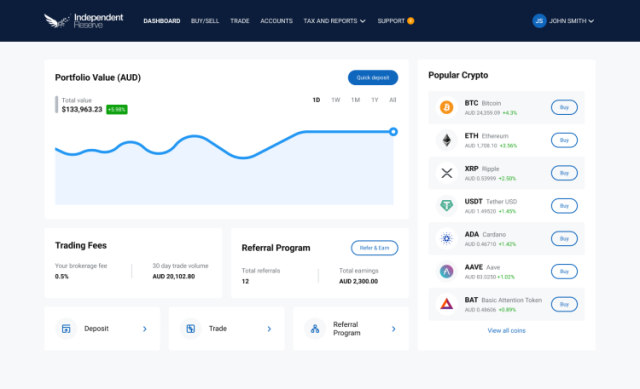
It offers more than 35 cryptocurrencies, with a lower trading fee of 0.5%. If you’re a large investor looking to make a sizable purchase (>$50,000), the platform also provides a dedicated OTC desk for high-net-worth individuals, institutions, and SMSFs.
VISIT THE INDEPENDENT RESERVE WEBSITE
The Best Crypto ETFs in Australia Compared
Let’s quickly compare the best crypto ETFs in Australia side by side to help you choose the one that suits your needs.
| ETF | Crypto Asset(s) | Type | Exchange Listed | Management Fee | Assets Under Management (AUM) |
| iShares Bitcoin Trust ETF (IBIT) | Bitcoin ($BTC) | Spot ETF | NYSE Arca/ASX | 0.25% | $46.41B |
| Betashares Crypto Innovators ETF (CRYP) | Invests in crypto-related companies such as Coinbase, Riot Blockchain, Microstrategy | Equity ETF | ASX | 0.67% | $122M |
| BetaShares Bitcoin ETF (QBTC) | Bitcoin ($BTC) | Spot ETF (via NYSE-listed Bitwise Bitcoin ETF) | ASX | 0.45% | $20.9M |
| BetaShares Ethereum ETF (QETH) | Ethereum ($ETH) | Spot ETF (via NYSE-listed Bitwise Ethereum ETF) | ASX | 0.45% | $17.4M |
| VanEck Bitcoin ETF (VBTC) | Bitcoin ($BTC) | Feeder fund (invests in the VanEck Bitcoin Trust (‘HODL’)) | ASX | 0.45% | $302.33M |
| Monochrome Bitcoin ETF (IBTC) | Bitcoin ($BTC) | Spot ETF (buy and hold $BTC) | CBOE Australia | 0.25% | $159.5M |
| Monochrome EthereumETF (IETH) | Ethereum ($ETH) | Spot ETF (buy and hold $ETH) | CBOE Australia | 0.25% | $6.6M |
| Global X 21shares Bitcoin ETF (EBTC) | Bitcoin ($BTC) | Spot Bitcoin ETF (physically backed) | CBOE Australia | 0.45% | $209M |
| Global X 21shares Ethereum ETF (EETH) | Ethereum ($ETH) | Spot Ethereum ETF (physically backed) | CBOE Australia | 0.45% | $61M |
Verdict – Are Crypto ETFs Worth It?
Yes, crypto ETFs are absolutely worth it as they allow retail investors to get exposure to the crypto market without dealing with exchanges, wallets, private keys, or complex custody requirements.
Right now, the top crypto ETFs include iShares Bitcoin Trust ETF (IBIT), Betashares Crypto Innovators ETF (CRYP), and VanEck Bitcoin ETF (VBTC).
However, remember this isn’t financial advice. ETFs are crypto-related products and are subject to market risks. Always do your own research before investing.
FAQs
1. Can I buy crypto ETFs in Australia?
Yes, you can buy crypto ETFs in Australia on the ASX and Cboe. These ETFs allow direct exposure to crypto prices, without actually owing the underlying asset. Crypto ETFs are considered as financial products under the Corporations Act and ETF providers must fulfil several conditions to be able to offer their products to Australian residents.
2. Are Bitcoin ETFs available on ASX?
Yes, several Bitcoin ETFs are available on the ASX such as the iShares Bitcoin Trust ETF (IBIT), the BetaShares Bitcoin ETF (QBTC) and the VanEck Bitcoin ETF (VBTC). These funds track the real-time price of Bitcoin either through anchored pricing or physical backing, allowing them to sell ETF units on the ASX.
3. How to buy crypto ETFs in Australia?
To buy crypto ETFs in Australia, you’ll need to open an account with a registered exchange broker such as CommSec, Interactive Brokers Australia (IBKR), or CMC Invest. Once your account is activated, you’ll need to deposit funds in your account. Then, search for the ticker (symbol) of the ETF you want to buy on the exchange, enter the quantity, and confirm to complete the buy transaction.
4. What is the difference between crypto ETF and direct crypto ownership?
Crypto ETFs are instruments that track the price of an underlying crypto asset. When you buy an ETF, you do not get any ownership in the asset itself. Instead, you’re only exposed to the crypto’s price movements through the ETF unit. However, when you buy crypto directly from exchanges, you own the asset and can use it the way you like – buy, sell, stake, send, or receive. Platforms like Bitcoin.com.au are great destinations to buy crypto in Australia, offering more than 35 tokens with a small 1% trading fee.
