


Bitcoin’s (BTC) drop below $77,000 over the weekend did more than extend a sell-off, it stripped away lingering assumptions about stability in a market still driven by sentiment, leverage, and macro forces.
After briefly holding above $80,000, the world’s largest cryptocurrency slid as low as the mid-$74,000 range, marking its weakest level in around ten months and deepening a correction that has been unfolding since mid-January.
The move came amid broad risk-off conditions across global markets. Precious metals posted some of their sharpest declines in decades, equities opened lower across Asia, and the U.S. dollar strengthened following renewed focus on Federal Reserve policy and leadership.
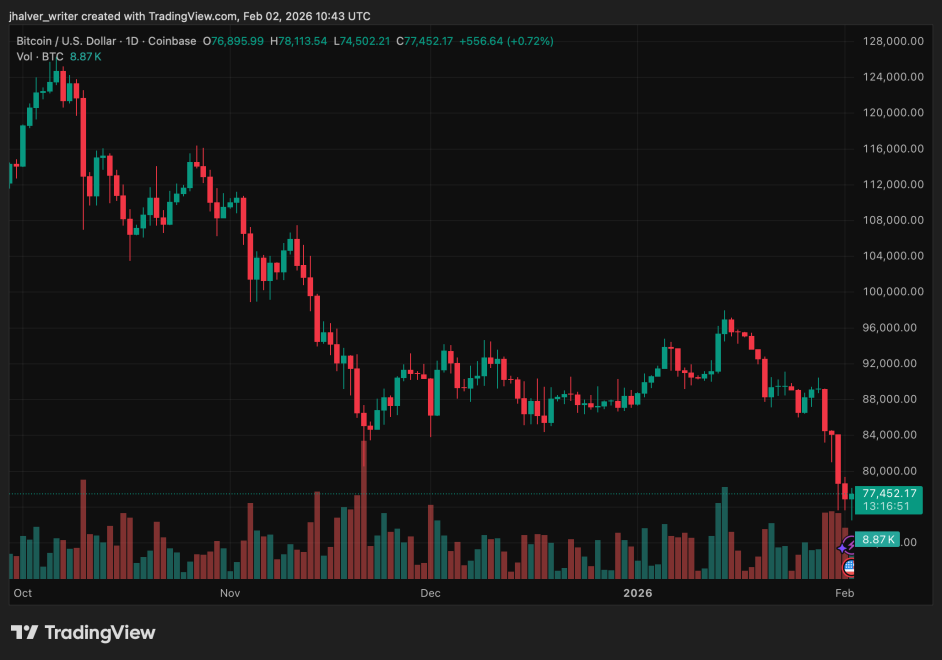
BTC's price trends to the downside on the daily chart. Source: BTCUSD on Tradingview
$80,000 Bitcoin (BTC) Break Projects Fragile Support
The loss of the $80,000 level marked a psychological turning point.
CNBC host Jim Cramer, a longtime Bitcoin holder, described the breakdown as evidence of fragile support and narrative-driven price defense. He questioned why large holders and vocal advocates failed to step in around what he called a “line in the sand” between $80,000 and $82,000.
Bitcoin’s weekend volatility also revived doubts about its short-term reliability as a store of value. Prices swung sharply during thin trading hours, underscoring how quickly sentiment can shift when leveraged positions unwind.
Exchange margin hikes, particularly in futures markets, accelerated forced liquidations, creating a cascade that pushed prices lower across crypto assets.
Macro Pressure and Technical Weakness
Macroeconomic factors played a central role. Renewed concerns over a potential U.S. government shutdown, combined with the Federal Reserve’s pause on rate cuts and the nomination of Kevin Warsh as Fed chair, backed expectations of tighter financial conditions.
Technically, Bitcoin remains under pressure. Indicators on daily and four-hour charts continue to favor bearish momentum, even as some oscillators suggest oversold conditions that could allow for short-lived rebounds.
The $76,000 area has emerged as near-term support, with a sustained break opening the door to deeper losses toward $74,000 or lower. On the upside, $80,000 remains the key resistance level that would need to be reclaimed to shift the short-term trend.
Bitcoin Still Sets the Market’s Direction
Despite years of talk about diversification within crypto, recent price action shows little has changed. Altcoins largely tracked Bitcoin’s decline, including tokens tied to revenue-generating protocols.
Data across multiple crypto indices show broad losses in line with BTC’s year-to-date drop, highlighting the market’s continued dependence on Bitcoin’s direction. Bitcoin’s slide below $77,000 serves as a reminder that the crypto market remains tightly linked to macro conditions, liquidity, and Bitcoin itself.
Cover image from ChatGPT, BTCUSD chart from Tradingview