Crypto exchange Bithumb is pursuing legal action to freeze nearly $500,000 in Bitcoin (BTC) unrecovered from the $40 billion payout error in February, signaling that the platform will turn to the courts to reclaim the assets.
Bithumb Launches Legal Action
On Thursday, local news media outlet Chosun Biz reported that the South Korean crypto exchange Bithumb had begun legal proceedings to recover part of the Bitcoin that had not been returned after a recent error.
On February 6, Bithumb accidentally distributed 620,000 Bitcoin, worth over $40 billion, to 249 users participating in the crypto exchange’s “random box” promotional event due to a “fat-finger” error.
The exchange quickly canceled the payments and recovered most of the assets. However, some customers immediately sold or exchanged the BTC for cash or other cryptocurrencies, leaving approximately 0.3% of the Bitcoin unrecovered.
According to the report, Bithumb filed for a provisional seizure this week to reclaim 7 Bitcoin it had failed to recover after the erroneous payout incident. This is a legal measure to temporarily freeze a debtor’s assets, preventing their concealment or disposal before a lawsuit to recover the money is filed.
Legal experts believe that customers who did not return the mistakenly paid Bitcoin would likely lose the lawsuit. Head of the Financial Supervisory Service (FSS) and a former attorney, Lee Chan-jin, has said that those customers are “clearly subject to the return of unjust enrichment. Those who sold and converted them into money (cash out) face disaster (as they could be drawn into lawsuits).”
An industry source told Chosun Biz that some of these clients argued they should not be responsible for the exchange’s mistake, but under South Korean law, mistakenly received assets are usually classified as unjust enrichment and must be returned in kind.
The report noted that if BTC’s price falls by the time of return, the customer could benefit, but if the price surges, the customer could face losses if the court rules in the exchange’s favor.
‘Ghost Bitcoin’ Error Reshapes Industry Practices
Although 99.7% of the BTC were recovered, the incident raised serious concerns about the crypto exchange’s internal controls. As reported by Bitcoinist, Bithumb held 175 BTC in its own books and less than 50,000 BTC between its own assets and customer-held assets at the time of the incident.
This meant that Bithumb’s system failed to block the irregular transaction, distributing assets that did not actually exist and distorting market prices. As a result, the FSS, alongside the Korean Financial Intelligence Unit (KoFIU) and the Digital Asset eXchange Alliance (DAXA), formed an emergency task force to organize follow-up measures and review industry-wide practices, including domestic exchanges’ virtual asset reserves, management practices, operational conditions, and internal control systems.
In March, the KoFIU preliminarily notified Bithumb of a six-month partial suspension of its business for alleged violations of Anti-Money Laundering (AML) and Know-Your-Customer (KYC) regulations.
Earlier this week, the Financial Services Commission (FSC) found that domestic crypto exchanges’ trade-halting systems, also known as kill switches, are unreliable when a massive asset mismatch occurs.
Therefore, the regulator ordered all domestic crypto exchanges to switch from the 24‑hour reconciliation cycles most exchanges currently have to a 5‑minute asset‑matching regime by the end of May. In addition, they asked all platforms to disclose their asset-matching balance daily.
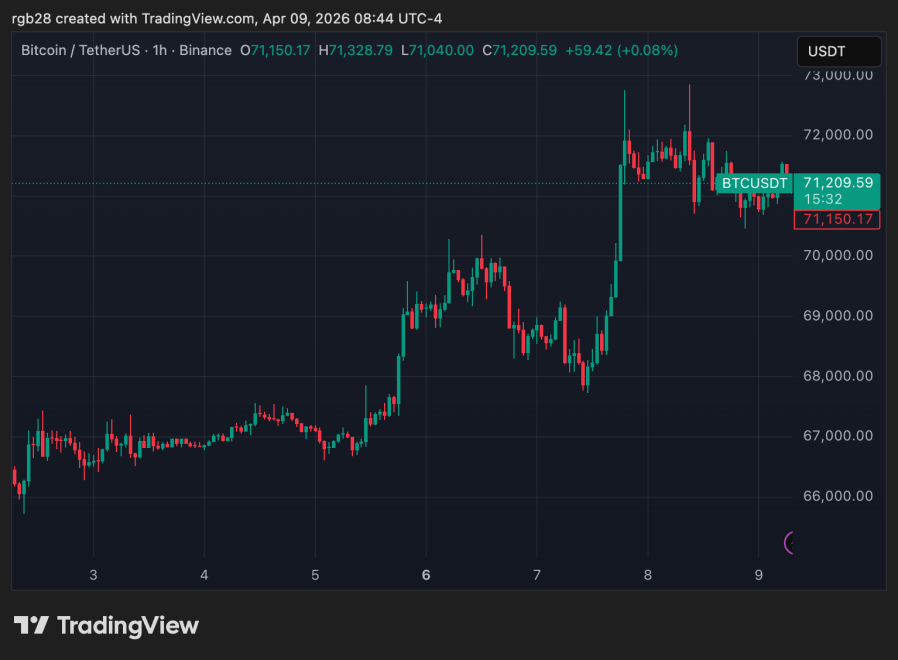
Bitcoin trades at $71,209 in the one-week chart. Source: BTCUSDT on TradingView