

The crypto market is consolidating. Bitcoin is range-bound. Altcoins are struggling at current demand levels. And beneath the price action, a CryptoQuant Research report has produced Q1 2026 exchange data that reframes what this consolidation actually represents.
The headline finding is stark: total centralized exchange trading volume fell approximately 48% from the October 2025 peak to $4.3 trillion in March 2026 — the lowest reading since October 2024. That is not a seasonal slowdown. It is a near-halving of market participation in five months, confirming that the cycle’s peak activity has passed and the participants who drove it have largely stepped back.
What remains is structurally revealing. Of the $4.3 trillion in March volume, perpetual futures accounted for $3.5 trillion — more than four times the $0.8 trillion recorded in spot markets. The crypto market is not being driven by holders buying and selling the underlying asset. It is being driven by leveraged traders making synthetic directional bets on where the price goes next.
That ratio — four dollars of derivatives activity for every one dollar of real spot demand — is not a sign of a healthy, conviction-driven market. It is the fingerprint of a market in transition, waiting for the underlying demand that turns leverage into trend.
The Crypto Market Shrank
The report’s competitive analysis delivers the most counterintuitive finding in the Q1 data. While total exchange volume contracted nearly 50% from the cycle peak, Binance maintained $248 billion in spot trading in March alone — translating to approximately 32% market share year-to-date in 2026, representing roughly $1 trillion in cumulative volume. Its nearest competitors are not close. MEXC holds 9%. Bybit holds 7%. Binance’s share is more than three times larger than either.

The decline from 37% in October 2025 to 32% today reflects genuine competitive pressure from secondary exchanges gaining traction during the contraction. MEXC, Bybit, Gate, and Crypto.com have all grown their spot volumes relative to the market. None have approached Binance’s scale. Increased competition without meaningful consolidation of leadership is the precise description of the current competitive landscape.
The derivatives picture reinforces the structural conclusion. Binance leads perpetual futures with $1.4 trillion in monthly volume and approximately 40% market share — more than double OKX at 19% and more than triple Bybit at 13%. Across $4.5 trillion in cumulative perp volume in 2026, derivatives have become the decisive growth engine for the entire exchange industry.
What the Q1 data ultimately describes is a market in which total participation has contracted sharply while the concentration of that participation has deepened. When volume returns — and the historical pattern suggests it will — it will return to the venues that held their ground during the contraction. The gap between Binance and everyone else means that dynamic disproportionately favors one player.
Total Market Cap Enters Transitional Range After Breakdown
The total crypto market cap is no longer trending — it is rotating. After peaking near the $3.8T–$4.0T region in late 2025, the market lost structure and broke below its short-term trend, triggering a sharp decline toward the $2.1T–$2.2T zone. That move marked a decisive shift from expansion to distribution.
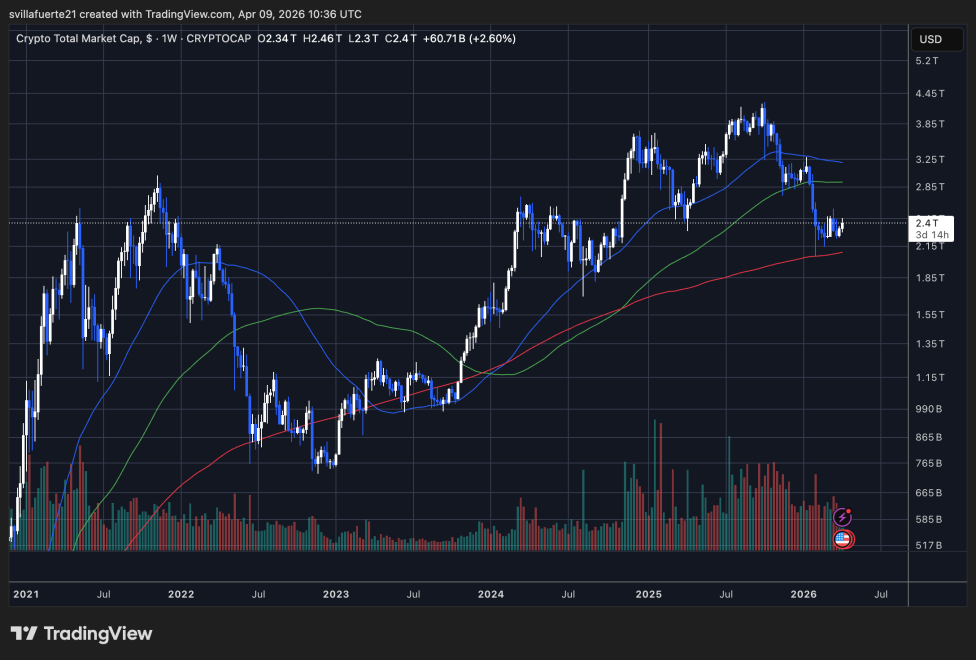
Since then, price has stabilized around $2.3T–$2.4T, forming a horizontal range rather than a directional trend. This level now acts as a pivot. However, the broader technical context remains fragile. The market is trading below the 50-week (blue) and 100-week (green) moving averages, both of which are flattening or turning downward. This reflects weakening momentum and a loss of sustained inflows.
The 200-week moving average (red), currently near $2.0T, is rising and has held as structural support during the recent drawdown. That level defines the lower bound of the current cycle unless a deeper macro shift occurs.
Volume behavior reinforces the transition narrative. Activity expanded into the late-2025 highs but has since declined alongside price, indicating reduced participation rather than aggressive accumulation.
Structurally, this is a re-accumulation or redistribution range. A reclaim of $2.8T–$3.0T is required to restore bullish continuation. Until then, the market remains in a neutral-to-bearish consolidation phase.
Featured image from ChatGPT, chart from TradingView.com