

Maelstrom, the family office of BitMEX co-founder Arthur Hayes, has published its first annual report for its Bitcoin Grant Program — revealing that four active developers have collectively advanced Bitcoin’s privacy, security, and codebase resilience across a 20-month program that began in October 2024, with five developers supported in total since inception.
The report, authored by Grant Program Administrator Jonathan Bier, covers the technical output of four currently active grantees — Rkrux, Stratospher, Benalleng, and Macgyver — two of whom work on Bitcoin Core directly and two of whom focus entirely on advancing Bitcoin’s privacy infrastructure. Grants are issued on 12-month contracts, paid monthly in Bitcoin, and can be stacked up to a cap of $400,000 per developer per year. The program is wholly funded by Maelstrom, per the report.
Bitcoin Core: The Unglamorous Work That Keeps The Network Safe
Two grantees are dedicated to Bitcoin Core — the software that runs the nodes securing the most valuable financial network ever built.
Rkrux, a grantee since October 2024, has become one of the project’s most prolific reviewers. In 2025 alone he made 1,155 review comments across more than 200 pull requests, ranking him the 11th most active commenter on the entire codebase, per a dashboard built by developer Niklas Gögge cited in the report. In the first five months of 2026 he added more than 400 additional PR comments.
His work spans MuSig2 — a protocol that makes multisignature transactions indistinguishable from single-signature transactions on-chain, simultaneously improving privacy and reducing fees — as well as the deprecation of legacy wallets in favor of modern descriptor-based wallets that improve interoperability across the ecosystem.
Stratospher, a grantee since November 2025, has focused on the areas where bugs carry the most catastrophic potential consequences — consensus-critical validation code and the peer-to-peer network. She discovered and fixed an undefined behavior bug in Bitcoin Core’s FindMostWorkChain function, contributed to the removal of the BLOCK_FAILED_CHILD flag, and worked on DLEQ cryptographic proofs in libsecp256k1 in relation to Silent Payments.
She also presented at the Africa Bitcoin Conference on two panels covering open source development and privacy. Her report notes directly that bugs in consensus code can cause nodes to disagree on the state of the network — a failure mode with no clean recovery path.
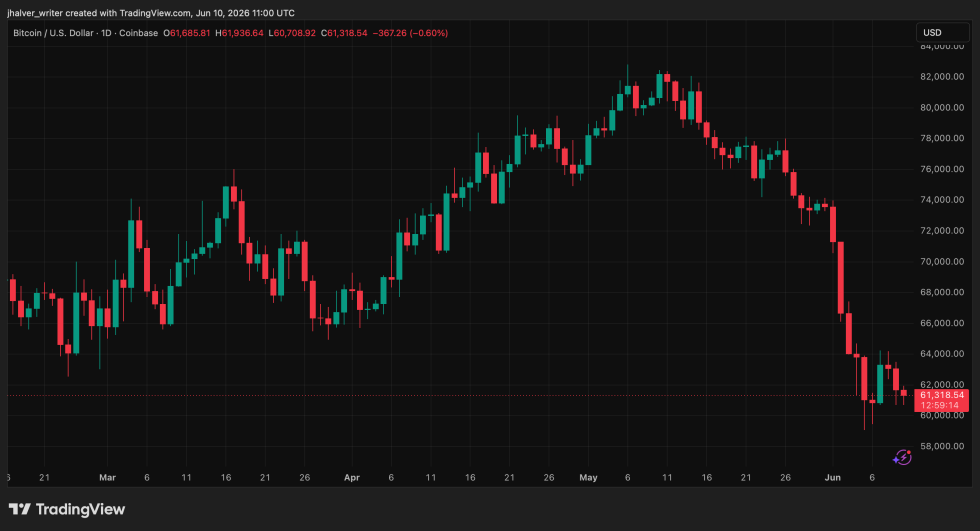
BTC's price trends to the downside on the daily chart. Source: BTCUSD on Tradingview
Privacy: The Infrastructure Bitcoin Still Needs
The other two grantees are wholly dedicated to Bitcoin privacy technologies — an area the report describes as central to Maelstrom’s philosophy.
Benalleng, funded since June 2025, works full time on Payjoin — a transaction protocol that allows both the sender and receiver to contribute inputs to a Bitcoin transaction, systematically breaking the surveillance heuristic that all inputs in a transaction belong to the same party. The Payjoin API has been integrated into Bull Bitcoin and Cake Wallet, with five or more additional wallet integrations currently in progress, per the report.
Bindings for Python, Javascript, Dart, and CSharp have been released to maximize developer accessibility. The report makes an argument that deserves attention: even minority adoption of Payjoin degrades chain surveillance capabilities for the entire network, including users who never use Payjoin themselves — a game-theoretic asymmetry Maelstrom considers one of Bitcoin’s most underappreciated privacy levers.
Macgyver, also funded since June 2025, is focused on Silent Payments — a protocol proposed by Ruben Somsen in 2022 that allows senders to make multiple payments to a recipient using a single static address, without ever reusing that address on-chain. Wallet adoption has progressed materially over the past 12 months: Blindbit-Desktop, Cake Wallet, and Dana Wallet now support both send and receive phases, while Sparrow Wallet and Nunchuk have added send support.
Bitcoin Core has draft implementations for both phases but they remain on hold pending a dependency on the Silent Payments module in libsecp256k1, per the report. Macgyver has formalized the Silent Payments roadmap, produced BIP-375 test vectors, proposed the first working BIP-375 hardware signer implementation for Coldcard, and organized monthly Silent Payments working group meetups.
What The Program Represents
Maelstrom’s grant framework is deliberately narrow — it funds open-source Bitcoin protocol work only, with no commercial strings attached and no token incentives involved. The review committee is two people: Arthur Hayes and Jonathan Bier. The funding comes from a single source.
And the work being done — reviewing consensus code, hardening P2P privacy, building transaction obfuscation tooling — is the kind of development that receives no headlines, generates no token price and yet underpins the security and privacy of a network that now holds hundreds of billions of dollars in value.
This development marks a pivotal moment for how the nascent sector’s most successful participants choose to give back. A family office that has profited substantially from Bitcoin’s appreciation deploying capital directly into the protocol’s open-source development stack — paid in Bitcoin, reviewed by peers, and published transparently — is a model the industry rarely produces and almost never documents this clearly.
Cover image from Grok, BTCUSD chart from Tradingview