

Wednesday 10 December 2025 – Global investment giant AllianceBernstein is not holding back this time. The firm suggests Bitcoin (BTC) is still heading toward the one-million mark, and possibly much sooner than people expect.
In its latest outlook, Bernstein projects BTC could hit around 150,000 dollars as early as 2026, even after the market recently pulled the price down to 84,000 from the previous peak of 126,000. And the project many investors think could help push Bitcoin that far is Bitcoin Hyper (HYPER).
Bitcoin Hyper is shaping up to be one of the fastest Bitcoin Layer-2 networks in the works, aiming to pull off something no other chain has managed yet. The idea is to let BTC move through applications at speeds similar to Solana while still using Bitcoin’s base layer for final settlement.
For a lot of people, that is exactly the missing trigger that could support the kind of valuations Bernstein is predicting. If Bitcoin suddenly gains real transactional speed and a broader economic layer around it, the demand could rise a lot faster.
Investors already seem to be acting on that belief. HYPER, the token running the whole ecosystem, has gathered 29.27 million dollars in presale funding, with many treating the current price as a possible bargain ahead of future exchange listings.
Right now HYPER trades at 0.013405 dollars, but only for the next 39 hours before the presale moves into a higher-priced round.
Bitcoin’s Problem Isn’t Settlement – It’s the Lack of a Real Execution Layer
Bernstein’s outlook puts Bitcoin on a sharp upward track: 150,000 dollars in 2026, 200,000 in 2027, and eventually the big one-million mark by 2033. Starting from today’s price near 92,000, that would mean a jump of about 63 percent next year, followed by another 33.3 percent heading into 2027, and an annualized return close to 34.9 percent across the next eight years to hit that long-term milestone.
After the recent pullback in Bitcoin’s price, these numbers might look harder to believe. But the real issue is that Bitcoin, as it functions right now, is still very limited. For a long time, BTC has basically been treated like something you lock away and hope grows in value, rather than a currency that moves around and powers real activity.

So even though Bitcoin was built to be peer-to-peer digital cash, its slow throughput and extremely decentralized, security-first design turned the base layer into a settlement system instead of a fast day-to-day money network.
And a great settlement layer can only do so much when the actual economic activity using it moves painfully slow.
This is where Bitcoin Hyper steps in. By creating a high-speed Layer-2 on top of Bitcoin, the project keeps all the core traits that make BTC valuable – decentralization, strong security, and immutability – while finally giving it the ability to circulate with speeds and costs similar to modern high-performance chains.
We are talking about thousands of transactions every second, all anchored back to Bitcoin’s base layer.
Unlocking Bitcoin’s Active Layer
Bitcoin Hyper is built around a simple idea: Bitcoin should function as real, everyday money, not just something people store and forget about. To make that possible, it leaves the Bitcoin base chain exactly where it performs best, acting as the settlement layer where final confirmations are handled. On top of that, Bitcoin Hyper adds a new execution layer that gives BTC the ability to move and transact in ways the main chain could never keep up with.
This execution layer is fully programmable and runs on the Solana Virtual Machine (SVM), which is widely seen as one of the fastest execution environments available. Because of that, developers can create apps that feel similar to Solana dApps – extremely quick, inexpensive to use, and capable of powering everything from DeFi and gaming to practical, real-world tools.
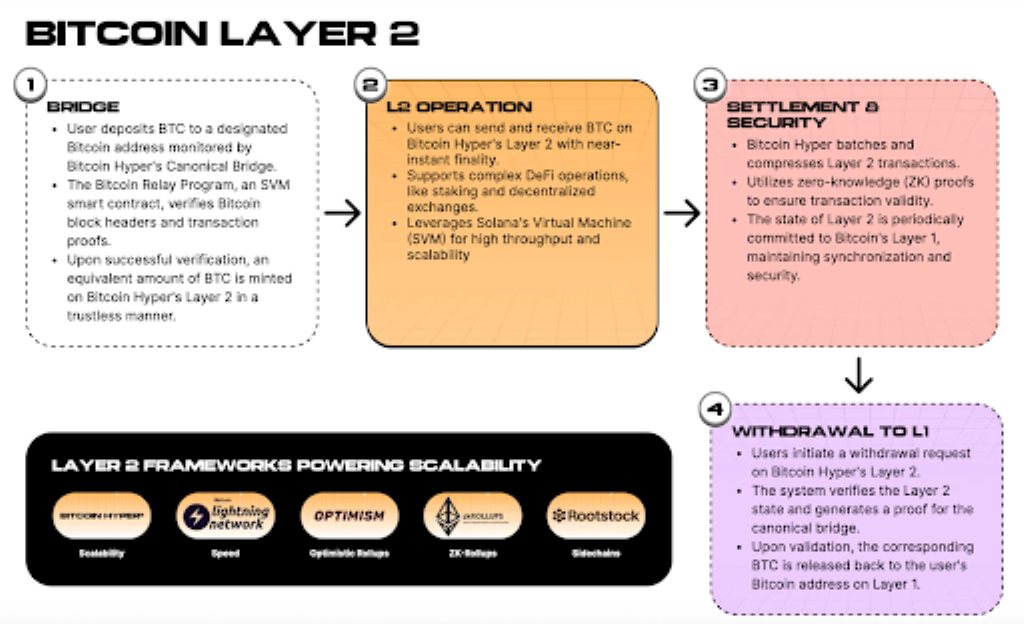
The crucial connection between Bitcoin and this high-speed layer is Bitcoin Hyper’s canonical bridge.
Here is how it functions: actual BTC is locked on the Bitcoin base layer, and then a wrapped version is created inside the Bitcoin Hyper network. That wrapped BTC is compatible with the SVM and can move easily across the apps built on Bitcoin Hyper, effectively becoming the currency driving them.
This means Bitcoin can finally circulate in a way it never has before. Instead of waiting roughly ten minutes for each movement on the base chain, BTC can now flow thousands of times per second within applications that treat it as a native asset.
This shift is exactly why early buyers see major potential in holding HYPER. Every BTC transaction running through the execution layer needs something to power it, and that is where HYPER steps in as the gas token. It forms the second half of the system: BTC acts as the money itself, while HYPER provides the energy that keeps the entire network operating.
How to Get HYPER
With the presale now passing 29.2 million dollars, many buyers think Bitcoin Hyper may be moving into its last phases, which means the chance to pick up HYPER at presale prices might not last much longer. For the moment, though, early participants can still secure their tokens before the project reaches its launch and shifts into open-market price discovery.
Taking part is straightforward. You just head to the Bitcoin Hyper website and buy HYPER using SOL, ETH, USDT, USDC, BNB, or even a credit card.
For easier handling of your tokens, Bitcoin Hyper suggests using Best Wallet. It is considered one of the stronger crypto and Bitcoin wallets, and HYPER is already listed in the Upcoming Tokens section, so buyers can purchase, follow, and later claim their tokens without complications.
Investors can also keep up with project news by joining Bitcoin Hyper’s official communities on Telegram and X.