Franklin Templeton has filed an updated registration statement for its proposed spot XRP exchange-traded fund, becoming the third issuer in recent days to tweak the pivotal “8(a)” effectiveness language that governs when an S-1 can go live. Bloomberg’s James Seyffart flagged the change and its timing, writing: “NEW: Franklin Templeton files updated XRP ETF s-1 with shortened 8(a) language. Looking to launch this month.”
The move follows a quickening cadence of XRP ETF edits. On October 31, Bitwise filed another amendment to its S-1—its fourth since the initial 2024 submission—an update observers characterized as one of the last steps before potential effectiveness, with details such as the intended listing venue and a stated management fee included in reporting around the filing.
Separately, smaller issuer Canary Funds removed the standard “delaying amendment” that ordinarily prevents automatic effectiveness, a procedural shift that puts the filing under Section 8(a) of the Securities Act and starts the 20-day clock. “SCOOP: Canary Funds has filed an updated S-1 for its XRP spot ETF, removing the ‘delaying amendment’… This sets Canary’s XRP ETF up for a launch date of November 13, assuming the Nasdaq greenlights the 8-A filing,” journalist Eleanor Terrett posted.
What Seyffart and Terrett are highlighting is a technical but consequential distinction in S-1 drafting. For most offerings, issuers include a delaying clause stating: “The registrant hereby amends this registration statement… to delay its effective date… as the Commission… may determine.” That language keeps the SEC in control of timing.
By shortening or removing it, issuers can allow the registration to become effective automatically after 20 days under Section 8(a), provided all other conditions—chiefly a separate exchange listing approval and the 8-A registration for the class of securities—are satisfied. Franklin’s update is exactly that kind of acceleration attempt.
Franklin Templeton Fast-Tracks XRP ETF For November Launch
Franklin’s XRP trust has been moving through the pipeline since spring. The trust first filed a Form S-1 on March 11, 2025, laying out the product structure, custody with Coinbase Custody for XRP and BNY Mellon for cash, and a Cboe BZX listing plan. That initial filing—and even an August 22, 2025 amendment—still contained the classic delaying clause, underscoring how notable any subsequent change to the 8(a) language would be at this stage.
Bitwise, meanwhile, has been iterating as well. SEC records show multiple S-1 amendments for the Bitwise XRP ETF through October, including venue and fee disclosures; third-party trackers.
The procedural backdrop matters because of the autumn regulatory environment. After an SEC operations slowdown tied to the October government shutdown, several crypto ETPs exploited the 8(a) pathway to go effective on a set timetable by removing delaying language. Issuers who had already substantially engaged with the Commission used the statutory 20-day mechanism to advance products despite administrative bottlenecks, enabling the launch of spot Solana (SOL) and Hedera (HBAR) ETFs last week.
For XRP specifically, today’s question is not whether a single update guarantees a green light—S-1 effectiveness, an effective Form 8-A, and a completed exchange approval still need to intersect—but whether three different issuers are now aligned on a path to list in November if no new regulatory objections arise.
Terrett summarized the scoreboard succinctly: “And another one. So far we’ve got @CanaryFunds, @BitwiseInvest and now @FTI_US updating their XRP S-1s.” Her thread, together with Seyffart’s note on Franklin’s “shortened 8(a) language,” captures the market’s interpretation: issuers are positioning for a near-term debut.
The next inflection points are therefore procedural. If Canary’s self-set timeline holds and Nasdaq completes its 8-A onboarding for the class of shares, November 13 is the first plausible listing date for a spot ETF.
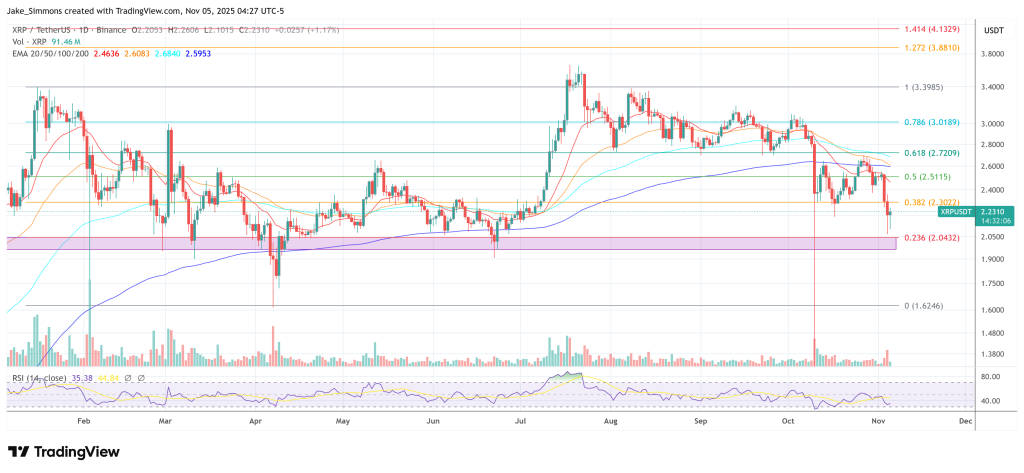
At press time, XRP traded at $2.23.