Market cycles rarely repeat exactly—but they rhyme. As analysts map the trajectory for the cryptocurrency market leading into 2026, the focus is shifting. We’re moving away from the speculative meme frenzies of 2024 toward tangible infrastructure scaling. Historical data from previous post-halving cycles suggests capital rotates from Layer 1 store-of-value assets into high-performance utility protocols roughly 18 months after a major peak. Sound familiar?
For 2026, the growth data highlights a glaring bottleneck: Bitcoin’s lack of native programmability. While Bitcoin remains the “pristine collateral” of the crypto economy, its inability to host complex DeFi applications without exorbitant fees leaves trillions in dormant capital. The market is currently pricing in a massive expansion of the “Bitcoin Layer 2” narrative. It mirrors how Ethereum Layer 2s dominated the 2022-2023 cycle.
That shift changes the metrics for what constitutes a “best” altcoin. It’s no longer about community hype. It’s about transaction throughput (TPS) and liquidity bridging. Investors are hunting protocols that can unlock Bitcoin’s liquidity with the speed of modern chains like Solana.
This data-driven outlook has directed significant smart money attention toward Bitcoin Hyper ($HYPER). By integrating the Solana Virtual Machine (SVM) directly with Bitcoin’s security architecture, the project fixes the main friction point preventing Bitcoin from absorbing the wider DeFi market. As the sector looks toward 2026, protocols bridging the gap between Bitcoin’s security and high-speed execution are statistically positioned to capture outsized market share.
Bitcoin Hyper Merges SVM Speed With Bitcoin Security
The technical argument for Bitcoin Hyper in a 2026 portfolio centers on “execution environments.” Historically, developers had a tough choice: Bitcoin’s security (but slow) or Solana’s speed (but with comparative centralization risks). Data suggests the winning protocols of the next two years will be the ones that eliminate that trade-off entirely.
Bitcoin Hyper functions as the first-ever Bitcoin Layer 2 utilizing the Solana Virtual Machine (SVM). This creates a powerful setup: it allows for the sub-second finality and low-latency processing DeFi traders demand, but anchors that activity to the Bitcoin network. For developers, it offers a familiar Rust-based environment. They can build high-speed gaming dApps and NFT platforms that settle on the world’s most secure blockchain.
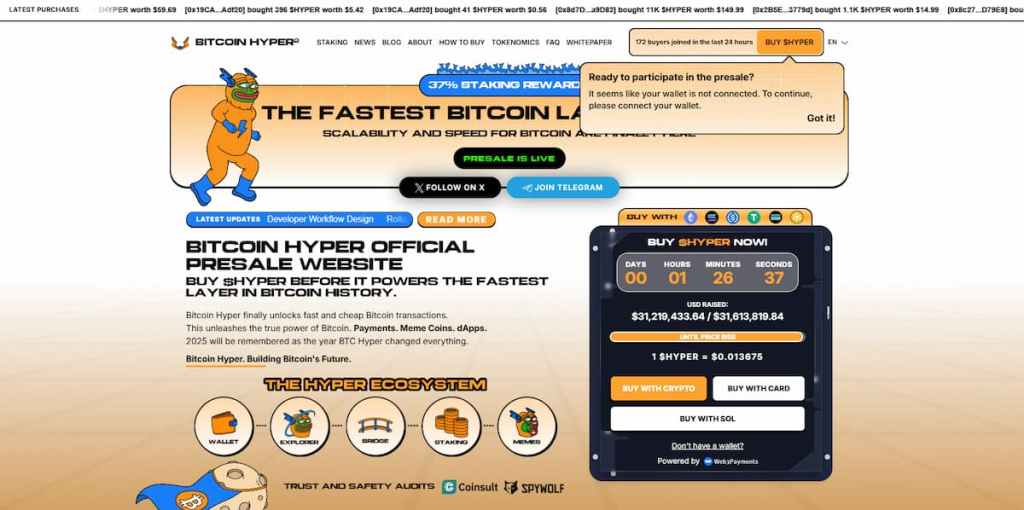
That architectural shift is critical. Ethereum’s DeFi dominance is largely due to its head start in smart contracts, but Bitcoin holds the majority of the industry’s capital. By deploying a Decentralized Canonical Bridge, Bitcoin Hyper allows for the seamless transfer of BTC into a high-speed environment. It solves the “programmability gap” that has historically capped Bitcoin’s utility.
(The integration of SVM isn’t just a technical upgrade—frankly, it represents a fundamental shift in capital efficiency.)
For investors eyeing 2026 growth potential, the key metric is adoption friction. Protocols forcing users to learn new languages or accept slow speeds struggle to scale. By using the existing, highly efficient SVM standard, Bitcoin Hyper bypasses the learning curve, offering immediate utility for millions of existing Solana and Bitcoin users.
Read the Bitcoin Hyper whitepaper.
Whale Accumulation Signals Confidence in The $HYPER Presale
While technical architecture provides the thesis, on-chain flows provide the timing. We’ve detected significant capital movements surrounding the Bitcoin Hyper presale, suggesting high-net-worth individuals are positioning themselves ahead of the project’s Token Generation Event (TGE).
According to Etherscan records, two whale wallets have accumulated $116K in recent allocations. The most notable activity occurred on Jan 15, 2026, when a single wallet bought $63K worth. This type of accumulation during a presale phase often indicates that “smart money” is attempting to front-run broader retail discovery—especially given the project’s positioning in the high-growth Bitcoin L2 sector.
The presale data reflects this institutional-grade interest. At the time of writing, Bitcoin Hyper has raised exactly $31,254,198.39—a figure that underscores significant market validation before the mainnet is fully public. With tokens currently priced at $0.0136751, the entry point remains relatively low compared to established Layer 2 governance tokens, which typically trade at multibillion-dollar valuations.
The tokenomics further encourage long-term holding, aligning with a 2026 investment horizon. The protocol offers high APY staking immediately after the TGE, with a specific 7-day vesting period for presale stakers to ensure stability. This structure rewards governance participation and community alignment rather than short-term flipping. For investors analyzing long-term growth data, the combination of capital raising, verified whale entries, and a stable vesting schedule presents a compelling case for $HYPER as a primary infrastructure play.
Visit the Bitcoin Hyper presale.
Disclaimer: The content provided in this article is for informational purposes only and does not constitute financial advice. Cryptocurrency investments carry inherent risks, including high volatility and the potential loss of capital. Always conduct your own due diligence before making investment decisions.