

US lawmakers are pushing to bring Bitcoin mining equipment manufacturing back to American soil — a move driven by growing concern that the country’s dependence on foreign-made hardware puts national security at risk.
That concern formed part of the backdrop when a four-star Navy admiral took a rare public stance on Bitcoin last Tuesday, telling a Senate committee it belongs in the same conversation as US military power.
Mining, Hardware, And The Supply Chain Problem
Admiral Samuel Paparo, commander of US Indo-Pacific Command, told the Senate Armed Services Committee that Bitcoin functions as a tool for “power projection.”
His remarks were prompted by a question from Senator Tommy Tuberville, who pointed out that China’s top monetary think tank has begun treating Bitcoin as a strategic asset and asked how Congress should respond.
Paparo didn’t answer that directly. What he did say was direct enough: “Bitcoin is a reality. It is a peer-to-peer zero-trust transfer of value. Anything that supports all instruments of national power for the United States of America is to the good.”
US Admiral Calls Bitcoin Key to Cybersecurity and Power Projection
Admiral Samuel Paparo sees Bitcoin as a strategic tool for U.S. cybersecurity and national power, emphasizing its proof-of-work advantages. (Read More)
➤ https://t.co/ik53cB163F#Power #Admiral #Bitcoin
— BTCN.it Short Crypto News (@bitcns) April 22, 2026
Beyond its role as a currency, Paparo argued that Bitcoin’s proof-of-work system carries real weight as a cybersecurity mechanism. The design of that system, he said, forces anyone trying to attack the network to spend enormous resources — making intrusions significantly more expensive.
“Outside of the economic formulation of it, it has got really important computer science applications for cybersecurity,” he told the committee.
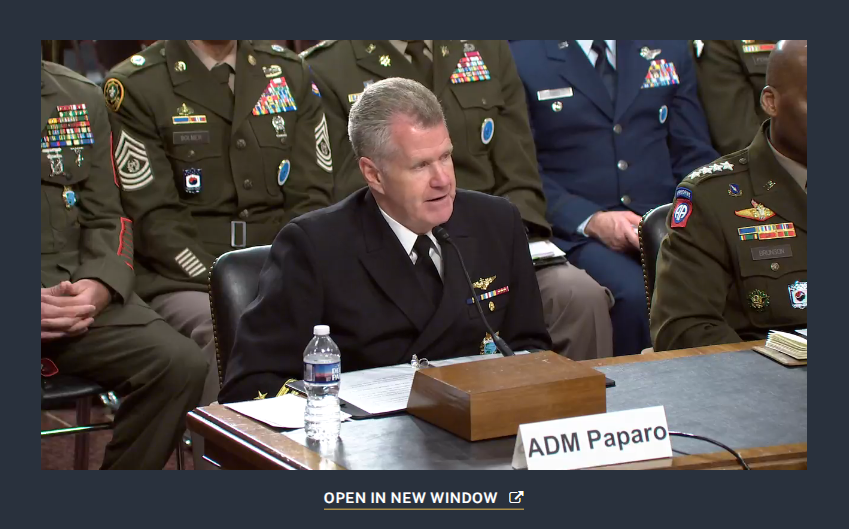
Admiral Samuel Paparo called Bitcoin a valuable computer science tool for power projection during a Senate Armed Services Committee hearing.
Not The First Voice From The Military
Paparo is not the first person in uniform to make this case. In December 2023, US Space Force member Jason Lowery argued that proof-of-work technology could be applied well beyond finance — used to protect data, messages, and command signals from hostile actors.
Lowery said at the time that treating Bitcoin purely as a financial tool understates what it can do for national security. The difference now is the rank of the person making the argument.
BTCUSD trading at $78,062 on the 24-hour chart: TradingView
The hearing covered a wide range of security threats, including China’s military buildup, the war in Ukraine, the conflict in the Middle East, and ongoing aggression from North Korea.
Cybercrime was woven through much of that discussion. North Korea’s Lazarus Group, for instance, has stolen billions in crypto over the past decade, with proceeds allegedly funneled into the country’s weapons program.
A Push To Manufacture Domestically
The US currently holds more Bitcoin than any other national government and controls the largest share of the global mining network. But that position comes with a vulnerability: the physical machines used to mine Bitcoin are largely manufactured overseas.
Featured image from Meta, chart from TradingView