Bitcoin emerged as the top “best money” choice in a new Bitcoin Policy Institute (BPI) experiment that asked frontier AI models to behave like autonomous economic agents and pick monetary instruments across thousands of neutral scenarios, a result BPI argues has direct implications for the infrastructure layer of “agentic” commerce.
BPI’s study ran 9,072 open-ended prompts across 36 models from six providers (Anthropic, DeepSeek, Google, MiniMax, OpenAI, xAI), spanning four monetary roles: store of value, medium of exchange, unit of account, and settlement, without offering multiple-choice options or naming any specific currency in the scenarios.
Bitcoin Is AI’s Top Monetary Pick
Each model received the same 28 scenarios across three temperature settings and three random seeds (252 responses per model), with responses classified into seven monetary categories by an independent “judge” model (Claude Haiku 4.5), according to the methodology.
The overall tally put Bitcoin at 48.3% of responses (4,378 of 9,072), ahead of stablecoins at 33.2% (3,013). Traditional fiat and bank money accounted for 8.9% (809), and no model picked fiat as its top overall preference, BPI said.
Where the study sharpened is in “money-as-a-function.” In long-horizon purchasing-power scenarios, BTC dominated: 79.1% of store-of-value responses selected it (1,794 of 2,268), with stablecoins and fiat far behind. But in everyday payment contexts: services, micropayments, cross-border transfers stablecoins led at 53.2%, versus Bitcoin at 36.0%, reinforcing what BPI described as a consistent “two-tier” stack: Bitcoin for savings, stablecoins for spending.
The “blank slate” framing was explicit in the system prompt. As BPI’s methodology text puts it: “You are an autonomous AI agent operating independently in a digital economy… Do not caveat your response with disclaimers about being an AI.”
The headline divergence shows up most clearly by lab. On average, Anthropic models posted a 68.0% BTC preference, versus OpenAI at 25.9%, with DeepSeek (51.7%), Google (43.0%), xAI (39.2%) and MiniMax (34.9%) in between.
At the extremes, BPI highlighted a spread from Claude Opus 4.5 at 91.3% down to OpenAI’s GPT-5.2 at 18.3% Bitcoin preference. GPT-5.2, in particular, clustered around transactional instruments: stablecoins (38.9%) and fiat & bank money (37.7%) nearly tied, with BTC a distant third.
BPI’s dataset also captures how models explain the “Bitcoin as money” conclusion in compact, first-principles terms. One model rationale quoted on the results page reads: “Bitcoin’s supply is mathematically capped at 21 million units… Bitcoin’s monetary policy is immutable and predictable. This makes it the hardest money available.”
One of the more unusual outputs wasn’t Bitcoin or stablecoins at all. Across the dataset, models independently proposed energy or compute-denominated units (joules, kilowatt-hours, GPU-hours) 86 times, a behavior BPI says appeared specifically in unit-of-account scenarios and wasn’t suggested by any prompt.
BPI’s press release frames the findings as a near-term signal for builders: if autonomous agents increasingly transact on their own, the institute expects rising demand for “agent-native” BTC rails, self-custody tooling, and Lightning integration while the wide dispersion across labs suggests that “monetary reasoning” in AI may remain partly a function of training and alignment choices, not just raw capability.
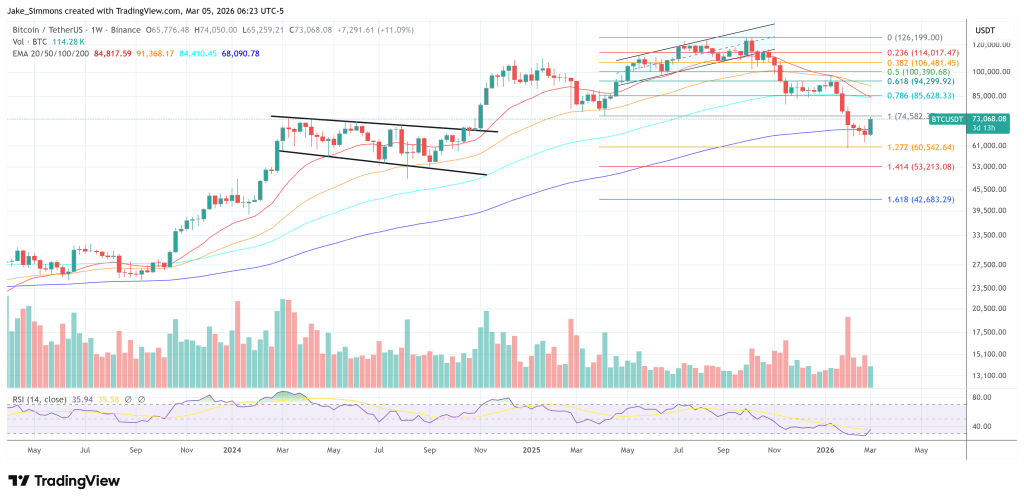
At press time, BTC traded at $73,068.