

Russia’s government has just approved a package of crypto regulation bills that make trading through regulated intermediaries the only legal route, highly limiting off retail access.
An Authoritarian Crypto Restriction?
On Monday, the Russian Ministry of Finance said in a press release that Moscow had greenlit a bundle of draft laws to legalize the circulation of digital currencies and digital rights inside Russia.
Retail “non‑qualified” investors now face an annual purchase limit of about ₽300,000 (around $3,700) per broker or intermediary,and can only access a narrow list of high‑liquidity coins approved by the central bank.
Trading without intermediaries is also banned. Banks will not be allowed to process payments to unlicensed foreign platforms. Qualified investors can keep broad access and no caps but must still pass tests and go through licensed platforms.
As the press release states it:
The regulation prohibits transactions involving digital currencies without regulated intermediaries. However, residents are permitted to purchase digital currencies abroad, paying from foreign accounts, and transfer foreign currency purchased through Russian intermediaries. Residents will be required to notify the Federal Tax Service of Russia of any foreign transactions.
Russia is joining a broader trend of countries tolerating crypto only under banking‑style licenses, turning exchanges into tightly supervised gatekeepers instead of open platforms.
A new Crypto Legislation In Russia
This announcement follows the legislation targeting a full framework around mid‑2026, with liability and penalties for illegal intermediaries ramping up into 2027, as covered by Bitcoinist.
The new package of bills effectively shuts down Russia’s gray P2P and OTC market and cuts off most citizens from global exchanges like Bybit, OKX and other unlicensed offshore venues. The Kremlin wants to pull flows onshore, tax them, tighten AML controls and protect the ruble, while keeping crypto banned for domestic payments and pushing the digital ruble as the “safe” alternative.
Russian retailers should expect loss of access to long‑tail altcoins, fragmented liquidity across “friendly” jurisdictions, heavier surveillance, and higher friction for cross‑border transfers.
In global markets, a reduced Russian flow on major offshore exchanges could slightly dent volumes in some pairs, but the bigger story is the precedent: if more large economies adopt “intermediaries only” models, the free‑wheeling P2P era in crypto could be in structural decline.
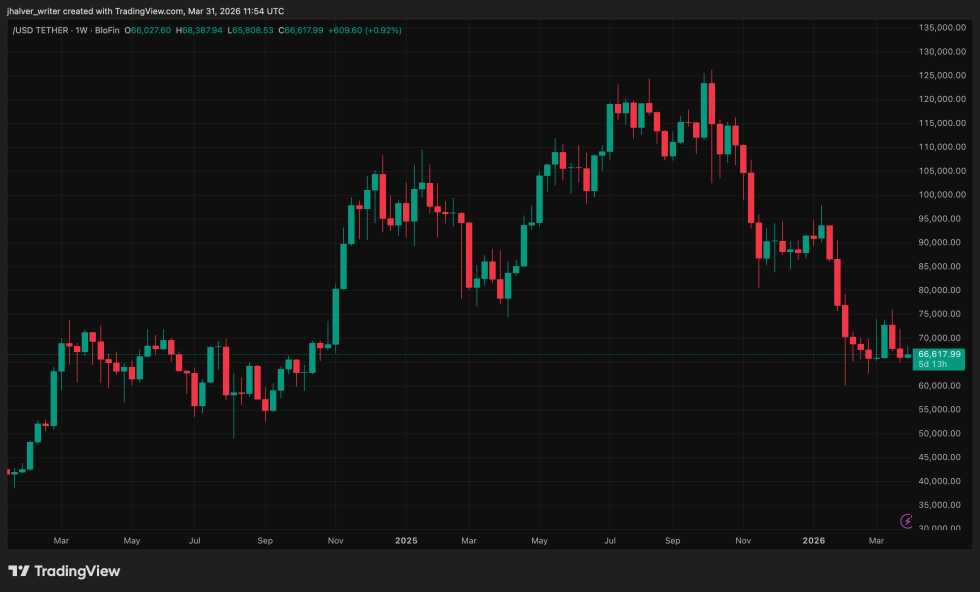
At the moment of writing, BTC trades for the highs $66k. Source: BTCUSDT on Tradingview
Cover image from Perplexity, BTCUSDT chart from Tradingview